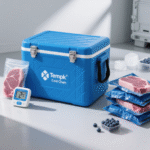
A escolha de uma caixa isolada OEM decide se suas remessas permanecerão dentro do alcance ou se tornarão exceções caras. Em 2026, variações de temperatura ainda geram grandes perdas de produto, enquanto parcerias OEM mais inteligentes podem reduzir o risco em até dois terços.
Um transportador bem projetado também pode manter a temperatura por 48 a 120 horas, dependendo da pista e da carga útil, mas somente se o sistema for especificado, construído, e embalado de forma consistente.
This guide will answer for you
How an insulated box OEM delivers a repeatable shipping outcome (não “apenas uma caixa”)
A quote-ready insulated box OEM RFQ template you can send today
Quais materiais (EPS, PPE, VIP, híbrido, fibra) fit your lane and budget
A practical checklist to audit an insulated box OEM factory (mesmo por vídeo)
How to validate performance with lane-based testing and clear pass/fail rules
O que “sustainability in 2026” realmente significa (prova, rotulagem, substâncias preocupantes)
O que um OEM de caixa isolada realmente oferece 2026?
Uma caixa com forte isolamento OEM oferece um resultado de envio repetível, not just a prototype that looks good. Em termos simples, the OEM controls how the walls are built, how parts fit, and how repeatable production is at scale—because a great sample is useless if mass production drifts.
Here’s the simplest way to avoid confusion: you own the lane reality, the OEM owns the build reality.
What you control vs. what the insulated box OEM controls
| Responsibility | Você (shipper owner) | Insulated box OEM | O que isso significa para você |
|---|---|---|---|
| Product limits | Define min/max + excursion rules | Design around it | Vague limits = overdesign or failures |
| Lane conditions | Definir duração + seasons + para | Model and test to it | Real lane data reduces cost and risk |
| Build quality | Approve specs + Critérios de aceitação | Execute process controls | Quality is designed, não “checked later” |
| Validation plan | Approve profiles + aprovado/reprovado | Run tests or support labs | Proof must match reality |
Conclusão prática: Ask your insulated box OEM for a one-page production control plan to prevent “good samples, bad batches.”
Which specs matter most in an insulated box OEM RFQ?
If your RFQ is vague, you’ll get quotes that look cheap—but explode later through redesigns, extra refrigerant, or failed validation. Your RFQ should describe the shipping reality in a way a factory can build and a tester can validate.
The RFQ “must-have” inputs (copy/paste friendly)
Use this table as your insulated box OEM RFQ template.
| RFQ field | Exemplo | Why the insulated box OEM needs it | O que isso significa para você |
|---|---|---|---|
| Banda de temperatura | 2–8 ° C. | Drives refrigerant choice | Fewer spoilage + re-shipments |
| Tempo de espera | 72 horas | Sets insulation thickness | Menos “almost made it” falhas |
| Summer profile | 35°C peak | Builds worst-case | Less seasonal surprise |
| Carga útil | 2 kg, 4× vials | Heat capacity matters | Better pass rates in testing |
| Pack-out constraint | <6 minutos | Trabalho + error risk | Cumprimento mais rápido, menos erros |
Tips that prevent RFQ rework
If lanes vary: create two RFQs—one “típico” e um “worst-case.”
If ambient extremes are unclear: use realistic exposure assumptions, then test worst-case.
Se você enviar por via aérea: confirm labeling and booking expectations early.
Exemplo real: A biotech team reduced redesign cycles by adding one RFQ line: “Payload must never drop below 2°C.”
Which materials should your insulated box OEM recommend in 2026?
Material choice is a three-way trade-off: desempenho térmico, durabilidade, and end-of-life. O “melhor” pick depends on whether your biggest enemy is heat, manuseio brusco, or disposal pressure.
Pense no isolamento como uma jaqueta de inverno: thicker can be warmer, but it can also be heavy and expensive to ship.
Buyer-friendly material comparison
| Material | Pontos fortes | Cuidados | O que isso significa para você |
|---|---|---|---|
| EPS | Baixo custo, bom isolamento | Policy pressure in some regions | Lower unit cost, more compliance planning |
| PPE | Durável, reutilizável | Custo inicial mais alto | Better total cost in return loops |
| Espuma PU | Strong insulation + estrutura | Disposal can be complex | Better long holds, fewer refrigerant bricks |
| VIP híbrido | Paredes finas, high insulation | Needs protection, custo mais alto | More payload volume, less dim-weight risk |
| Fiber-based | Disposal-friendly in some regions | Moisture resistance varies | Good for sustainability goals if repeatable |
Regra simples: Don’t choose VIP “because it’s best.” Choose it when you must hit long durations or tight temperature bands in a small shipper.
Um rápido “material fit” ferramenta de decisão
If you need low cost + decent insulation: start with EPS or fiber-based, então valide.
If you need reuse + resistência: prioritize EPP and plan cleaning/returns.
If you need thin walls + alto desempenho: shortlist hybrid or VIP hybrid, then protect panels.
How do you match an insulated box OEM design to your shipping lane?
The right insulated box OEM design starts with your lane profile: duração, ambient range, Sensibilidade da carga útil, e manuseio. If you skip this, you’ll either overpay for “extra safety” or underbuild and risk excursions.
O 5 inputs that decide real-world performance
Duração: door-to-door hours, including delays
Gama ambiente: hottest and coldest likely conditions
Carga útil: massa, temperatura inicial, sensibilidade
Estratégia de refrigeração: pacotes de gel, PCM, ou gelo seco
Pack-out workflow: how fast your team can pack consistently
Pack-out decision tool
Use this mini-tool to align quickly with your insulated box OEM.
Etapa 1: Choose lane duration
0–24 hours → prioritize speed + baixo custo
24–72 hours → prioritize repeatability + seasonal pack-outs
72–120 hours → prioritize insulation quality + validation depth
Etapa 2: Choose temperature mode
Refrigerado (2–8 ° C.)
Controlled room temp (15–25ºC)
Congelado (-20°C ou inferior)
Etapa 3: Pick risk level
Baixo: local, algumas transferências
Médio: regional, occasional delays
Alto: multiple hubs, extremos sazonais
If you picked “72–120 horas” ou “Alto risco,” ask your insulated box OEM for a lane-specific qualification plan, not a brochure test.
Practical tips that reduce failures
Define starting temperatures. UM “frio” gel pack is not the same as a “congelado” um.
Train one standard pack-out. Variation is the hidden enemy of hold time.
Ask for pack-out photos + a one-page SOP to prevent drift over time.
Exemplo real: A seafood exporter reduced spoilage by standardizing gel pack conditioning and adding a top-layer spacer to prevent direct-contact freezing.
How do you audit an insulated box OEM factory before you sign?
Audit process control, not showroom samples. A factory can look clean and still produce inconsistent batches if incoming checks and assembly controls are weak.
Audit checklist (ask these exact questions)
Incoming materials: do they record lot numbers and inspect density/thickness/defects?
Tooling and molds: do they maintain molds and document changes?
Assembly control: do they measure fit, lacunas, lid compression, adhesive cure time?
In-process checks: do they sample during production, not only at the end?
Rastreabilidade: can they link a finished shipper back to raw material batches?
What to ask for (before or during the visit)
A one-page production control plan
Sample QC inspection records
Change control process for tooling or materials
Dica: If the factory can’t show you a QC form, they probably don’t use one consistently.
How do you validate insulated box OEM performance?
Validation proves the shipper works in your real-world lane—not just in a lab. Without this, you’re trusting marketing claims instead of data.
O 3 levels of validation
| Nível | What it tests | Quando usar | O que isso significa para você |
|---|---|---|---|
| Lab simulation | Controlled chamber profile | Early design stage | Fast feedback, not final proof |
| Piloto de campo | Real shipment with loggers | Before scale-up | Catches real-world surprises |
| Ongoing monitoring | Spot-checks in production | After launch | Detects drift before failures |
Visão principal: Lab tests set the baseline; field pilots catch what labs miss (atrasos, manuseio incorreto, seasonal swings).
Pass/fail rules you should define
Banda de temperatura: por exemplo, 2–8 ° C., no excursions below 2°C or above 8°C
Duração: por exemplo, 72 horas porta a porta
Perfil ambiente: por exemplo, 35°C summer, 5°C winter
Estado da carga útil: por exemplo, product starts at 5°C, gel packs at 0°C
Dica: Write pass/fail rules into your RFQ so the OEM designs to them—not to a generic brochure spec.
How do you manage change control with an insulated box OEM?
Change control protects your validation. Sem isso, um “pequeno” material swap or mold adjustment can quietly break performance.
What triggers a change review?
Material supplier change
Density or thickness adjustment
Mold or tooling modification
Adhesive or closure change
Pack-out SOP revision
Simple change control process
OEM notifies you before the change
You assess impact (minor, major, crítico)
If major or critical: re-validate before production
Document the decision and keep records
Dica: Adicione a “no silent changes” clause to your supply agreement.
O que faz “sustentabilidade” mean for insulated box OEM in 2026?
Sustainability in 2026 is about proof, não slogans. Buyers and regulators want documented materials, clear disposal labels, and awareness of substances of concern.
O 3 sustainability questions to ask your OEM
What are the materials, and can you document them?
How should the end user dispose of this shipper?
Are there any substances of concern for food-contact or sensitive markets?
Practical sustainability checklist
| Area | O que perguntar | O que isso significa para você |
|---|---|---|
| Material documentation | Can you provide a material data sheet? | Proof for audits and compliance |
| Disposal labeling | Is the disposal path clear to the end user? | Reduces confusion and complaints |
| Substances of concern | Any restricted chemicals in the product? | Avoids market access issues |
| Dimensionamento correto | Is the shipper sized to the payload? | Menos desperdício, menor frete |
Dica: “Reciclável” claims are only useful if the end user knows how to recycle it. Ask for clear labeling.
How do you compare insulated box OEM suppliers fairly?
Comparing OEMs on price alone is a trap. The real cost includes validation, retrabalhar, and failed shipments. Use a scorecard that weights what matters.
OEM comparison scorecard
| Critérios | Peso | O que procurar |
|---|---|---|
| Desempenho térmico | 25% | Validated hold time for your lane |
| Production consistency | 20% | QC records, controles de processo |
| Rastreabilidade | 15% | Lot tracking, controle de mudanças |
| Sustainability documentation | 15% | Material data, disposal guidance |
| Custo total | 15% | Unit + frete + retrabalhar + validação |
| Capacidade de resposta | 10% | Tempo de espera, communication, flexibilidade |
Dica: Ask each OEM to fill in the same RFQ template so you can compare apples to apples.
Autoavaliação de prontidão
Use this quick self-assessment to check if you’re ready to scale with an insulated box OEM.
| Pergunta | Yes = 1 apontar |
|---|---|
| Do you have a written lane profile (duração, ambiente, carga útil)? | ☐ |
| Do you have a one-page RFQ with pass/fail rules? | ☐ |
| Do you have a pack-out SOP your team can follow? | ☐ |
| Have you piloted with monitoring data? | ☐ |
| Do you have a change control process with your OEM? | ☐ |
Interpretação da pontuação
| Pontuação | Readiness | Recommended action |
|---|---|---|
| 0–2 | Alto risco | Don’t scale yet; define lane + pack-out first |
| 3–4 | Risco médio | Pilot with tight monitoring + clear SOP |
| 5 | Scale-ready | Lock spec, validar, negotiate supply terms |
CTA: If you scored 3 ou menos, build a one-page RFQ + pacote de POP, then request a pilot build.
2026 latest insulated box OEM developments and trends
O maior 2026 trend is system thinking: the market is moving from “a box that insulates” to a shipping system that is validated, tamanho certo, and easier to comply with.
Últimos desenvolvimentos de vista
More right-sized designs: menos espaço vazio, menor frete, menos desperdício
More documentation-ready packaging: buyers want traceability, não são afirmações de marketing
More focus on substances of concern: especially for food-contact and sensitive markets
Nota operacional: Handling guidance keeps evolving, and the document notes updates in IATA Temperature Control Regulations (2026 edição) that reinforce rising compliance expectations.
Perguntas frequentes
Q1: What’s the biggest mistake when choosing an insulated box OEM? Buying on unit price alone. The real cost is failed deliveries, substituições, e rotatividade de clientes. Choose based on validated outcomes, documented controls, and repeatable pack-out—not a cheaper sample.
Q2: How long does insulated box OEM development take? Most projects take 4–8 weeks for design, prototipagem, and testing. Timelines can be faster if you reuse existing tooling, but you should still protect time for pilot pack-out and data review.
Q3: Pode “too much refrigerant” be a problem in 2–8°C shipping? Sim. O resfriamento excessivo pode causar congelamento, and many chilled products are harmed by freezing, not just warming. Use lane-based validation and set a clear “no-freeze” rule in your RFQ and SOP.
Q4: What documents should an insulated box OEM provide for audits? No mínimo: material specs, Verificações de controle de qualidade, traceability approach, and a change control process. For regulated lanes, keep validation reports organized so investigations are faster and less disruptive.
Q5: Do I need testing for every lane? Nem sempre. Start with your highest-risk lanes first (longa duração, estação quente, transferências múltiplas). Once the design and pack-out are stable, expand carefully with periodic verification checks.
Q6: How do I make insulated packaging more “2026-preparar” for sustainability? Right-size the shipper, improve disposal label clarity, document materials, and plan ahead for stricter rules and timelines in target markets. Ask your OEM for proof, não slogans.
Resumo e recomendações
A strong insulated box OEM helps you control temperature risk with a repeatable system. Define your lane and product limits first, then write an RFQ with temperature band, duração, perfil ambiente, carga útil, e regras de aprovação/reprovação. Validate the full system (caixa + refrigerante + empacotar), then lock specs with change control.
Seu próximo passo
Pick one SKU and one worst-case lane.
Create a one-page RFQ + pack-out checklist.
Run a pilot with monitoring, fix the human failure points, então dimensione.
Sobre Tempk
E tempk, we focus on temperature-controlled packaging that works in real operations. We design insulated shipping systems that prioritize repeatable pack-out, documentação clara, and scalable manufacturing—so your insulated box OEM program is built to ship reliably, not just look good on paper.
Próximo passo: Share your lane profile (duração, faixa de temperatura, temporada, tamanho da carga útil). We’ll help you turn it into a quote-ready RFQ and a validation plan your team can actually run.