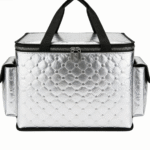
A cooler backpack industrial product is not just a soft bag with foam inside. It is a mobile cold chain tool for teams that need to carry temperature-sensitive products while walking, climbing, servicio, or working away from fixed vehicles. If you choose the right model, you gain easier movement, better route discipline, and more consistent temperature protection. If you choose the wrong one, you create the opposite: overloaded staff, weak closures, cleaning delays, and unpredictable hold time.
The right buying mindset is simple. Start with the route, not the catalog. A cooler backpack industrial decision should be based on target temperature range, duración, calor ambiental, frecuencia de apertura, metodo de limpieza, and expected reuse count. When those six items are clear, the best construction choice usually becomes obvious.
Marzo 2026 fact check: The FDA Food Code still anchors cold-holding planning around 41°F/5°C for many food-service decisions. CDC recommends digital data loggers with buffered probes and at least 30-minute readings for vaccine storage monitoring. WHO qualification guidance and EU GDP both emphasize documented qualification and representative temperature mapping, while ASTM D3103 and ISTA 7E remain useful thermal test references for transport packaging. Al mismo tiempo, FAO and packaging regulators are pushing buyers toward lower-loss, more reusable cold chain formats. (A NOSOTROS. Administración de Alimentos y Medicamentos)
This article will help you decide
- Whether a cooler backpack industrial format is right for your route
- Which materials and coolant systems fit your temperature band
- Cómo comparar la durabilidad, facilidad de limpieza, and carrying comfort
- What validation steps reduce sourcing risk
- Cual 2026 trends matter for industrial buyers
What problems does a cooler backpack industrial solve best?
A cooler backpack industrial format works best when staff must move product by foot across medium distances. Think plant catering, campus service, mobile healthcare support, sample movement, or field teams carrying cold items between work zones. In these situations, a backpack often beats a hand-carried tote because it frees both hands and spreads weight more naturally.
It also helps operational discipline. Staff are less likely to set the bag down carelessly, carry it at an awkward angle, or leave it half-open while working. That matters because real thermal performance is shaped as much by user behavior as by insulation.
Quick fit test
- A cooler backpack industrial bag is usually the right choice if most of these are true:
- Your team walks the route for part of the job
- The load is moderate, not pallet-scale
- The bag is opened several times per shift
- Hand fatigue or mobility is already a problem
- Reusable soft transport is more practical than rigid cases
- If those points do not match, another format may serve you better.
What specifications matter most in a cooler backpack industrial bag?
Buyers often compare thickness first because it is easy to understand. A better method is to compare the whole structure. The best cooler backpack industrial design balances insulation, calidad del cierre, liner durability, ergonomic carry, y facilidad de limpieza.
The outer shell should match the environment. A coated Oxford may be enough for indoor use. Tarpaulin or TPU-like surfaces usually make more sense where floors are rough, weather is mixed, or the bag is shared heavily. The liner should be smooth, limpiable, and leak-resistant. The base should resist abrasion. The straps should be wide enough to control load pressure during longer walks.
Spec comparison matrix
- Practical buying advice
- If your route is indoor and short: You may not need the heaviest cooler backpack industrial wall.
- If the bag is shared by many staff: Prioritize easy cleaning and closure durability.
If the route is outdoors in summer: Put more budget into thermal design and coolant layout before spending on decoration.
How should you choose insulation and coolant?
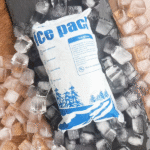
Material choice is where many projects win or lose. A cooler backpack industrial bag can be built with flexible foam, more efficient PU structures, or hybrid walls that use higher-performance components in strategic zones. The goal is not to buy the most advanced material. The goal is to buy enough control for your real lane.
Marzo 2026 technical note: Vacuum insulation panels can be around 0.003–0.004 W/m·K in pristine condition, while rigid polyurethane foam often falls around 0.023–0.04 W/m·K depending on formulation. PCM solutions improve stability by storing and releasing heat around a selected transition point, and cold-chain field work has shown that PCM-equipped packaging can significantly reduce temperature swings compared with non-PCM layouts. (科学出版社)
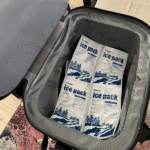
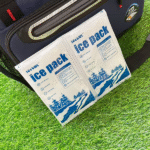
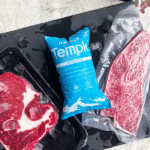
En términos simples, better insulation slows heat entry, while better coolant strategy smooths temperature change. You often need both. A cooler backpack industrial bag with strong walls but careless pack-out can still fail. So can a good PCM setup inside a badly sealed shell.
Coolant decision tool
- Pack-out rules that buyers should enforce
- Pre-condition the bag before loading
- Pre-condition the product before loading
- Estandarizar la colocación del refrigerante
- Reducir el espacio de aire vacío
- Limit unnecessary openings during the route
These rules look basic, but they are often the difference between a successful cooler backpack industrial rollout and a disappointing one.
How do you validate a cooler backpack industrial purchase?
Validation does not need to be complicated, but it does need to be real. Start with a lab or supplier test, then run a small pilot on your actual route. Use a logger when the application is sensitive or when the program scale is large. Even a modest data set can expose weak points in pack-out, manejo, or closure use.
ASTM D3103 gives buyers a recognized reference for thermal insulation performance of distribution packages. ISTA thermal profiles help frame realistic transport exposure. WHO and EU GDP guidance reinforce the value of documented qualification and representative mapping. For healthcare-adjacent work, continuous logger use is especially important. (ASTM International | ASTM)
Validation checklist
- Define exact temperature range
- Define trip duration and opening pattern
- Specify coolant type and quantity
- State ambient conditions
- Record logger placement
- Decide pass/fail criteria before testing
Caso práctico: An industrial meal service team first approved a sample because the bag “felt thick.” Field trials later showed temperature losses near the zipper after repeated openings. Once the closure path and internal divider layout were changed, the same route became stable enough for rollout. The lesson was clear: feel is not validation.
Qué 2026 trends should shape your buying decision?
The first big trend is reuse with accountability. Buyers want a cooler backpack industrial product that lasts longer, is easier to clean, and fits a real return loop. The second trend is evidence-driven sourcing. Procurement teams increasingly ask for test logic, route assumptions, and repeat-order quality control. The third trend is portfolio buying. One organization may need a light backpack for indoor service, a rugged version for outdoor mobility, and a monitored system for higher-control lanes.
Marzo 2026 sustainability note: FAO continues to connect better refrigeration with lower food loss and waste, while the EU’s PPWR framework and EPA’s packaging guidance are pushing packaging buyers to think beyond unit price. Reuse only works well when cleaning, devolver, and durability are designed into the system from the start. (FAOInicio)
2026 trend snapshot
- Route-based qualification is replacing generic brochure claims
- Reusable operating loops matter more than “green” labels alone
- Hybrid material structures are gaining attention in premium programs
- Data-backed sourcing is becoming standard in larger organizations
Preguntas frecuentes
How often should the keyword cooler backpack industrial appear in a product page?
Use it naturally in the title, early introduction, major subheads, image alt text, and FAQ, but always keep the page readable for real buyers.
Can a cooler backpack industrial bag be used for both food and healthcare?
A veces, but only if the validation, metodo de limpieza, and operating range match the intended application. Do not assume one sample fits every lane.
What is the most common buying mistake?
Buying by appearance or claimed hold time without defining the actual route, empacar, and opening pattern first.
Should I choose one big model or multiple sizes?
Multiple route-specific sizes usually work better. One oversized solution often adds weight and reduces efficiency.
Resumen y siguiente paso
The best cooler backpack industrial choice is the one that matches the real trip. Focus on route logic, material fit, coolant control, calidad del cierre, and validation. That is how you improve mobility and temperature reliability at the same time.
Your next step should be to write a one-page brief with temperature range, duración del viaje, condiciones ambientales, frecuencia de apertura, metodo de limpieza, and target bag size. That brief will improve every supplier discussion that follows.
Acerca de Tempk
Y tempk, we help B2B buyers turn cold chain transport needs into workable product specifications. We focus on practical insulation choices, route-based sampling, and repeatable production details so the final bag supports daily work instead of creating new problems.