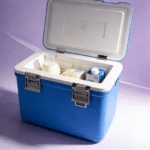
Vaccine ice box provider price only becomes useful when you know exactly what type of device you are pricing. In the vaccine cold chain, product labels can sound similar while actual device classes are very different. Some products are simple short-range carriers. Others are advanced passive systems built for longer cold life, safer freeze management, or easier field use. That is why raw price comparison often misleads buyers.
Public benchmark tools make this easier to navigate. WHO defines cold boxes and vaccine carriers in its E004 immunization-device category as passive insulated containers used mainly for vaccine transport and temporary storage, and UNICEF provides current price-data resources plus public catalogue entries that show a broad indicative range across device classes. ([WHO Extranet][6])
Este artículo responderá:
- What vaccine ice box provider price really reflects
- How to use public WHO and UNICEF references properly
- Why mission fit is more important than the lowest benchmark number
- What the best 2026 price-comparison process looks like
What does vaccine ice box provider price actually reflect?
**It reflects function, not just material.** A provider price usually reflects the class of device, the expected cold life, the design’s handling logic, and sometimes its ability to reduce field-use mistakes. That means price often maps to mission difficulty.
A simple short-transfer job may only need a basic carrier. A longer or more variable outreach mission may justify a more advanced design. If you compare those prices directly without sorting the missions, the decision will be flawed from the start.
A better way to read the number
Ask what the device is supposed to do, how long it is supposed to do it, and under what field conditions. Then ask whether the price belongs to that class of work.
| Price Interpretation Question | Por que importa | Better Outcome |
|---|---|---|
| What job is this device built for? | Defines class fit | Stops false comparison |
| How much margin does it provide? | Shows risk protection | Better field planning |
| How easy is it to use correctly? | Predicts handling success | Fewer avoidable errors |
| What public benchmark range exists? | Gives market context | Stronger negotiation |
Consejos prácticos
- Para adquisiciones: Never compare mixed device classes in one simple ranking.
- Para operaciones: Include field users in the evaluation if possible.
- For budgeting: Judge price against protected value, not only visible spend.
> **Ejemplo:** A more expensive device may be the correct price for a harder job rather than an overpriced version of a simple job.
How should public benchmarks be used?
**Public benchmarks are a reference layer, not a decision layer.** UNICEF public listings show a wide range across vaccine carriers and cold boxes, and its price-data page notes an update in December 2025. Those resources help you understand the market spread and whether a provider quote feels roughly consistent with the class being offered. ([supply.unicef.org][1])
But benchmarks do not replace product fit. A lower public reference point does not help you if it belongs to the wrong class. Public data is strongest when it helps you ask better questions rather than forcing every quote toward the lowest visible number.
How can benchmarks improve negotiation?
They help you test whether a provider’s pricing narrative makes sense. If a quote is high, ask what feature, clase, or use case explains the difference. If it is very low, ask what may be missing in capacity, cold life, or field handling support.
Why does field use still matter in a price conversation?
Because vaccine-handling quality depends on correct storage and handling practices, not on the container alone. CDC emphasizes that vaccine quality is a shared responsibility and highlights proper storage units, monitoreo de temperatura, delivery inspection, and stock handling. That broader principle matters here too: a device that is hard to use correctly can become a poor value even if its purchase price is low. ([Centros para el Control y la Prevención de Enfermedades][8])
That is why the best provider price is often the price attached to the easiest correctly usable device for the mission, not the cheapest device in the catalog.
Consejos prácticos
- For short controlled transfers: Keep the device simple and fit-for-purpose.
- For outreach or variable conditions: Pay for margin when it clearly reduces field risk.
- For provider comparison: Ask what user mistakes the product design is meant to reduce.
2026 Desarrollos y tendencias
el mas grande 2026 shift is better pricing context. WHO product-category visibility and UNICEF price-data tools are giving buyers stronger reference points, while current vaccine-handling expectations continue to keep attention on correct cold-chain practice. ([联合国儿童基金会][11])
This is making the market easier to read, but only for buyers willing to classify before they compare. That is the new discipline.
Últimos desarrollos de un vistazo
- More public visibility: Easier access to reference categories and ranges
- More disciplined comparison: Better separation of device classes
- More field-use focus: Usability matters more in value judgment
Preguntas frecuentes
What is the biggest mistake in vaccine ice box price comparison?
Comparing different device classes as though they are direct substitutes.
Can public benchmark data replace supplier evaluation?
No. It improves context, but mission fit and field use still decide the best choice.
Why can a higher provider price be justified?
Because the product may offer more suitable cold-life margin, Manejo más seguro, or a better fit for the real mission.
Summary and recommendation
Vaccine ice box provider price in 2026 should be evaluated through device class, mission fit, field usability, and public benchmark context. The strongest buyer decision comes from sorting first, benchmarking second, and negotiating third. ([WHO Extranet][6])
If you want the best value, choose the product class that fits the task, then compare prices within that class only.
Acerca de Tempk
Tempk develops insulated transport and temperature-controlled packaging solutions for cold-chain use. We focus on practical matching between device class, transport need, and real handling conditions.
If you are comparing vaccine provider prices now, begin with the mission and product class before you look at the price ladder.