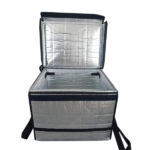
A well-designed thermal bag polyester product remains one of the most practical insulated bag formats in 2026. Polyester gives the bag strength, cleaner branding, and better repeated-use potential, while the insulation core and liner handle the real temperature-control work. That combination is why polyester is used so widely across food delivery, tienda de comestibles, bolsas de almuerzo, private-label retail, and reusable cold-chain support products.
But buying the right polyester thermal bag is no longer only about strength and price. Buyers now also ask whether the polyester is recycled, whether the textile chemistry is better controlled, and whether the whole bag can support a wider sustainability and compliance story. This optimized guide brings those questions together into one clear buying framework.
Este artículo te ayudará a responder.:
- What polyester contributes in a thermal bag and what it does not
- How to compare polyester shell, núcleo de espuma, transatlántico, and structure together
- When recycled polyester makes sense and how to verify it
- Which safety and compliance references matter most
- Cómo 2026 sustainability expectations are changing polyester bag sourcing
Why is polyester still the default choice for many thermal bags?
Because polyester gives buyers a strong balance of durability, apariencia, and commercial flexibility. It usually performs better than lighter short-life materials in repeated-use situations, supports more stable printing, and works well across many shapes and bag formats. That makes it a reliable outer shell for both everyday delivery bags and higher-visibility retail cooler bags.
The biggest practical advantage is that polyester scales well across project levels. You can use it in a simple insulated tote, in a medium-duty grocery cooler, or in a more structured premium bag. The material family is familiar, adaptable, and easy for buyers to compare once the rest of the construction is specified.
Typical polyester thermal bag applications
| Solicitud | Why polyester works | Buyer advantage |
|---|---|---|
| entrega de comida | Resists daily handling better | Longer-use value |
| Grocery fulfillment | Supports load-bearing shapes | Better usability |
| Retail cooler bags | Supports stronger printing | Better shelf appeal |
| Corporate gifts | Looks cleaner than entry materials | Better presentation |
| Reusable lunch bags | Balances structure and style | Better consumer acceptance |
What technical details matter beyond “polyester”?
The biggest sourcing mistake is to treat polyester as the full specification. It is not. Polyester is the shell. Thermal performance depends mainly on the insulation layer, while cleaning and spill handling depend heavily on the liner. Long-term service life also depends on the zipper, the handle build, and how well the bag holds shape.
That is why strong buyers treat the product as a layered system. capa exterior, insulation core, transatlántico, cierre, and reinforcement all need to make sense together. A better polyester shell cannot save a poor zipper path. A thick foam core cannot compensate for weak handles on a grocery bag.
Full-system review table
| Capa | Main job | Riesgo común | Best buying question |
|---|---|---|---|
| Polyester shell | Strength and appearance | Wear or weak finish | Is the fabric level right for daily use? |
| Núcleo de aislamiento | Ralentiza la transferencia de calor | Compression loss | Is thickness and resilience fit for route length? |
| Forro interior | Cleaning and spill control | Cracking or staining | Will it survive repeated wipe-down? |
| Cierre | Limits heat exchange | Gaps or snagging | Will it seal consistently during repeated use? |
| Reinforcement | Load support | Handle or seam failure | Can it carry the real payload safely? |
- Practical evaluation tips
- Test with real loads, not empty-bag handling.
- Check the bag after cleaning cycles, not only after delivery cycles.
- Focus on cost per use if the bag is intended for reuse.
Practical reminder: En muchos programas, the best value comes from balanced construction, not the thickest shell or the heaviest build.
Should you choose virgin polyester or recycled polyester?
Choose based on verified performance and verified traceability. Recycled polyester has become much more important in 2026 because buyers want stronger sustainability logic and more credible material claims. Textile Exchange continues to position recycled polyester as part of a shift away from virgin fossil-based feedstocks, and GRS gives buyers a way to discuss recycled-content tracking plus environmental, social, and chemical-related criteria in one system. (Textile Exchange)
Dicho esto, recycled polyester should still be judged like any commercial material. Does it meet the strength and appearance need? Can the supplier verify the claim? Is supply stable enough for repeat orders? The right answer is not “always virgin” or “always recycled.” The right answer is “the best verified option for this use case.”
When recycled polyester often makes sense
- Retail-facing or brand-facing products
- Sustainability-led private label programs
- Reusable bags where cost-per-use matters
- Buyers that need stronger traceability language
Which safety and compliance references should you review?
For reusable textile bags, material confidence matters more than ever. OEKO-TEX states that STANDARD 100 is a label for textiles tested for harmful substances, which makes it a useful reference when users will carry or touch the bag repeatedly. If you are making recycled-content claims, GRS is the stronger route compared with loose supplier marketing statements. (OEKO-TEX)
For food-related use, review whether unpackaged food may touch the liner or any other part. FDA explains that food-contact substances intended for packaging or holding food must meet applicable authorization rules for their intended use, and EU food-contact law also applies strict safety rules to materials intended to contact food. That means the intended-contact layer matters more than generic whole-bag claims. (A NOSOTROS. Administración de Alimentos y Medicamentos)
Cómo están 2026 trends changing thermal bag polyester buying?
The direction is clear: buyers want polyester bags that last longer, explain themselves better, and fit into broader sustainability expectations. EU packaging rules are increasing scrutiny around sustainability and labeling, while buyers are also paying more attention to whether a bag’s material story is simple enough to communicate honestly. (EUR-Lex)
Al mismo tiempo, durability is becoming a stronger commercial and sustainability metric. Large-scale reusable packaging is still limited, which means products that genuinely survive repeated use can stand out. That is one reason polyester remains attractive: it can support better cycle life when the rest of the bag is built correctly. (EMF Portal)
Últimos desarrollos de un vistazo
- Recycled polyester is increasingly requested in RFQs
- Verified claims matter more than “eco” language
- Textile safety evidence is gaining visibility
- Durability is now part of the sustainability decision
- Common questions about thermal bag polyester
Does polyester keep food cold by itself?
No. Polyester mainly supports durability and appearance. The insulation layer handles most of the thermal job.
- Is recycled polyester always the better choice?
Only when it is verified, performs well, and fits your supply needs.
What matters more for delivery: polyester shell or liner?
Both matter, but the liner and insulation often shape daily performance more directly.
Can polyester bags be premium and reusable?
Sí. Many of the best reusable soft insulated bags use polyester shells with stronger structure and better reinforcement.
What is the smartest first step?
Write a layered specification instead of asking for “polyester thermal bag” in general terms.
Resumen y recomendaciones
A strong thermal bag polyester product works because the polyester shell, aislamiento, transatlántico, and reinforcement are designed as one system. En 2026, buyers should also review recycled-content traceability, textile safety, and service life as part of the same decision.
The best next step is to build a sourcing brief with five fields: polyester level, insulation target, liner requirement, reuse scenario, and claim requirement. That will help you compare suppliers more accurately and choose the right polyester bag for real use.
Acerca de Tempk
Tempk develops insulated bag solutions with a practical view of materials, condiciones de la ruta, and daily handling. We help buyers compare polyester options, recycled-content possibilities, and full bag construction so the final choice fits both performance and sourcing goals.
That lets your next thermal bag polyester project move from a broad material request to a smarter product decision.