


Kualitas glasir dan permukaan
Perubahan suhu dapat mempengaruhi lapisan es, penampilan permukaan, dan kepercayaan pelanggan.
Palet makanan laut beku membutuhkan kontrol beku plus perlindungan kualitas permukaan. Rencana rute harus mengelola kondisi glaze, kebocoran karton, pemisahan aroma, karton tepi terekspos, dan dukungan es kering saat transfer.
Rute palet harus dinilai dari suhu tingkat muatan dan kondisi penerimaan. Rencana di bawah ini memberikan titik awal praktis sebelum menjalankan uji jalur dengan pola palet dan proses trailer sebenarnya.
Perubahan suhu dapat mempengaruhi lapisan es, penampilan permukaan, dan kepercayaan pelanggan.
Kerusakan akibat pencairan atau karton dapat menyebabkan air meleleh, bau, dan menerima masalah sanitasi.
Palet makanan laut mungkin perlu dipisahkan dari produk campuran, kemasan yang dapat dikembalikan, atau karton penyerap.
| Kondisi rute | Tujuan suhu | Pengaturan perlindungan muatan | Perencanaan media pendingin atau penutup | Pemeriksaan penerimaan |
|---|---|---|---|---|
| Frozen gudang to truk reefer, 0-4 h paparan dok | Simpan makanan laut dalam keadaan beku, umumnya direncanakan dekat -18 C, dan melindungi tepi palet yang terbuka. | Palet yang sudah dibekukan sebelumnya, penutup beku selama transfer, pemisahan kebocoran/bau jika tercampur, pencatat data inti terbaik. | Biasanya tidak ada es kering jika pengangkutan beku aktif stabil. Gunakan penutup atau liner beku untuk paparan dock. | Tepi dan suhu inti, kondisi glasir, karton basah, bau, dan waktu perpindahan. |
| Titik transbordo atau jalur beku multi-stop, 4-12 H | Rute beku dengan perlindungan tambahan untuk kualitas permukaan makanan laut dan pengendalian kebocoran. | Frozen penutup palet or liner, pola karton yang stabil, lapisan pengontrol kebocoran jika diperlukan, pisahkan es kering jika sudah divalidasi. | Es kering cadangan dapat diujicobakan 10-25 kg per palet bila diperbolehkan, dengan ventilasi dan kontrol penerimaan. | Kurva pencatat data, pencairan tepi, mengacai, kebocoran, perpindahan bau, dan sisa es kering. |
| Risiko penundaan atau segmen beku pasif, 12-24 H | Perlindungan beku yang tervalidasi dengan es kering bening, menutupi, dan prosedur penerimaan. | Selubung beku berkinerja tinggi, pemisahan kebocoran/bau, zona es kering jauh dari kerusakan karton, tinjauan risiko rute. | Tentang 25-55 kg es kering mungkin diperlukan untuk beberapa jalur makanan laut yang dipalet; menghitung dan memvalidasi rute. | Peta suhu, kondisi glasir, karton basah, bau, stabilitas muatan, dan sisa es kering. |
Gunakan rentang ini untuk pengambilan sampel dan kutipan. Final es kering, PCM, pak gel pendingin, menutupi, atau pilihan liner harus dikonfirmasi dengan massa palet, pola karton, durasi rute, ventilasi, Aturan operator, paparan lingkungan, dan menerima penanganan.
Jangan gabungkan makanan laut dengan karton penyerap bau kecuali lapisan atau rencana pemisahannya telah diperiksa.
Gunakan penutupnya, liner, dan peta data pencatat untuk melindungi tepi atas dan luar tempat pemanasan pertama kali dimulai.
Gunakan pelapis atau lapisan pemisah ketika air lelehan atau kerusakan karton akan memperlambat penerimaan atau mencemari muatan di dekatnya.
Jika es kering diperlukan, rencana massal, penempatan, ventilasi, pelabelan, dan menerima penanganan sebelum uji jalur.
Ini adalah masalah yang terlihat dan operasional yang harus dikurangi oleh rencana palet sebelum beban mencapai penerima.
Gunakan kurva tes sebagai perbandingan kerja, kemudian validasi dengan massa palet sebenarnya, menutupi, liner, dukungan pendingin, proses trailer, dan musim. Untuk palet, tepi terekspos dan lapisan atas seringkali sama pentingnya dengan intinya.
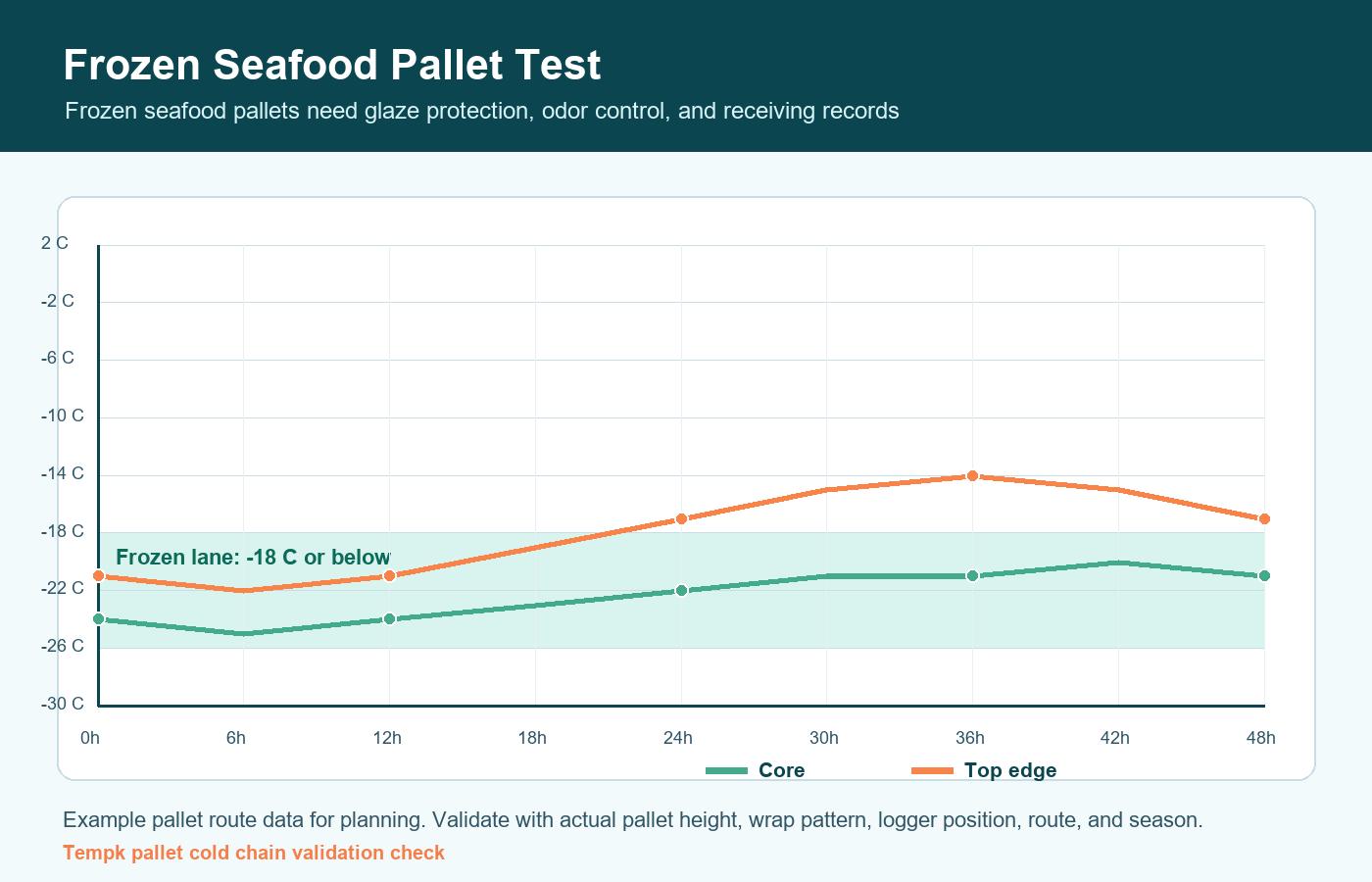
Gunakan halaman ini untuk membandingkan palet rute terdekat, perencanaan es kering, pilihan isolasi, dan risiko rute sebelum pengambilan sampel.
Palet makanan laut beku need frozen temperature plus moisture and odor control. Glazed makanan laut, karton dengan liner, dan muatan spesies campuran dapat berperilaku berbeda di trailer yang sama.
Kegagalan yang umum terjadi adalah karton sudut yang mencair, hilangnya glasir, makanan laut odor in the trailer, karton basah, dan kotak-kotak yang hancur karena penumpukan yang tidak rata.
Gunakan kemasan bagian dalam yang anti bocor, karton yang kuat, pelindung sudut palet, dan penutup atas yang melindungi dari kondensasi dermaga tanpa memerangkap air lelehan.
Tambahkan es kering atau gel beku hanya setelah memeriksa ventilasi, pengendalian bau, dan keselamatan pawang. Jangan letakkan cairan pendingin di tempat yang dapat merusak lapisan karton.
Periksa glasir, bau, kelembaban karton, dan suhu sudut palet. Pemeriksaan palet makanan laut harus mencakup catatan kebocoran dan bau.
Palet makanan laut beku should be validated beyond palet temperature. Glazed makanan laut, fillet kotak, dan kerang dapat menimbulkan masalah kelembapan dan bau jika bagian tepi karton mencair sebagian selama waktu tunggu berlabuh.
Gunakan karton yang kuat, pelindung sudut, dan penutup atas yang melindungi dari kondensasi tanpa memerangkap air lelehan. Es kering atau gel beku tambahan tidak boleh menghalangi aliran udara atau merusak lapisan karton.
Tempk harus memetakan inti palet, sudut terbuka, lapisan atas, dan posisi sisi dermaga. Penerimaan harus memeriksa kondisi glasir, bau, kelembaban karton, stabilitas palet, dan kekerasan produk.
Custom konfigurasi kemasan support
Untuk ukuran karton tetap, batas muatan, persyaratan merek, jalur musiman, atau target validasi, Tempk can adapt this solution into a custom cold-chain konfigurasi kemasan.
Bagikan dimensi palet, massa produk, pola karton, suhu target, waktu dock, jenis trailer, titik transbordo steps, kondisi sekitar, dan menerima cek. Tempk dapat membantu membandingkan sampul, liner, pak gel pendingin, PCM, es kering support, pencatat data positions, dan langkah validasi.
Minta tinjauan rute palet