Projeto de embalagem de cadeia fria: Da geometria ao POP de embalagem
Cold chain packout design defines how product, refrigerante, isolamento, protective parts and monitoring equipment form one reproducible shipping assembly. It also defines the preparation and working sequence needed to put that assembly into its intended starting condition.
The finished design is therefore more than a layout. It is a connected set of specifications, desenhos, instructions and supporting evidence. A useful design process works from the product interface outward, checks the limits of ordinary production and packing, and releases only the configurations that the operation can identify and reproduce.
Draw three boundaries around the proposed shipment
The first boundary is thermal. Establish the product’s required temperature conditions, condition at packing and intended protection interval. Include the relevant external exposure and handling assumptions. These inputs come from the product and distribution requirements; they should not be inferred from a generic description such as medical cooler.
The second boundary is spatial. Describe the actual product presentation, orientação, shipping quantities and protective packaging. Identify usable product space after coolant, barreiras, retainers and monitoring equipment are installed. Nominal internal volume is not the same as usable payload capacity.
The third boundary is operational. Identify preparation equipment, available staging, sequência de embalagem, operator tasks and receiving arrangements. A design that depends on a process the dispatch site cannot perform is not a suitable candidate, even when its laboratory concept is promising.
Assess these boundaries together. A compact layout may leave too little tolerance for production variation. A thermal solution may require preparation capacity the warehouse does not have. A simple assembly may not preserve the separation needed by a sensitive product. The relevant trade-off is between the complete alternatives, not isolated component advantages.
Record assumptions that are still unresolved. An uncertain route exposure, unconfirmed product presentation or undefined preparation capability should remain an open design input. Assign an owner and a closure method rather than allowing an optimistic assumption to become a hidden performance claim.
Also define what the design does not cover. A closed parcel configuration should not be treated as suitable for repeated opening, another temperature category or an unrestricted range of loads without assessment. Explicit boundaries help the ordering system reject unsupported combinations before they reach the packing bench.
Build the physical definition from the product interface outward
Begin with the product location and the relationships that must be preserved. Identify the surfaces the product may contact, the orientation it must maintain and the movement that needs to be prevented. Then define the parts that establish those relationships.
Where separation from coolant is necessary, specify how that separation is achieved and retained. A barrier’s material, geometry and position can matter; a generic instruction to add protective packaging leaves those variables uncontrolled. Do not prescribe a universal barrier thickness or coolant placement without evidence for the particular system.
Choose restraint that serves the actual load arrangement. The smallest shipment may need a different locating feature from the largest. Loose filler should not be used as an informal substitute for a defined arrangement, especially where movement can create new product-to-coolant contact.
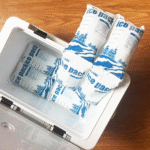
Locate coolant according to the intended thermal function and available evidence. Equal coolant mass does not make two arrangements equivalent: forma, área de contato, distance and preparation state can differ. More coolant is not automatically safer where excessive local cooling is a relevant risk.
Continue outward through the insulation, articulações, lid and external protection. Check how internal parts affect closure. A folded liner, over-height insert or instrument cable can prevent the intended lid engagement. The design should define a normal closing condition rather than depend on operators forcing the package shut.
Review dimensional variation across the assembled stack. Components individually within their purchasing tolerances can still combine into an assembly that has insufficient clearance or excessive compression. Identify the important combinations and verify the resulting fit using representative parts or a justified dimensional analysis.
A hypothetical low-fill order illustrates the design decision. Removing several cartons from an approved full-load arrangement creates free space and changes restraint. The response is to define and evaluate the smaller arrangement, not to assume that fewer cartons make the original design automatically suitable. The example identifies a question; it does not claim a tested outcome.
Use a bill of materials that reaches the functional accessories. A spacer or locator should not disappear from configuration control because it costs less than the enclosure. Its role in maintaining an important interface determines the control it needs.
Specify the starting state as carefully as the drawing
A layout describes where components go; preparation determines the thermal state in which they arrive. Both belong to the packout definition. The same physical assembly can behave differently when product or coolant enters it under different conditions.
Request the preparation method associated with the candidate system. Identify relevant equipment capability, arranjo de carregamento, release criteria and handling after release. Exact temperatures, times and coolant quantities should come from the applicable system specification and evaluation, not from an unrelated example.
Distinguish the coolant’s material identity from its readiness. The correct part number can still be unsuitable for immediate use when its preparation is incomplete or its history is uncertain. Por outro lado, a prepared-looking pack with the wrong formulation is not an acceptable substitution merely because it fits the designated space.
Review whether routine preparation batches represent the process considered during development. Loading more material into equipment, changing separation between packs or introducing another transfer step can affect the starting condition. Assess meaningful differences rather than treating equipment setpoint as a complete description of the process.
Define the status flow between preparation and assembly. Unprepared, em processo, ready and uncertain components should remain distinguishable as they move. The packing team needs a reliable acceptance check, and the preparation team needs a record of what it released.
Include pauses and unused material in the method. State how a delayed assembly, interrupted preparation cycle or returned coolant batch is handled. Do not assume that placing material back into a conditioning area instantly restores the required state or restarts an allowed period.
Product preparation deserves equivalent attention. Escolhendo, staging and loading should preserve the intended starting condition. A packout designed to maintain a product condition should not be presumed capable of correcting a product that begins outside that condition.
Remove dependence on memory, judgment and invisible corrections
Build candidate assemblies with the people who will use the instruction. Observe where they hesitate, rotate a component repeatedly, press a lid into place or ask a specialist to confirm a choice. These observations identify design questions that a finished photograph may conceal.
Ferramentas úteis de decisão
Verifique os detalhes antes de escolher a embalagem
Essas ferramentas rápidas podem ajudá-lo a comparar o risco da rota, necessidades de dimensionamento, escolhas de refrigerante, e detalhes da embalagem antes de solicitar um orçamento.
Forro de caixa & Dimensionamento da cobertura de paletes
Verifique a lógica de dimensionamento do forro da caixa e da tampa do palete para projetos de embalagens isoladas.
Dimensionamento estimadoCalculadora de gelo seco
Estime as necessidades de gelo seco para remessas congeladas ou ultrafrias antes de embalar.
Estimar gelo secoSeletor de embalagens
Compare opções de embalagens isoladas por produto, rota, e necessidade de temperatura.
Encontre embalagensPrefer physical location and clear identification where they can replace repeated judgment. A shaped retainer can establish position; distinct component identifiers can prevent confusing similar coolants; a visible closure feature can make incomplete seating easier to detect. Any retained feature needs to be included in the assessed configuration.
Define checks at the moment the relevant feature is still visible. A bottom barrier should be verified before it is covered. A logger should be identified and mounted before the lid blocks access. End-of-line inspection alone cannot reliably establish every hidden assembly detail.
Design the instruction for ordinary working conditions. Consider gloves, condensação, limited bench space and the need to read labels. Use clear views and identifiers rather than depending only on color or an angle that conceals the difference between parts.
Test exception recognition as well as normal assembly. Present controlled training examples of a missing insert, an unsupported quantity or an uncertain preparation status. The operator should know when to stop and which decision owner to contact, rather than being expected to invent a technical correction.
Keep development observations honest. A successful assembly that required repeated undocumented expert intervention has not yet demonstrated that the instruction is sufficient. Revise the design or procedure, then observe the revised version under representative conditions.
Consider receiving usability before freezing the candidate. The opening sequence should allow product removal and access to monitoring information without avoidable disturbance. Para sistemas reutilizáveis, identify which components return and how their identities remain recognizable after unpacking.
Ask the prototype evidence to answer specific design questions
Separate fit demonstrations, thermal development, handling evaluation and formal qualification. Each has a different purpose. A successful fit check does not establish temperature protection, and a favorable temperature trace does not independently establish repeatable assembly or resistance to relevant handling.
Use development tests to challenge the proposed mechanisms. Examine vulnerable product positions, relevant payload arrangements, initial conditions and the exposure sequence. Include the possibility that handling changes an interface. Select the required scope with the technical and quality teams and any adopted method.
Identify what the measurement system actually measures. External exposure, ar interno, product surface and a representative product surrogate are different quantities. Select locations and device characteristics to answer the design question, then document their physical meaning.
Ensure instrumentation does not create a better or worse package than the intended one without recognition. A cable can open a closure path; a large logger can displace a carton; a probe fixture can accidentally restrain the load. Record and assess unavoidable differences between instrumented and ordinary assemblies.
Preserve unsuccessful observations. A local cold response or displaced insert can reveal why a design relationship needs stronger control. Such observations are investigation leads, not automatic diagnoses. Verify the preparation, setup and records before deciding which change addresses the mechanism.
When the design is ready for formal assessment, freeze the relevant revisions. WHO’s container-qualification guidance connects evaluation with the specified assembly. The practical design requirement is that the configuration in the report, the components ordered and the instruction at the bench can be shown to correspond.
Do not extend the evidence beyond its supported use. Uma carga alterada, substituted coolant or revised preparation process may need further assessment. The appropriate response depends on the affected relationship and applicable requirements, not simply on whether the outer shell looks unchanged.
Release one connected design package, not separate files that disagree
The design handover should let another qualified team understand what to purchase, preparar, montar, inspect and assess. It should also let an operator identify the applicable configuration without interpreting an engineering report at the packing bench.
| Controlled deliverable | What it should make unambiguous | Connection to preserve |
| Intended-use definition | Produto, operation and limits covered by the design | Requirements and approval scope |
| Lista de materiais | Identity and specification of functional components | Purchasing and incoming inspection |
| Assembly drawings | Posição, orientação, interfaces and closure | Approved component and drawing revisions |
| Permitted-load guide | Product arrangements, quantity boundaries and filler | Order selection and evaluated configurations |
| Instruções de preparação | Required starting state and how it is established | Equipment process and release records |
| POP de embalagem | Sequence, cheques, identification and stop conditions | Operator execution and shipment record |
| Monitoring instruction | Device purpose, localização, activation and retrieval | Measurement evidence and receiving workflow |
| Supporting assessment | What was evaluated and which restrictions remain | Released design and change-control record |
These documents may be combined where that improves usability. The important point is consistency, not file count. A single controlled instruction can be better than several disconnected documents, provided it contains the necessary definitions and links to the supporting record.
Check the release package against a physical build. Use the specified production-representative components and the permitted load arrangement. Record discrepancies between the drawing, written steps, material list and actual assembly, then resolve them before release.
Define configuration identification at shipment level. A broad commercial box name is insufficient where several internal arrangements share the enclosure. The record should allow a later reviewer to establish which design revision and permitted arrangement were actually used.
Agree supplier change notification and incoming acceptance criteria. Control should reach the features that maintain important relationships, including relevant dimensions, materiais, retention and preparation characteristics. A supplier’s claim that an alternative is equivalent should be assessed where it affects those features.
Review later changes through the relationships they could disturb
When a change is proposed, identify its path through the design. A new product carton may alter clearance and thermal response. A revised coolant pouch may affect fit and contact. Another preparation site may change the starting-state process. These mechanisms are more informative than labeling a change minor or major without explanation.
Retain evidence that remains applicable and identify what needs additional work. Depending on the requirements and uncertainty, the response may involve document review, targeted evaluation, revised instructions or a new configuration. Record the rationale and release an identifiable revision when the design changes.
Para sistemas reutilizáveis, include condition and repair in this review. Approved replacement parts, inspection criteria and handling of uncertain components help preserve the evaluated arrangement. Do not let repeated returns gradually introduce mixed versions or undocumented repairs.
Can the same shell support several packouts?
Sim, potentially, but each permitted internal configuration needs a clear identity, selection rule and appropriate supporting assessment. Shared external dimensions do not make the internal arrangements interchangeable. The inventory benefit should be weighed against the added selection and training burden.
Should a delayed shipment receive extra coolant?
Only through a specifically assessed and authorized procedure where appropriate. Adding coolant changes the configuration and may change local temperature risks. Use the approved delay response and product-quality process instead of treating extra coolant as a universal recovery method.
Cold chain packout design is ready for implementation when geometry, preparação, instructions and evidence describe the same system. Provide Tempk with the actual product presentation, load variations and packing-site capabilities to discuss a candidate configuration, then confirm its permitted use through the responsible technical and quality review.