High-Density Shock-Absorbing EPP Box: Why Use It?
UM high-density shock-absorbing EPP box helps you stop transit damage antes it becomes refunds, retrabalhar, and broken customer trust. Se você envia produtos frios, fragile electronics, ou dispositivos médicos, you’re fighting two enemies at once: variação de temperatura e manuseio brusco. Enquanto isso, food loss remains a real global issue—FAO reports 13.2% de alimentos são perdidos entre a colheita e o varejo.
Este artigo vai te ajudar:
-
Escolha o certo high-density shock-absorbing EPP box using density, ajustar, e risco de pista.
-
Reduce damage and “lid pop” problems with practical design and packing steps.
-
Validate performance using a simple test plan (including ISTA-style thinking).
-
Decide if a reusable loop makes sense for your business in 2025.
What Is a High-Density Shock-Absorbing EPP Box?
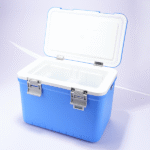
A high-density shock-absorbing EPP box is a reusable foam container that absorbs impact and resists crushing while also insulating the payload. PPE (polipropileno expandido) is a closed-cell bead foam known for absorção de energia e resistência a impactos múltiplos, and it can be produced across a wide density range. BPF
That matters because real shipping is messy. Parcels get dropped. Loads get stacked. Vans vibrate for hours. UM high-density shock-absorbing EPP box is built to keep protecting your product even after repeated hits.
Why EPP is different (em linguagem simples)
EPP behaves like a good running shoe midsole. It compresses when it must, then “springs back.” That rebound helps maintain shape, so your lid alignment and fit stay consistent over repeated uses.
| What you’re trying to prevent | What usually causes it | How EPP helps | O que isso significa para você |
|---|---|---|---|
| Rachaduras, amassados, micro-damage | Gotas + corner impacts | Spreads impact energy | Fewer damage claims |
| “Lid doesn’t seal anymore” | Crush + permanent deformation | Better shape recovery | More consistent temperature control |
| Unstable pack-out | Vibração + internal movement | Inserts hold position | Menos erros de embalagem |
Dicas práticas que você pode usar
-
If customers report “crushed corners,” you need higher density and stronger corners.
-
If customers report “arrived warm,” check lid fit and seal stability after impacts.
-
If packing errors happen, add keyed inserts that only fit one way.
Caso real: Teams often see fewer “mystery failures” once a high-density shock-absorbing EPP box replaces brittle, single-use foam that cracks early.
How Does a High-Density Shock-Absorbing EPP Box Absorb Impact?
A high-density shock-absorbing EPP box protects by turning sharp impacts into controlled compression. Instead of passing the full force to the product, the foam deforms, spreads the load, and then recovers.
Think “car suspension,” not “hard shell.” A hard shell can look fine, while the product inside takes the hit.
O 4 most common impact forces (e o que fazer)
| Impact source | Nível de risco | What a high-density shock-absorbing EPP box should do | Sua lição prática |
|---|---|---|---|
| Drop impact (corner/edge) | Alto | Reinforce corners + allow controlled compression | Design for corners first |
| Sorting/handling shocks | Médio | Prevent lid shift + maintain closure geometry | Test lid interface after drops |
| Vehicle vibration | Médio | Dampen micro-movement | Control internal clearance |
| Stack pressure | Alto | Resist crushing over time | Add ribs + density where loads sit |
Dicas práticas e recomendações
-
Vias de encomendas: focus on corners and lid-lock geometry.
-
Retail DC stacking: prioritize compressive resistance and ribbing.
-
Rotas longas: prioritize internal stability so products don’t “walk” inside.
Caso real: One common hidden failure is a small lid gap after a hit, which increases heat gain and leakage risk.
What Density EPP Foam Is Best for a High-Density Shock-Absorbing EPP Box?
The “best” density depends on weight, drop risk, and stacking pressure—higher density is stronger, but fit still controls peak force. EPP can be produced in a wide density range (often cited 15–200g/L for EPP). BPF
To make this real, here is a reference dataset showing compressive strength rising with density under standardized testing methods. ARPRO
Density numbers you can actually use
| Densidade (g/L) | Compressive strength @25% strain (MPa) | @50% strain (MPa) | O que isso significa para você |
|---|---|---|---|
| 30 | 0.15 | 0.22 | Better for light payloads, lower crush risk |
| 60 | 0.39 | 0.53 | Strong “all-around” option for tough parcel lanes |
| 90 | 0.65 | 0.88 | Best for heavy payloads, empilhamento, reutilizar loops |
A simple selection rule (no lab needed)
-
Luz + frágil: densidade média + more controlled clearance (avoid “too stiff”).
-
Peso médio + manuseio misto: high density + smart inserts.
-
Pesado + empilhado: very high density zones + costelas + load pads.
Caso real: A lot of overpaying happens when teams buy “max density” instead of fixing insert geometry and clearance first.
High-Density Shock-Absorbing EPP Box vs EPS vs EPE: O que muda?
A high-density shock-absorbing EPP box usually wins when you need repeat protection and reuse. EPS can crack and crumble. EPE can cushion, but often lacks structural strength for stacking and reuse.
What fails first (the useful way to compare)
| Material | Shock behavior | Typical failure mode | Reuse reality | O que isso significa para você |
|---|---|---|---|---|
| EPS | Frágil | Rachaduras, crumbles | Baixo | Damage can spike suddenly |
| EPE | Softer | Permanent deformation/tearing | Médio | Cushioning is OK, stacking is weaker |
| PPE (high density) | Elastic | Recovers shape | Alto | More stable protection across trips |
Dicas práticas e recomendações
-
If your network is rough: avoid brittle materials that crack early.
-
If you stack: prioritize compressive strength and corner geometry.
-
If you plan reuse: EPP durability reduces replacement churn.
Caso real: Many “random damage” patterns disappear when the packaging stops changing shape after the first few hits.
How Do You Size a High-Density Shock-Absorbing EPP Box for Real Drops?
Sizing is not “tightest fit.” It’s controlled space + controlled contact points. If your fit is too tight, the foam cannot compress correctly. If it’s too loose, the product builds momentum and hits harder.
O 3 sizing rules your team can remember
-
Clearance: give the foam room to do its job.
-
Contact points: support the product at strong zones, not weak faces.
-
Energy path: guide impact forces through foam geometry, not into the product.
A quick sizing guide
| Product situation | Clearance strategy | Insert approach | O que isso significa para você |
|---|---|---|---|
| Luz + frágil (telas) | More clearance | Corner blocks / cradle | Lower peak force |
| Pesado + robusto | Moderate clearance | Load pads + costelas | Prevent bottoming out |
| Kits (multiple parts) | Controlled spacing | Divisores + partições | Prevent internal collisions |
Dicas práticas e recomendações
-
Center the mass: off-center payloads amplify corner failures.
-
Protect the weak face: design around the most fragile side.
-
Prevent sliding: don’t rely on tape to “fix” internal movement.
Caso real: Switching from “full-face clamp” to corner-block support often reduces screen and edge cracks.
Which Insert Design Works Best in a High-Density Shock-Absorbing EPP Box?
Insert geometry is where performance is won or lost. Smart inserts spread force, prevent pressure points, and keep the product stable through vibration.
Corner blocks vs cradle vs full-wrap (fast comparison)
| Tipo de inserção | Melhor para | Risk if misused | O que isso significa para você |
|---|---|---|---|
| Corner blocks | Fragile housings, telas | Too small = pressure points | Fast packing, proteção forte |
| Cradle (2–4 point) | Balanced loads | Wrong alignment = wobble | Great repeatability |
| Full-wrap | Clean control, dust protection | Too tight = force transfer | Funciona, but needs careful fit |
Dicas práticas e recomendações
-
Use rounded contact: sharp edges create stress spikes.
-
Add alignment features: keyed inserts reduce “wrong-way” packing.
-
Separate “position control” from “shock control”: geometry should do both.
Caso real: Keyed cradles can improve pack speed while reducing damage, because packers stop improvising.
How Do You Test a High-Density Shock-Absorbing EPP Box (ISTA/ASTM)?
Testing turns “we think it’s safe” into “we can ship it with confidence.” Para pistas de parcelamento, ISTA procedures are commonly used to simulate parcel delivery hazards. ista.org+1
For distribution simulation planning, ASTM D4169 provides a structured approach using hazard sequences representative of distribution environments. ASTM Internacional | ASTM
Minimum test set (simples, repetível)
| Tipo de teste | O que isso revela | O que assistir | Pass/fail idea |
|---|---|---|---|
| Gotas (edge/corner/face) | Proteção contra impactos | Alinhamento da tampa, corner crush | Nenhum dano ao produto + lid still seals |
| Vibração | Loosening + drift | “Walking” parts, vestir | No internal shift beyond tolerance |
| Compressão | Stacking performance | Permanent set, collapse | No functional deformation |
| Closure/seal check | Vazar + heat gain risk | Gaps after impacts | Full closure with no gaps |
Dicas práticas e recomendações
-
Test the worst pack-out, não é o melhor.
-
Incluir novos packers na validação to expose real errors.
-
Retest after compression + gotas to see cumulative damage effects.
Caso real: Many teams find failures cluster in one corner. Fixing that corner geometry can remove repeat claims.
Can a High-Density Shock-Absorbing EPP Box Support Reuse and Compliance?
Yes—if you control returns, taxa de perda, and cleaning speed. If you can’t control those, reuse becomes a slow money leak.
high-density shock-absorbing EP…
Reuse also matters more in Europe because Regulation (UE) 2025/40 sets reuse targets for transport packaging: 40% reutilizável por 2030 (e um nível de “esforço” de 70% por 2040) for listed transport packaging formats. EUR-Lex
The same regulation also focuses on reducing “empty space” and sets a maximum empty space ratio of 50% for grouped/transport/e-commerce packaging (with exemptions for reusable packaging within a reuse system). EUR-Lex
Reuse Readiness Scorecard (quick self-test)
Dê a si mesmo 1 point for each “yes.”
high-density shock-absorbing EP…
-
Do you ship to repeat destinations with predictable returns?
-
Can you bundle returns weekly or monthly?
-
Do you have space to store empties?
-
Can you scan containers in and out?
-
Você pode limpar ou limpar recipientes embaixo 2 minutos?
-
Do you know your acceptable loss rate?
-
Do you have a backup plan if returns are late?
Guia de pontuação (simples):
-
0–2: Focus on single-trip protection first.
-
3–5: Pilot reuse on one lane with tracking.
-
6–7: Scale the reusable high-density shock-absorbing EPP box program.
high-density shock-absorbing EP…
Practical reuse tips (that reduce loss)
-
Add a visible ID zone for scan-in/scan-out.
high-density shock-absorbing EP…
-
Design for nesting/stacking of empties.
-
Replace closures or labels instead of replacing full containers.
Caso real: Programs improve fast once scan-in/scan-out becomes non-optional.
high-density shock-absorbing EP…
How Does a High-Density Shock-Absorbing EPP Box Cut Total Cost?
O preço unitário pode ser maior, but the cost-per-use can be lower. The real savings come from fewer damages, fewer re-ships, and less packaging replacement.
This matters in cold chain. FAO highlights that 13.2% of food is lost before retail globally. FAOHome
Food loss and waste are also tied to 8–10% of annual global greenhouse gas emissions. 联合国气候变化框架公约秘书处
Nos EUA, ReFED reported surplus food rebounded to 31% of the food supply (2023 dados) in one recent analysis. Refed
Cost-per-use table (what finance teams understand)
| Tipo de embalagem | Ciclos típicos de reutilização | Common hidden cost | O que isso significa para você |
|---|---|---|---|
| Single-use foam | 1 | Quebra + repack labor | Cheap upfront, expensive over time |
| Somente papelão ondulado | 1–2 | Crush, umidade, inconsistência | Alta variação de falha |
| High-density shock-absorbing EPP box | 50–200+ (lane-dependent) | Controle de perdas + limpeza | Predictable cost per shipment |
Mini calculadora: “Damage Cost Reality Check” (3 minutos)
Preencha os espaços em branco:
-
Monthly shipments: ____
-
Current damage/spoilage rate: ____ %
-
Cost per failed shipment (produto + trabalho + re-ship): ____
-
Target reduction using a high-density shock-absorbing EPP box: ____ %
Estimated monthly savings =Shipments × Failure rate × Cost per failure × Reduction
Caso real: Many pilots “pay back” once you stop paying for the same failure twice (substituição + re-ship).
2025 High-Density Shock-Absorbing EPP Box Trends to Watch
Em 2025, the best high-density shock-absorbing EPP box designs are built for speed, reutilizar, and proof—not just thickness. Three forces are shaping decisions:
-
Automação: faster sorting and handling increases impact exposure.
-
Compliance pressure: reuse targets and space-efficiency rules are clearer in some markets.
-
Waste pressure: food loss and waste remain significant globally.
Instantâneo do progresso mais recente (prático, not hype)
-
Zoneamento de densidade: higher density at corners and load paths, lower density elsewhere.
-
Inserções modulares: one outer box, multiple insert sets.
-
Rastreabilidade: IDs and scanning built into reuse programs.
-
Eficiência espacial: reduced filler dependency aligns with “empty space” constraints (50% cap in EU rule).
| 2025 tendência | What changes in the warehouse | O que você deve fazer a seguir |
|---|---|---|
| Transferências mais rápidas | More drops, more corner hits | Reinforce corners, validar pistas |
| Reuse targets | More pressure to run loops | Comece com uma pista + monitorando |
| Less “air in the box” | Less filler allowed/desired | Improve fit + inserir geometria |
Perguntas comuns (Perguntas frequentes)
Q1: What density EPP foam is best for a high-density shock-absorbing EPP box?
Match density to weight and crush risk. Data shows compressive strength rises with density (por exemplo, 30 vs. 60 vs. 90 g/L). ARPRO
Q2: Is a high-density shock-absorbing EPP box always better than medium density?
Não. If fit is too tight, higher density can transmit peak forces. Fix clearance and insert geometry first.
Q3: What are the most useful drop test standards for a high-density shock-absorbing EPP box?
For parcel-style risks, ISTA Procedure 3A is commonly used for individual parcels.
Q4: Do I still need an outer carton with a high-density shock-absorbing EPP box?
Often yes—for labeling, scuff protection, and tamper control. You may reduce void fill if fit is better.
Q5: How do I reduce packing mistakes fast?
Use keyed inserts and a quick “rock test.” If it rocks, it’s not packed right.
high-density shock-absorbing EP…
Q6: How do reuse rules affect transport packaging decisions in the EU?
Regulamento (UE) 2025/40 sets reuse targets for certain transport packaging (40% por 2030; 70% por 2040 as an endeavour). EUR-Lex
Resumo e recomendações
UM high-density shock-absorbing EPP box helps you protect products in rough lanes by absorbing impacts, resisting crushing, and staying consistent across repeated handling. The biggest wins come from basics you can repeat: right density, right clearance, smart inserts, and a simple test plan.
O que fazer a seguir (plano simples)
-
Identify your top 2 damage patterns (corner drop, crush, vibration drift).
-
Piloto um high-density shock-absorbing EPP box size with modular inserts.
-
Standardize pack-out with a photo SOP and a “rock test.”
high-density shock-absorbing EP…
-
Validate with drops + compressão + seal checks.
-
Scale only after results are consistent across packers.
CTA: If damage and re-ships are eating margin, stop “adding padding everywhere.” Start using a tested, repetível high-density shock-absorbing EPP box sistema.
Sobre Tempk
No Tempk, we build packaging systems that are practical for real warehouses and real delivery lanes. We support high-density shock-absorbing EPP box programs with a focus on repeatable pack-out, durable inserts, and lane-based validation. We also help teams plan reuse loops with simple tracking and loss-control steps, so performance stays consistent across cycles.
Próximo passo: Compartilhe seu tipo de produto, weight range, modo de envio (parcel/air/pallet), and top damage pattern. We’ll map a high-density shock-absorbing EPP box concept and a validation plan your team can run quickly.