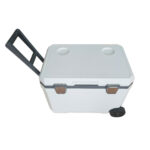
A caixa de remessa refrigerada VIP para envio de kits de diagnóstico é a escolha certa quando você precisa de um transportador passivo que combine alto isolamento, controle prático de embalagem, and documentation-friendly performance. Em 2026, essa combinação é mais importante do que nunca. Cold-chain networks are moving more biologics, Diagnóstico, and specialty products through smaller parcels, more outsourced routes, and more final-mile handoffs. Buyers therefore need packaging that protects the product and simplifies decision making at the same time.
A strong VIP-based design can do exactly that. Fresh vacuum insulated panels can deliver thermal conductivity in the low 0.002 para 0.004 W/m-K range, while many common foams are roughly an order of magnitude higher. That insulation density can translate into smaller outer dimensions, better payload space, and more controlled thermal performance when the route is demanding. But the best result comes only when insulation, refrigerante, payload configuration, monitoramento, and route qualification are treated as one system. That is the mindset behind this optimized guide.
Este guia irá ajudá-lo a responder
- Why VIP Shipping Box for Diagnostic Kit Shipping matters in diagnostic kit shipping and when it clearly outperforms simpler formats
- How VIP insulation, escolha de refrigerante, and payload mass work together
- How to choose the right hold time, load range, and logger strategy
- Which standards and quality rules matter most for qualification and scale-up
- O que 2026 trends in market growth, sustentabilidade, and digital monitoring mean for your purchase
Why does VIP Refrigerated Shipping Box for Diagnostic Kit Shipping matter to your shipment?
The purpose of the package is not to look advanced. It is to protect the product zone through the real shipment journey. In diagnostic kit shipping, the shipment may encounter ambient swings, lidar com abuso, tempo de espera, or receiving delays. many diagnostic reagents are temperature sensitive and can lose performance long before the outer package looks damaged; freeze-sensitive enzymes, calibrators, and controls require tighter protection than a generic cold pack box can give; and weekend holds and mixed-temperature components complicate the packaging plan. A package that manages those stresses well protects product quality, reduz o desperdício, and shortens the time quality teams spend explaining avoidable deviations.
This is why buyers increasingly choose VIP Shipping Box for Diagnostic Kit Shipping when the route becomes more critical. They are often looking for compact insulation for smaller, higher-value kit payloads, better control for freeze-sensitive refrigerated products, and easy integration with indicators or digital loggers for complaint review. Those gains can improve both technical performance and business performance. Less outer cube can help freight efficiency. More payload room can help shipping economics. Better thermal control can reduce the chance that one delayed shipment becomes a product complaint or a write-off.
How does VIP Refrigerated Shipping Box for Diagnostic Kit Shipping work, and when does it beat conventional foam?
The core advantage is thermal efficiency per unit of wall thickness. Fresh vacuum insulated panels can deliver thermal conductivity in the low 0.002 para 0.004 W/m-K range, while many common foams are roughly an order of magnitude higher. That means a VIP-based shipper can often deliver the same or better protection in a smaller geometry than a basic foam design. The practical outcome is not just better insulation on paper. It is more freedom to design a package that fits real parcel, correio, or depot workflows without becoming oversized and awkward to use.
Mesmo assim, VIP does not eliminate the need for good design. Performance still depends on panel protection, seam management, fechamento da tampa, colocação de refrigerante, and the thermal mass of the payload. Buyers should therefore compare complete systems, not only insulation materials. Ask how the package behaves when partly full, when the route is delayed, when ambient conditions change, and when the box is opened at the receiving site. Those are the moments that separate a credible packaging system from a simple specification sheet.
A practical comparison table for VIP Shipping Box for Diagnostic Kit Shipping
| <forte>Ponto de decisão</forte> | <forte>O que verificar</forte> | <forte>Boa resposta</forte> | <forte>Por que isso importa</forte> |
| Alvo de temperatura | label range and stability limit | qualified around the real product zone | wrong target means the best insulation still fails |
| Perfil de rota | exposição ambiental, risco de atraso, e transferências | summer and winter logic defined | route reality drives hold-time need |
| Tamanho da carga útil | minimum and maximum thermal mass | qualified for both small and full loads | payload changes package behavior |
| Plano de monitoramento | logger type and location | calibrated device in the product zone | data becomes useful during release and CAPA |
How should you select hold time, tamanho da carga útil, and coolant for VIP Refrigerated Shipping Box for Diagnostic Kit Shipping?
Begin with the labeled product range. Then define the real shipment profile: normal transit time, likely delay time, minimum payload, maximum payload, and destination readiness. A package should be qualified for the conditions you will actually face, not just for an ideal shipping window. WHO guidance is explicit on this point: Anexo da OMS 9 says insulated passive containers should be qualified with full assembly details, thermal conditioning rules, and minimum and maximum shipping volume, peso, and thermal mass. That is a reminder that route profile and payload range belong inside the package decision from the beginning.
Coolant selection comes next. Gel packs can be good for simpler chilled lanes, PCM packs are usually stronger when you need a defined temperature plateau, and dry ice only makes sense when the product truly needs that deeper level of cold. Good engineering avoids overcooling just as carefully as overheating. The best packout maintains the product zone predictably instead of simply creating the coldest internal environment possible.
| <forte>Refrigerante</forte> | <forte>Onde cabe</forte> | <forte>Atenção principal</forte> | <forte>O que isso significa para você</forte> |
| pacotes de gel | basic chilled diagnostic kits | common and simple, but can freeze edge-near product | Choose simplicity |
| Pacotes PCM | freeze-sensitive refrigerated kits | better for precise 2 to 8°C protection | Choose tighter control |
| gelo seco | selected frozen components | only when product labeling truly requires deep freezing | Choose only when product really needs deeper freezing |
How do you qualify VIP Refrigerated Shipping Box for Diagnostic Kit Shipping for compliant, repeatable shipping?
Qualification should be treated as a system exercise. EU GDP says temperature conditions must be maintained within acceptable limits during transport, the route should be risk assessed, and transport monitoring equipment should be maintained and calibrated at regular intervals at least once a year. EU GDP also expects initial temperature mapping before use and placement of monitors where the greatest fluctuations occur. WHO also says transport routes should be profiled and qualified against the anticipated ambient conditions over the journey. Junto, those expectations tell you what regulators and quality teams care about: correct temperature, documented route thinking, monitored evidence, and clear response if an excursion occurs. A good package helps because it supports all those needs with a repeatable assembly process and a defensible monitoring plan.
Em termos práticos, the qualification package should define preload conditions, assembly sequence, condicionamento de refrigerante, faixa de carga útil, localização do registrador, suposições de rota, Critérios de aceitação, and seasonal variants if they exist. It should also be easy for operators to follow. Many packaging failures are not caused by bad materials. They are caused by small but repeatable errors in assembly, such as wrong coolant conditioning, the wrong payload fill, or a logger pushed into the wrong position. A controlled SOP is therefore part of package performance.
A repeatable qualification workflow
- Lock the product-zone target and the acceptable excursion logic.
- Profile or simulate the route, including delays and seasonal exposure.
- Test minimum and maximum loads with the real payload packaging format.
- Fix coolant conditioning, assembly order, and logger placement in writing.
- Review results against the product zone and investigate any edge-zone anomalies.
- Requalify after major changes in route, carga útil, component, or supplier.
What does the ideal packout look like for diagnostic kit shipping?
The ideal packout is not the most elaborate one. It is the one that operators can build correctly every time and that recipients can understand immediately. In diagnostic kit shipping, that usually means the package clearly separates the product zone from the coolant, protects the most temperature-sensitive items from direct contact with extreme cold, reserves a defined space for the logger, and includes simple handling instructions for the receiving side. If a package is hard to build, hard to inspect, or hard to receive, it becomes harder to trust at scale.
A good packout also reflects the specific application. Diagnostic kit shipping is not just about arriving cold. It is about arriving usable. If a reagent loses sensitivity, if a control drifts, or if a freeze-sensitive component gets damaged by direct contact with frozen coolant, the shipment has failed even when it reaches the lab on time. That application lens matters because the same package architecture is not ideal for every lane. A direct-to-patient box, a GDP wholesale shipper, a diagnostic kit shipper, and a cryogenic transport system all need different trade-offs. The best suppliers will talk through those trade-offs openly and show why a certain configuration fits your use case instead of pushing one generic design for everything.
| <em>Exemplo aplicado: A diagnostics company shipping refrigerated assay kits replaced a one-packout-fits-all foam box with a VIP refrigerated shipping box qualified around the kit's real thermal mass. Freeze damage complaints fell because the PCM layout protected the product zone instead of overcooling the edges.</em> |
O que fazer 2026 mercado, sustentabilidade, and monitoring trends mean for VIP Refrigerated Shipping Box for Diagnostic Kit Shipping?
The broader market continues to support higher-performance cold-chain packaging. Public market research in 2025 e 2026 continues to show strong growth in pharmaceutical cold chain packaging as biologics, vacinas, and specialty medicines expand. The broader temperature-controlled packaging sector is also expanding, helped by direct-to-patient delivery, healthcare e-commerce, e pressão de sustentabilidade. That growth is being shaped by more complex therapies, greater reliance on small shipments, and stronger expectations for documented performance. Buyers increasingly want packaging that can stand up to both operational stress and quality review. In this environment, higher insulation is valuable because it creates flexibility without immediately forcing a move to active systems.
Sustainability is adding another layer to the decision. O Regulamento de Embalagens e Resíduos de Embalagens da UE entrou em vigor em 11 Fevereiro 2025, generally applies from 12 Agosto 2026, and pushes the market toward recyclability and circular design. A strong VIP package can contribute because it often reduces freight cube and can support durable reuse models. But the 2026 standard is higher than a recycled-content claim. Buyers now ask how the packaging will be recovered, limpo, inspecionado, and eventually recycled or refurbished. Digital monitoring is also becoming more central. A package that makes logger use easy and consistent can reduce investigation time and improve release confidence.
2026 instantâneo de tendência
- More decentralized testing and distributed lab networks.
- Stronger need for mixed-channel delivery to hospitals, Clínicas, e laboratórios de referência.
- Higher interest in compact monitored packaging for premium reagents.
Perguntas frequentes
How long can a VIP refrigerated shipping box hold temperature in diagnostic kit shipping?
It depends on the qualified design, o refrigerante, the payload thermal mass, and the actual route profile. Treat hold time as a validated system result, not a catalog headline. Para pistas regulamentadas, qualify summer and winter packouts separately and define minimum and maximum payload sizes before commercial use.
Is VIP Shipping Box for Diagnostic Kit Shipping better than a conventional foam shipper?
For many lanes, yes-especially when you need strong thermal performance in a smaller footprint. Fresh vacuum insulated panels can deliver thermal conductivity in the low 0.002 para 0.004 W/m-K range, while many common foams are roughly an order of magnitude higher. The practical benefit is that you can often gain payload room, reduce refrigerant, or extend hold time. But the advantage only counts if the complete packout is qualified for your shipment.
When should you use PCM instead of dry ice with VIP Shipping Box for Diagnostic Kit Shipping?
Use PCM when you need a defined target range such as 2 to 8°C or controlled room temperature and want steadier product-zone conditions. Use dry ice only when the product stability profile truly calls for deep-frozen or ultra-cold transport. For freeze-sensitive payloads, PCM is usually the safer and more precise choice.
Do you need a data logger in every diagnostic kit shipping shipment?
Not every lane has the same risk, but monitored shipments are strongly recommended whenever the payload is high value, the route is new, or compliance evidence matters. CDC recommends digital data loggers for vaccine storage and handling, set to record at least every 30 minutos. For GDP and validation work, a calibrated logger turns a package from a promise into documented proof.
Can VIP Shipping Box for Diagnostic Kit Shipping be reused?
Muitas vezes sim, if the design is built for repeat trips and you can control inspection, limpeza, reforma, e logística de retorno. WHO guidance also expects reusable shipping containers to be cleaned and records maintained. Reuse is only a real advantage when the operating process is as disciplined as the packaging design.
How do you qualify VIP Shipping Box for Diagnostic Kit Shipping before launch?
Start with the product’s allowed temperature range and stability limits. Then qualify the packout against the real route, perfil ambiente, minimum and maximum payload, and likely handling pattern. Anexo da OMS 9 says insulated passive containers should be qualified with full assembly details, thermal conditioning rules, and minimum and maximum shipping volume, peso, and thermal mass. Finalmente, lock the winning configuration into a written SOP so operators build it the same way every time.
Resumo e recomendação
The strongest reason to choose VIP Shipping Box for Diagnostic Kit Shipping is that it can deliver concentrated thermal performance in a package format that still supports operational simplicity. That matters because modern cold-chain shipping is no longer defined by temperature alone. You also need lane realism, repeatable packout logic, usable monitoring data, and a package that fits your receiving workflow. When those factors align, a VIP-based system can protect product value while improving the overall shipping process.
The best next step is to compare candidate systems using your real route, your actual payload range, and your chosen logger method. Look at temperature results, operator usability, receiving-site ease, peso dimensional, and documentation quality together. The winner should not only keep the shipment safe. It should also make your cold chain easier to run, mais fácil de escalar, and easier to defend.
Sobre Tempk
Tempk develops passive cold-chain packaging with a focus on high-efficiency insulation, practical packout design, and real-world qualification logic. We aim to connect materials, monitoramento, and route reality in one clear system so customers can choose packaging with confidence instead of guesswork. That approach is especially useful when shipment value, quality requirements, and service complexity are all high.
If you want a package decision that holds up in operations and in quality review, comece com a rota, the product zone, and the packout discipline. Uma vez que isso esteja claro, the right thermal packaging format becomes much easier to identify and much easier to justify.