


Calor e luz solar
Tempo de espera quente pode afetar cor, odor e confiança na marca, especialmente quando os pacotes ficam em veículos, armários ou portas.
Pacotes de sérum de vitamina C precisam de controle de calor, proteção contra luz e suporte cuidadoso do frasco. O objetivo é reduzir exposição ao calor do verão sem causar contato congelado, rótulos molhados, vazamento da tampa ou movimento do frasco de vidro.
Para entrega cosmética em cadeia de frio, a melhor embalagem protege tanto a condição da fórmula quanto a apresentação ao cliente. A configuração abaixo é um ponto de partida prático antes dos testes de rota.
Tempo de espera quente pode afetar cor, odor e confiança na marca, especialmente quando os pacotes ficam em veículos, armários ou portas.
Um gel pack muito próximo ao cartucho de varejo pode molhar rótulos e caixas impressas mesmo quando a temperatura do produto parece aceitável.
Frascos de vidro e conta-gotas precisam de suporte na cavidade central para que o produto não chacoalhe, chip, ou pressione em um pacote de gel.
| Condição da rota | Objetivo de temperatura | Configuração de embalagem | Faixa preliminar de refrigerante | Verificação no recebimento |
|---|---|---|---|---|
| Correio local, 4-8 h | Proteção fria contra o calor; siga as instruções de armazenamento do rótulo se for necessário manuseio refrigerado. | Mala postal isolada ou pequena caixa isolada, manga de frasco, 1-2 pequenos pacotes de gel condicionado ou PCM com placa espaçadora. | Sobre 0.3-0.7 kg por um 0.5-2 kg de carga útil de soro. | Movimento da garrafa, vedação da tampa, secura do rótulo, e tempo de transferência quente. |
| Rota calorosa do comércio eletrônico, 8-24 h | Muitas vezes planejada como uma rota fria, como 8-15°C, quando a marca precisa de redução de calor; evite congelar. | Caixa isolada ou caixa EPP compacta, cavidade central do produto, refrigerante condicionado nas posições lateral/superior, buffer corrugado ou de espuma. | Sobre 0.7-1.5 kg por um 0,5-3 kg de carga útil. | Temperatura mínima, umidade do rótulo, esmagamento de caixa, e qualquer preocupação com cor ou odor. |
| Rota quente ou risco de atraso, 24-36 h | Use um alvo refrigerado testado com base no rótulo do produto e na promessa do cliente. | Isolamento mais espesso, maior massa de PCM ou gel-pack, produto isolado de superfícies frias, registrador opcional para pistas premium. | Sobre 1.5-2.6 kg para um transportador compacto; validar antes do lançamento. | Curva do registrador, estado refrigerante restante, vazamento da tampa, e aparência do produto. |
Use essas faixas para discussão e amostragem de embalagens. A massa refrigerante final deverá ser confirmada com a fórmula real, contagem de unidades, tamanho de frasco ou pote, dimensões da caixa, duração da rota, condição ambiente, e qualquer exigência do registrador.
Não congele ou resfrie demais os frascos, a menos que o rótulo e o processo interno de qualidade permitam. Condition refrigerante before configuração de embalagem so the product is not shocked by a frozen surface.
Coloque os frascos em uma manga, bandeja, ou divisor. Mantenha material absorvente ou resistente à umidade entre a embalagem de varejo e o refrigerante.
Use posicionamento lateral e superior para pistas de verão, mas mantenha um espaçador físico entre o refrigerante e o frasco ou caixa de varejo.
Verificação no recebimentos should include temperature record if used, secura do rótulo, condição da tampa, movimento de vidro, e sinais visíveis de cor ou odor.
Esses são os problemas que a configuração de embalagem deve reduzir antes que a remessa chegue ao cliente.
Use a curva de teste como uma comparação funcional, em seguida, valide com o produto real, refrigerante mass, isolamento, duração da rota, e estação. For cuidados com a pele, verifique também a apresentação: secura do rótulo, condição da caixa, vedação da tampa, e textura do produto.
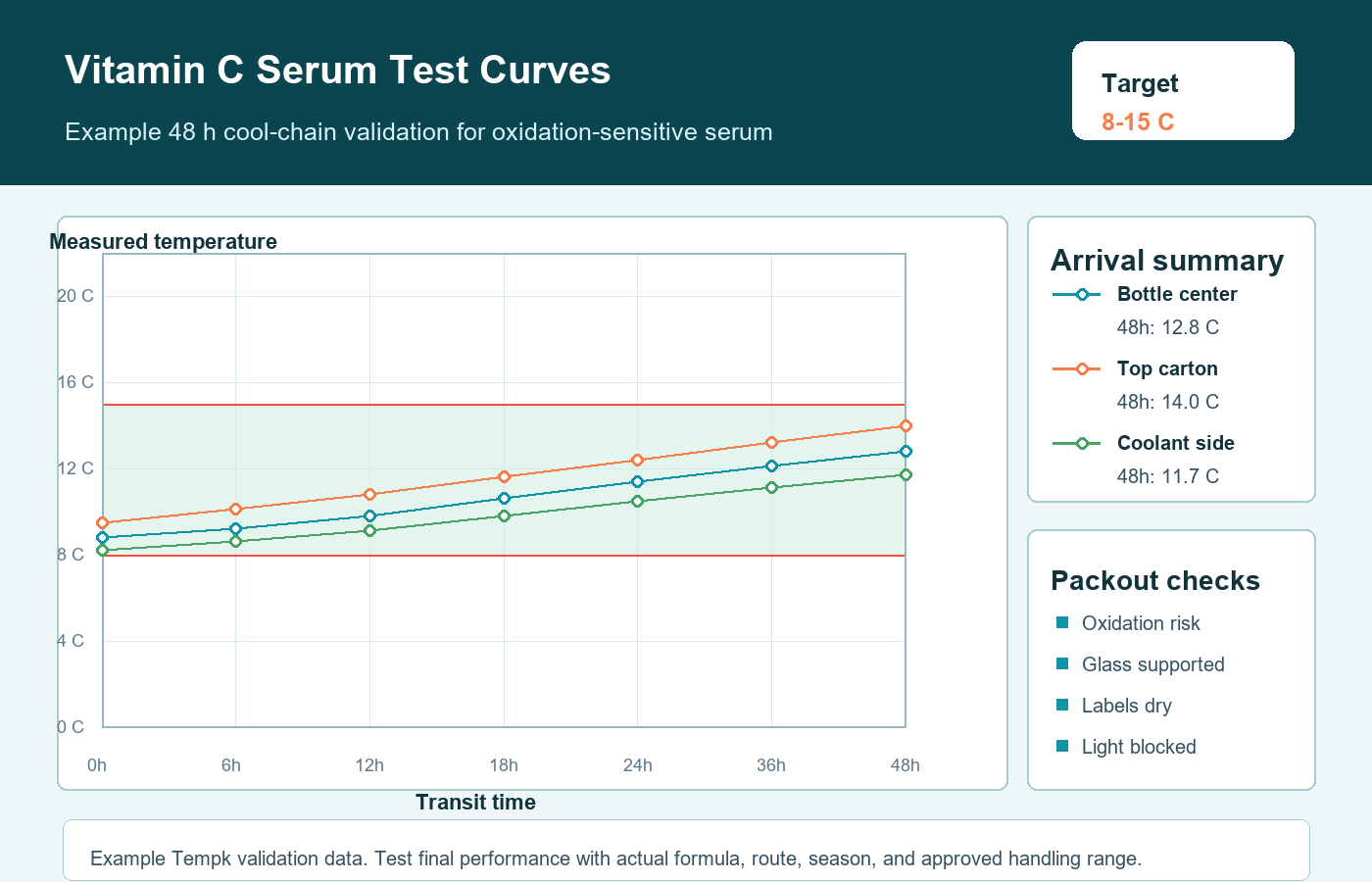
Use estas páginas para comparar rotas de produtos próximas, select refrigerante, e verifique o risco da rota antes da amostragem.
soro de vitamina C pode escurecer ou perder apelo quando exposto ao calor e à luz. The configuração de embalagem should moderate temperature while protecting glass frascos, conta-gotas, e caixas de varejo.
Observe a mudança de cor, conta-gotas vazando, inchaço da caixa, levantamento de etiqueta, e vidro quebrado por contato direto com refrigerante duro.
Use uma divisória ou célula de frasco, adicione uma barreira contra umidade ao redor da caixa de varejo, e coloque o refrigerante ao lado de um tampão em vez de contra o vidro.
Use pacotes de gel resfriado ou PCM para entrega de encomendas na estação quente. Evite o resfriamento excessivo se a fórmula não estiver rotulada para transporte refrigerado.
Comparar cor, clareza, viscosidade, e função conta-gotas antes e depois da rota. Um registro fotográfico é útil para avaliação da qualidade da marca.
Para soro de vitamina C em frascos conta-gotas de vidro, use divisórias ou células de frasco dentro do pacote isolado. Gel resfriado ou PCM pode reduzir os picos de calor do verão, mas o refrigerante não deve tocar diretamente nas caixas de vidro ou papel. Adicione uma barreira contra umidade onde os rótulos ou caixas ficam voltados para a zona fria. Se o produto não estiver rotulado como refrigerado, validate a heat-moderation configuração de embalagem rather than a very cold payload. Comparar cor, clareza, viscosidade, função conta-gotas, adesão de etiqueta, e secura da caixa antes e depois da rota.
Custom configuração de embalagem support
Para tamanhos de caixa fixos, limites de carga útil, requisitos de marca, pistas sazonais, ou alvos de validação, Tempk can adapt this solution into a custom cold-chain configuração de embalagem.
Compartilhe as instruções de armazenamento, contagem de unidades, tamanho da caixa, peso da carga útil, duração da rota, condição ambiente, transferência de entrega, e se você precisa de um registrador de temperatura. Tempk pode ajudar a comparar pacotes de gel, PCM, PPE, caixas isoladas, camadas de buffer, e recebimento de cheques.
Solicitar uma revisão de configuração