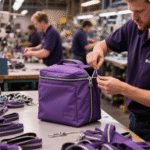
Double bubble insulated liner factories are easy to compare badly and much harder to compare well. The common mistake is to look only at the quote and assume all double bubble liners are basically interchangeable. In Wirklichkeit, the factory behind the liner strongly affects how the product behaves. Bubble consistency, lamination quality, dimensional repeatability, Versiegelung, and bundle flatness all shape the final user experience.
If you are sourcing double bubble insulated liners for cold chain boxes, direct-to-consumer shipments, export packaging, or thermal barrier applications, this guide will help you look at the full picture. That means production quality, OEM ability, route fit, supply reliability, and future packaging direction.
Dieser Artikel hilft Ihnen bei der Beantwortung:
- What double bubble insulated liner factories should be able to control
- How to compare factories fairly on process and output
- When direct factory sourcing is better than wholesale sourcing
- Why validation awareness and compliance context matter more now
- How sustainability is changing factory expectations in 2026
What makes one double bubble insulated liner factory better than another?
The best factory produces stable product behavior, not just acceptable material. That means the bubble structure is consistent, the laminate holds together well, the cut sizes repeat reliably, and the finished liner fits your packaging process. When these basics are well controlled, you get easier packing, more predictable thermal behavior, and fewer supplier-side surprises.
A weak factory may still produce a liner that looks acceptable in photos. The real problems tend to show later: poor fit, awkward folding, lot-to-lot variation, or weak finish quality. This is why a factory review must go deeper than a sample photo and a price sheet.
The production factors that matter most
- Bubble formation consistency
- Reflective surface stability
- Lamination bond quality
- Converting precision
- Fold and seal repeatability
- Flat-packed bundle behavior
- Standard and peak production lead time
- Praktische Ratschläge
- For first projects: Ask for production-grade samples, not hand-trimmed ones.
- For repeat orders: Review whether the factory keeps an approved reference standard.
- For operations-heavy programs: Test fit and folding speed before final approval.
Praktischer Fall: A frozen food program improved packing speed after moving to a factory with more consistent cut accuracy. The material concept did not change much, but the factory discipline did.
When should you buy directly from a factory?
Direct factory sourcing is strongest when your specifications are stable and your volume is meaningful. If you already know your box dimensions, expected annual volume, and preferred liner format, a direct factory relationship can improve cost visibility and OEM responsiveness. It can also make custom development more efficient.
Jedoch, direct sourcing works best when your team can define what it needs clearly. If your sizes are still changing or your demand is mixed and uncertain, a wholesaler or trading partner may still be the simpler route.
Factory vs wholesaler comparison
The point is not that one is always better. The point is that the right source should match your program maturity. Many buyers begin with a wholesaler, then move core sizes to factory sourcing once volume and dimensions settle.
Praktische Ratschläge
- For stable cartons: Explore direct factory pricing and OEM options.
- For early-stage growth: Keep flexibility until your demand pattern is clear.
- For mixed programs: Consider split sourcing by core and secondary sizes.
Praktischer Fall: A meal-delivery operator kept specialty sizes with a flexible supplier but moved its best-selling carton size to a direct factory program for better long-term economics.
How should you evaluate a factory technically?
Evaluate a factory through process detail, not just specification labels. Ask how bubble quality is checked, how lamination stability is controlled, what the dimensional tolerance is, and how finished liners are packed. You should also understand how the factory handles design changes and what happens between first sample and full production.
This technical review matters because a double bubble liner is a converted product. Even small variation in bubble quality or cut precision can affect fit, Handhabung, and consistency. The better factory is usually the one that understands those details as process variables, not as afterthoughts.
Technical review checklist
- Confirm nominal size and tolerance
- Review bubble and laminate consistency in sample form
- Check fold pattern and closure logic in your real box
- Ask about production QC and issue response
- Review bundle packing, carton count, and pallet density
- Approve a production-quality sample before first mass order
- Praktische Ratschläge
- For QA teams: Compare first production against approved sample.
- For procurement: Do not ignore packing density and carton count.
- For pack lines: Watch where the liner slows human handling.
Praktischer Fall: A specialty dessert brand identified a fold issue during the production-sample stage and avoided a large first order that would have created a packing bottleneck.
Why do validation awareness and compliance context matter in 2026?
Because buyers increasingly expect factories to understand application, not just output. FDA’s FSMA sanitary transportation rule sets expectations for covered food transport practices. EMA says GDP is the minimum standard for preserving medicine quality and integrity through wholesale distribution. WHO also notes that almost all vaccines in immunization programs still rely on the traditional 2°C to 8°C cold chain. This environment makes buyers more cautious about packaging claims and more interested in use-case logic. (UNS. Food and Drug Administration)
Testing awareness is also becoming more valuable. ISTA says 7E is the new standard for thermal transport testing in parcel delivery and that it is based on real-world transport profiles. ASTM D3103 is intended to evaluate the thermal performance of insulated packaging for high-value, high-risk materials. Buyers increasingly prefer factories that understand how liner structures fit into route-based packaging qualification rather than simply stating that a material is “insulated.” (Internationaler Verband für sichere Transporte)
The best factory does not need to act like a lab. But it should understand enough to support a realistic conversation about application and limitations.
Praktische Ratschläge
- For parcel routes: Ask the factory what use case the liner is truly suited for.
- For quality-sensitive shipments: Keep a written summary of the chosen liner logic.
- For supplier comparison: Treat application understanding as a real evaluation category.
Praktischer Fall: A chilled snack program rejected one low-cost factory because it could not explain where its double bubble liner worked best. The saving was not worth the uncertainty.
How is sustainability changing double bubble factory sourcing?
Because packaging decisions are increasingly judged on future direction as well as current performance. Eins 2025 report estimated the global cold chain packaging market at USD 33.73 Milliarden in 2025 und USD 38.30 Milliarden in 2026, which shows strong demand momentum in temperature-sensitive logistics. Gleichzeitig, the EU Packaging and Packaging Waste Regulation entered into force in February 2025, begins applying from mid-2026, verlangt, dass alle Verpackungen recycelbar sind 2030, and includes a PFAS ban in packaging from August 2026. Those forces push factories to think about material strategy more seriously. (Grand View Research)
Für dich, that means factory selection should include questions about product evolution. Can the factory support better fit and lower packaging volume? Is it thinking about simpler structures or newer formats? Can it discuss trade-offs honestly? Those questions do not replace performance review, but they matter more than they did a few years ago.
2026 trend checklist
- More custom and semi-custom double bubble programs
- More buyer pressure on consistency and route fit
- More attention to waste reduction and packaging density
- More discussion of future material direction
- More segmentation between low-cost volume factories and higher-support OEM factories
- Praktische Ratschläge
- For long-term sourcing: Prefer factories that can explain where their portfolio is headed.
- For consumer-facing brands: Review waste and package cube along with thermal behavior.
- For current RFQs: Ask both current-product and future-direction questions.
Praktischer Fall: A premium online grocery brand stayed with a double bubble solution, but only after the selected factory showed how fit improvements could lower box cube and reduce material waste.
Häufig gestellte Fragen
What is the most important factor when choosing a double bubble insulated liner factory?
Production consistency. Ohne es, price and design advantages are difficult to trust.
Is direct factory sourcing always cheaper?
Nicht immer. It often works best when volume is stable and specifications are clear.
Do I need to audit the factory?
For important or repeated business, a structured quality review is a smart move.
Why should a factory understand testing and route logic?
Because buyers increasingly want application-based confidence, not generic thermal claims.
How does sustainability affect double bubble liner sourcing?
It pushes factories and buyers to think about waste, material direction, and future packaging expectations.
Summary and recommendation
The best double bubble insulated liner factories in 2026 combine process control, application understanding, and future-ready thinking. They produce consistent liners, support OEM decisions clearly, and help buyers choose with more confidence. That is why factory comparison should cover production quality, validation awareness, supply reliability, and sustainability direction together.
Your next step is to build a factory scorecard that includes bubble consistency, lamination quality, cut tolerance, sample discipline, and future material strategy. That will give you a much stronger basis for selection than price alone.
Über Tempk
Und Tempk, we believe good thermal liner performance begins in manufacturing discipline. We focus on fit, converting quality, and practical packaging decisions that work in daily shipping operations. The right factory choice should improve consistency, not just reduce quote level.
If you are evaluating factories now, start with the real use case and the real packing process. That is where better sourcing decisions are made.