What a “Trockeneisbeutel” Is—and When Food Shippers Should Use It
Dry ice is solid CO₂ that SULBLIMATE (überspringt die flüssige Phase), staying near –78,5 ° C. at atmospheric pressure. That deep‑freeze profile makes it ideal for Eiscreme, gefrorenes Fleisch/Meeresfrüchte, Bäckereidesserts, and any SKU that must remain ≤ −18 °C End -bis -Ende. Weil es sich in Gas verwandelt, Es gibt kein Schmelzwasser, um Kartons einzuweichen.
Aus Planungsstandpunkt, dry ice absorbs roughly 25–27kJ/mol when it sublimes—about ~571 kJ/kg, eine praktische Zahl für die Schätzung der Haltezeit und der Masse.
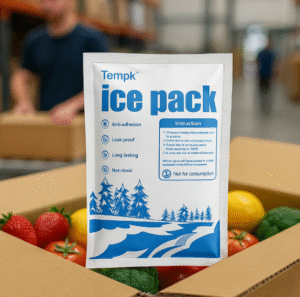
Schnelle Entscheidungsmatrix: Trockeneis vs. Gel vs. PCM (Essen)
| Szenario | Zieltemp | Beste Wahl | Warum es gewinnt |
|---|---|---|---|
| Ice cream to homes, 24–72H | ≤ −18 °C | Trockeneisbeutel | Deep‑freeze, langer Halt; Etikett + Entlüftung erforderlich. |
| Mahlzeiten / produzieren, 1–2 days | 0–8 ° C | Gelpackungen | Holds “refrigerated” range without freezing. |
| Gefroren, aber nicht ultralahm (viele Lebensmittel) | −20 °C band | −20 °C PCM or dry ice | PCMs avoid CO₂ hazards + Hazmat Papierkram; Testen Sie Ihre Spur. |
Tipp: For mixed‑temp boxes, isolate zones—dry ice above the frozen portion, gel packs around the chill portion.
The 10‑Minute Pack‑and‑Label SOP (2025)
-
Voraussetzung
Vorfreies Produkt; pre‑chill the shipper to cut initial heat load. -
Choose a vent‑capable shipper
EPS/EPP/VIP or validated corrugated‑foam sets. Niemals make it airtight; pressure from CO₂ gas must escape. (Required by 49 CFR §173.217.) -
Laden & isolieren
Die Box auslegen; keep food bagged and separated from dry ice surfaces. Top‑load blocks for stability; use pellets to fill side voids. -
Schließen, but keep venting
Secure flaps/tape seams without sealing every possible leak path; confirm a gas‑escape path. (49 CFR + IATA.) -
Markierungen anwenden & Etiketten (air/ground couriers)
Auf der äußere Paket, hinzufügen:
-
Und 1845
-
Richtiger Versandname: Trockeneis oder Kohlendioxid, solide
-
Nettomasse von Trockeneis (kg)
-
Klasse 9 Hazard -Etikett
Follow IATA PI 954 + operator acceptance checklist (2025).
-
Auf dem Frachtbrief (when no Shipper’s Declaration is required)
If dry ice only cools nicht dängliche Güter, enter this in AWB “Nature and Quantity of Goods”:
(Format per IATA + carrier job aids; FedEx example below.)
-
Zart & Schiene
Zu Beginn der Woche versenden; add a data logger on new lanes.
USPS (UNS. Post) is different: inländisch air mail ≤ 5 lb (2.27 kg) per mailpiece and requires a Shipper’s Declaration affixed to the outside; Internationale Post mit Trockeneis ist verboten.
The Sizing Math (Schnell)
Energy method (good starting point):
-
Sublimation energy: ~571 KJ/kg
-
Trockeneis erforderlich (kg) ≈ Total heat load (KJ) ÷ 571
-
Total heat load = Heat gain (kj / h) × Transit Stunden
-
Hinzufügen 20–30% Puffer for delays/heat waves.
Rule‑of‑thumb for food shippers (first trial):
| Zeit halten | Small shipper (8–12 qt) | Medium shipper (20–30qt) |
|---|---|---|
| 24 H | 2.3–3.6 kg (5–8 Pfund) | 3.6–5.4 kg (8–12lb) |
| 48 H | 4.5–6.8 kg (10–15 Pfund) | 6.8–9.1 kg (15–20lb) |
| 72 H | 6.8–11.3 kg (15–25 Pfund) | 9.1–13.6 kg (20–30 Pfund) |
These bands reflect common CDC/EHS guidance to budget ~5–10 Pfund pro 24 Stunden and should be tuned by your insulation, Kastengröße, and route temps.
Copy -Paste -Rechner (any notebook):
Safety You Can Audit
-
PS: Isolierte Handschuhe + Augenschutz; dry ice is ~−78.5 °C.
-
Co₂ -Exposition: OSHA PEL 5.000 ppm (8 H zwei); Stel 30.000 ppm—ventilate pack‑out rooms, Fahrzeuge, and receiving areas.
-
Gasvolumen: 1 lb dry ice → ~250 L CO₂; small rooms can reach hazardous levels quickly.
-
Niemals luftdicht: Vent required by 49 CFR; Hier ist pi 954 addresses mark/label/documentation for air.
Receiving routine (food ops): Crack the box in a ventilated area, remove product, and allow remaining dry ice to dissipate—nicht put in sinks/bins with sealing lids.
Träger & Rule Highlights (2025)
| Regelsatz / Operator | Core requirement you’ll actually use | Warum ist es wichtig |
|---|---|---|
| Hier ist pi 954 + 2025 Checkliste für die Abnahme | Und 1845 + richtiger Versandname + Netz kg + Klasse 9; AWB text when no Declaration is required; operators use checklists. | Universal air‑cargo baseline; reduces acceptance failures. |
| 49 CFR §173.217 (UNS.) | Pakete müssen Entlüftung; specific markings; vehicle/containers marked appropriately. | Legal in the U.S.; prevents pressure incidents. |
| USPS 9A (UNS. Post) | Air mail ≤ 5 lb Trockeneis; address‑side text + Klasse 9; Shipper’s Declaration required (Luft). | USPS is stricter than couriers; avoid rejections. |
| FedEx | AWB -Linie: UN 1845, Dry Ice, _ x _ kg; no DG Declaration if cooling non‑DG only. |
Copy‑ready wording; smooths intake. |
| UPS | “How to ship dry ice” mirrors PI 954; planen 5–10 Pfund pro 24h as a rule‑of‑thumb. | Practical mass planning + compliance pointers. |
Passenger baggage context (keine Fracht): many airlines allow ≤2,5 kg pro Person in carry‑on/checked bag for perishables if vented and marked—don’t confuse with cargo limits.
2025 Changes & Was ist neu
-
IATA DGR 66th Ed.: Acceptance checklist for dry ice is live; überprüfen Bedienervarianten und bereitstellen net weight during booking when requested (aircraft limits).
-
WER (Ausgabe 7, 2025): Aktualisiert Richtlinien für die internationale Verpackung und den Versand von Impfstoffen—good patterns for venting, Dokumentation, and handling if you ship food + health products together.
Copy‑Ready Labels & AWB Text
On the box (near the Class 9 Etikett):
(Hier ist pi 954 + 49 CFR basics.)
Auf dem Luftwaybill (Kuriere; when Declaration not required):
(FedEx job aid format.)
USPS -Luftpost (inländisch): add required Versendererklärung, ≤ 5 lb pro Poststück, and mandated address‑side markings.
FAQ (Food Shippers)
Wie viel Trockeneis für 48 Stunden?
Typischerweise 10–20lb Abhängig von der Isolierung, shipper volume, and summer heat. Start with the table above and tune from logger results.
Ist Trockeneis für Lebensmittelsendungen sicher??
Yes—if food is wrapped and nicht in direct contact; ventilate and handle with PPE. (Co₂ PEL 5.000 ppm; STEL 30,000 ppm.)
Will my package explode if sealed?
Airtight packages can rupture as CO₂ builds. Regulations require Entlüftung for exactly this reason.
Was ist das maximale Trockeneis pro Packung von Luft?
IATA practice allows up to 200 kg pro Paket unter PI 954 (far above typical parcel weights); Überprüfen Sie immer den Bedienerschwankungen.
If I only need 0–8 °C?
Verwenden Gelpackungen—they hold refrigerator temps without freezing chocolate/produce.