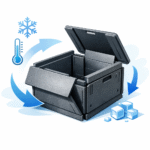
A strong insulated mailer bag trade strategy in 2026 starts with one idea: you are buying a thermal shipping system, not just a bag. The right solution depends on lane time, Umgebungseinflüsse, Nutzlastempfindlichkeit, Kältemittelplan, outer-box fit, and the way the warehouse actually packs the order. In cold-chain trade, product choice without system thinking is where cost and failure begin.
Dieser Artikel wird antworten:
- What inputs should define mailer selection
- Which standards and tests support smarter buying
- Why food safety and sustainability now shape trade decisions
What should drive product selection first?
Start with the thermal mission. Define the product type, Zieltemperatur, expected transit time, Umgebungsrisiko, refrigerant layout, and pack-out dimensions. Only then should you compare materials or price. An insulated mailer that works for one lane may be wrong for another.
This also means qualification should cover the complete system. A strong mailer can still fail if the coolant is placed badly or the outer box leaves too much empty space.
Which technical frameworks help most?
ISTA says Standard 20 is a design and qualification process for insulated shipping containers and includes 7E thermal transport profiles. ASTM says D3103 is intended for evaluating the thermal insulation performance of distribution packaging for high-value, high-risk materials. These references are useful because they move the trade conversation from vague marketing to structured thermal validation. (Internationaler Verband für sichere Transporte)
Praktische Tipps und Empfehlungen
- For DTC food shipping: Define one core payload and one standard refrigerant layout.
- For warehouse teams: Keep pack-out instructions visual and simple.
- Zur Kostenkontrolle: Reduce void space before increasing material thickness.
Praktischer Fall: A shipper lowered total packaging cost by redesigning the pack-out around the actual payload instead of oversizing the outer carton. The result improved both freight efficiency and thermal consistency.
Why is food safety central to trade decisions?
FoodSafety.gov says shipped perishables should arrive frozen, partially frozen with visible ice crystals, or at least at refrigerator temperature of 40°F or below. The FDA’s online-delivery guidance also highlights packaging and temperature control as key risk-management issues. That means insulated mailer bag trade must be treated as a food-safety and process-control issue, not just a procurement issue. (FoodSafety.gov)
How is sustainability changing cold-chain packaging?
McKinsey’s 2025 research shows strong consumer interest in recyclability, recycelter Inhalt, and other circularity factors. In der Zwischenzeit, das PPWR der EU, which entered into force in 2025 and applies from August 12, 2026, strengthens pressure around recyclability, Abfallreduzierung, and PFAS restrictions in packaging. For mailer buyers, that means cold-chain performance must now be balanced with packaging efficiency and clearer material direction. (McKinsey & Unternehmen)
2026 insulated mailer bag trade trends
The strongest trade programs are becoming more test-driven, more operationally simple, and more aware of total packaging impact.
What is changing now
- Lane-specific qualification is becoming more common
- Better cube efficiency is now a buying priority
- Buyers want fewer pack-out variables and clearer documentation
- FAQ
- What is the first thing I should define?
- The shipping lane and thermal mission, not the mailer material.
- Why do standards matter?
- Because they help connect the product choice to a real qualification process.
What is the biggest mistake in 2026?
Adding more packaging without improving pack-out logic or validating the system.
Zusammenfassung und Empfehlung
A better insulated mailer bag trade strategy is built on thermal mission clarity, standard-aware qualification, and cleaner operational discipline. In 2026, those are the foundations of both performance and credibility.
Define one lane, eine Nutzlast, one outer-box system, and one qualification plan before scaling. That will create a stronger, leaner, and more defensible cold-chain packaging program.
Über Tempk
Tempk helps buyers develop insulated mailer systems with stronger qualification logic, smarter pack-out design, and better production control. We focus on cold-chain solutions that work in actual shipping conditions, not just in theory.