If you want to grow a thermal bag business in 2026, you need more than a broad catalog and a low price. You need a product story that makes sense to operators, a compliance story that reduces buyer anxiety, and a route story that explains how the bag actually protects what is inside. For food buyers, 41°F remains a familiar cold-holding benchmark in FDA thinking. For refrigerated vaccines and many medical products, 2°C to 8°C remains the working range many buyers know best. That means the best thermal bag business pages speak clearly about intended use, not vague “hot and cold” promises. (UNS. Food and Drug Administration)
Dieser Artikel hilft Ihnen bei der Beantwortung:
- What makes a thermal bag business commercially strong
- Which product features matter most in real routes
- How to prove compliance and reduce procurement friction
- Was 2026 rules and trends are changing buyer expectations
- How to turn a thermal bag business page into a better SEO and sales asset
What makes a thermal bag business attractive in 2026?
The best thermal bag business is built around use-case clarity. Buyers want to know what the bag is for, how long it is meant to protect the payload, which coolant pairing you recommend, and what handling limits apply. Das klingt einfach, but many suppliers still hide behind generic words like “premium insulation” or “excellent temperature retention.”
A stronger commercial position comes from choosing a clear lane. You might focus on restaurant delivery, grocery fulfillment, pharma handoff, or field healthcare. Once that lane is clear, every important decision becomes easier: Taschengröße, opening style, liner choice, reinforcement, Zubehör, und Dokumentation.
Simple buyer self-check
- Ask yourself these questions before you expand your SKU range:
- What exact temperature-sensitive product is inside the bag?
- How long is the real route, not the hoped-for route?
- How often will the bag be opened?
Who cleans it, stores it, and reuses it?
If you cannot answer those four questions, your thermal bag business is still selling bags, not solutions.
Which products and materials should you sell?
You should sell fewer products with clearer performance stories. A long catalog looks impressive, but it often slows down quoting and weakens conversion. A tighter range with better explanations usually wins. Build your product family around route types: short last-mile runs, multi-drop foodservice, controlled handoff, or premium reusable retail packaging.
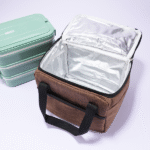
Your material stack should also follow route logic. The shell needs abrasion resistance and water resistance. The insulation core needs to slow heat movement. A reflective layer helps reduce radiant heat load. The liner needs to be easy to clean and stable over repeated use. The closure system should reduce warm-air entry and support fast handling.
Product comparison table
- Practical build tips
- Use modular sizing: standard families reduce cost and speed up repeat orders.
- Offer controlled options: two or three tested coolant pairings are better than endless guesswork.
- Prioritize closure design: a weak zipper line can erase the benefit of a better insulation core.
Praxisbeispiel: A regional prepared-meal brand improved field consistency after it stopped ordering custom bag sizes for each menu format. It moved to three standard sizes, fixed coolant positions, and a simple loading guide. Complaints dropped because the workflow got easier.
How do you prove performance and compliance?
Proof wins where claims fail. If your bag touches food or supports food pack-out, buyers may ask how the materials fit FDA food-contact pathways or EU food-contact expectations. FDA notes that food contact substances used through packaging or storage handling must be authorized through the right regulatory path, and the EU framework requires food-contact materials to remain safe and inert enough not to harm health or change food unacceptably. ISO 22000 also remains useful language for food-chain process control. (UNS. Food and Drug Administration)
For medical or pharmaceutical applications, the standard becomes stricter. EMA states that GDP sets the minimum standards needed to preserve the quality and integrity of medicines throughout the supply chain. IATA’s CEIV Pharma expands that discipline into route planning, kalibrierte Überwachung, supplier management, Dokumentation, and process control. If your thermal bag business wants higher-value buyers, this is the language you need to understand. (Europäische Arzneimittel-Agentur (EMA))
A strong proof package should include
- Product specification sheet
- Material declaration
- Intended-use statement
- Cleaning and handling guide
- Test summary or route-validation summary
- Packing and storage instructions
- Testing and qualification that matter
ISTA’s thermal standards are especially useful when a buyer wants a structured qualification story. Standard 7E uses heat and cold profiles based on real-world transport data, while Standard 20 provides a qualification process for insulated shippers. This matters because buyers are increasingly tired of marketing tests that do not resemble real shipping conditions. (Internationaler Verband für sichere Transporte)
How should you price and scale a thermal bag business?
Price for operating value, not only unit cost. A buyer does not really buy “one bag.” They buy temperature stability, Einfacher Handling, fewer spoilage events, schnellere Reinigung, lower replacement frequency, and smoother audits. If you sell only by piece price, your thermal bag business becomes easy to replace.
A better pricing conversation includes service life, expected use frequency, replacement interval, and the cost of route failure. This is especially important now because cold-chain operators still face persistent cost pressure. GCCA reported refrigerated warehouse expenses rising in Q4 2024, with labor up 4.59% and electricity up 2.30% on average nationwide. That means your buyer cares deeply about operational efficiency. (Globale Kühlkettenallianz)
Commercial scaling tips
- Standardize your top 20% of SKUs first: that is usually where your margin lives.
- Sell documentation with the bag: it shortens procurement review.
- Use pilot programs: a short field trial often closes faster than a long theoretical pitch.
- 2026 latest developments and thermal bag business trends
The market is changing in ways that directly affect the thermal bag business. The EU’s PPWR now creates a stronger packaging framework focused on recyclability, weniger Abfall, Wiederverwendungssysteme, and conformity obligations; it applies from August 12, 2026. It also pushes design choices around empty space, recyclability grading, and harmful substances. That means bag suppliers must think beyond insulation and start thinking like packaging-system partners. (EUR-Lex)
Global market pressure also supports more disciplined design. GCCA says cold-chain demand continues to grow, while McKinsey’s packaging research shows consumer and market expectations vary widely by geography. Reuse is rising because recycling alone remains limited; the World Economic Forum and UNEP argue that reuse systems are a key shift for reducing packaging leakage and building better economics. The strongest thermal bag business brands will therefore position reusable bags as operational assets, not just eco-friendly accessories. (Globale Kühlkettenallianz)
Neueste Fortschritte auf einen Blick
- More reuse pressure: longer-life bag design is becoming a commercial advantage.
- More packaging discipline: documentation and conformity readiness matter more.
- More route-based selling: buyers want scenario-fit products, not generic insulation claims.
More traceability interest: even with delayed FDA enforcement, better records and cleaner communication still help suppliers look more credible. (UNS. Food and Drug Administration)
Häufig gestellte Fragen
How many times should I use the exact term thermal bag business on a page?
Use it naturally in the title, introduction, key subheads, and summary. Then support it with related phrases such as insulated delivery bag, reusable cold chain bag, and thermal packaging supplier.
What is the fastest way to improve conversion on a thermal bag business page?
Add clearer use cases, a product comparison table, and a proof section that explains materials, Reinigung, and validation.
Should I talk about sustainability even if buyers mainly care about performance?
Ja, but do it practically. Explain reuse life, material choices, und Verpackungseffizienz. Do not let sustainability claims replace thermal performance claims.
What kind of supplier wins better buyers in 2026?
The supplier that explains the route, the proof, and the handling process clearly. Clarity lowers buyer risk.
Zusammenfassung und Empfehlung
A better thermal bag business in 2026 is built on five things: clear target markets, fewer but stronger products, route-based design, practical proof, and better reuse thinking. Buyers want to know what the bag protects, Wie es funktioniert, and how easily they can approve it. When you give them those answers early, you reduce friction and improve both ranking and conversion.
Your next step should be to rebuild your main category page around one hero promise: the right bag for the right route, backed by clear materials, better documentation, and a realistic use case.
Über Tempk
Und Tempk, we design temperature-control packaging with real operations in mind. We focus on practical construction, clearer communication, and solution fit across food, Kaltkette, and specialty transport scenarios. That helps buyers compare faster and choose more confidently.
A useful next move is to review your current thermal bag lineup and identify which three products truly deserve to lead your 2026 Strategie.