Gel Brick Pallet Shipper Design Begins With the Load
A ladrillo de gel pallet shipper cannot be created by enlarging a parcel packout and multiplying its coolant count. Pallet loads develop different conditions at the center, faces, esquinas, arriba, y base. Bricks add substantial mass, long insulation joints create heat paths, and forklift handling can move or damage the thermal components. The first question is therefore not “How many bricks?” It is whether one passive pallet enclosure is the right control strategy for the product, carril, patrón de carga útil, depósito, y destino. Only then should the team design the coolant array and qualification program.
Select the Shipping Architecture Before the Components
Pallet quantity can move in several ways, and each distributes risk differently.
One passive enclosure around a complete pallet reduces individual packouts and can keep the unit load intact through freight handling. It also concentrates product value and creates a large internal gradient. A missing panel or displaced coolant module can affect many cases.
Nivel de caso cargadores calificados placed on a pallet use more packaging and labor, but each case has its own controlled configuration. This can suit loads that divide among several receivers or have mixed temperature requirements.
An active container or temperature-controlled vehicle manages the air around the load. It may fit long, alto valor, or variable routes, provided power, equipment availability, set-up, cargando, traspaso, and recovery are controlled. An insulated pallet cover can reduce short exposure during transfers, but a cover alone is not active refrigeration and should not be expected to pull down warm product.
Compare the architectures against these questions:
Does the load remain intact at destination or break into smaller deliveries?
How narrow are the product limits, and what is the consequence of an excursion?
Are active facilities dependable at every handoff?
Can the origin condition and install a pallet quantity of coolant consistently?
What delay or customs behavior occurs on the actual lane?
Can a returnable system be recovered, inspeccionado, and repositioned?
How much payload cube and freight mass does each option consume?
The least expensive outbound quote may carry the highest qualification burden or failure exposure. Decide with Quality, ingeniería de embalaje, logística, operaciones de almacén, and procurement at the same table.
Establish a Three-Dimensional Design Basis
A pallet should be treated as a mapped unit load, not a total weight. Document case dimensions, product mass and starting condition, orientación, layer pattern, maximum stack, partial-load rules, brecha, slipsheets, tableros de esquina, material a cargar, envoltura elástica, and pallet construction. Mixed cases can store and transfer heat differently even when the pallet weighs the same.
| Design input | Decision the team must make | Why it changes the system |
|---|---|---|
| Condición del producto | Required limits, sensibilidad a la congelación, and excursion process | Both cold perimeter and warm interior positions can matter |
| Patrón de carga | Approved full, mínimo, parcial, and mixed configurations | Density and headspace change gradients and airflow |
| Viaje | Tiempo puerta a puerta, habitar, demora, y ventana de recepción | Passive cooling has finite capacity across every handoff |
| External challenge | Relevant hot and cold seasonal conditions | Large faces, roof exposure, and floor contact respond differently |
| refrigerante | Formulación, geometría, condición, cantidad, and zone layout | Many units amplify tolerance and assembly variation |
| Enclosure | Paneles, articulaciones, base, tapa, cierre, y acceso | Seams and structural features can become thermal bridges |
| Manejo | Fork entry, vibración, compresión, restricción, e inclinar | Damage can change both load safety and thermal performance |
| Escucha | Mapping plan, routine positions, device control, y revisar | A center reading rarely represents the entire pallet |
| Reutilizar | Propiedad, devolver, limpieza, reparar, y jubilación | Reverse logistics can determine cost and environmental value |
The design basis becomes the reference for engineering, pruebas, obtención, and work instructions. If partial pallets are routine, define them now. Loose filler added at the dock is not an acceptable substitute for an approved low-load configuration.
Understand the thermal zones
Corner cases can receive heat from several surfaces. Top cases may face a warm trailer roof or ramp exposure, while the base interacts with the pallet deck, fork channels, warehouse floor, and vehicle surface. Central product is buffered by surrounding cases and may change slowly. That helps only when it begins in the approved condition; perimeter coolant cannot rapidly correct a warm pallet core.
Air paths also matter. Tight wrapping, open channels, and collapsed dunnage change movement within the enclosure. Preserve any designed gap or spacer through vibration and handling. A passive pallet does not have the controlled circulation of a refrigerated chamber.
Build Coolant and Structure as One Assembly
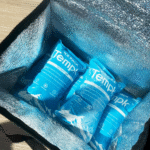
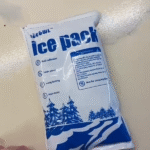
Loose bricks are hard to count and restrain at pallet scale. Bandejas, cassettes, bolsillos, or conditioned panels can group coolant into visible zones and reduce installation errors. A module should retain its contents through lifting, braking, vibración, and deconsolidation without puncturing the brick or blocking intended heat transfer.
Common layouts include side banks, a top deck, protected base modules, corner cassettes, or coolant between product tiers. Each has a trade-off. Perimeter coverage can overcool outside cases while leaving a different condition at the center. Interlayer coolant brings capacity closer to product but adds labor, stack complexity, and direct-contact risk. Base bricks require a structural deck and protection from fork damage.
Para productos sensibles a la congelación, separate product cases from deeply conditioned coolant according to the qualified design. More cooling reserve is not automatically safer. Phase-change materials or differently conditioned bricks may be considered where appropriate, but a nominal transition point does not establish uniform product temperature.
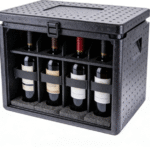
The insulation enclosure must survive freight reality. Define panel order, corner joints, door or lid closure, base interface, sujetadores, access points, correas, stretch-wrap pattern, and fork openings. Long joints, conductive frames, esquinas aplastadas, and penetrations may bypass an otherwise strong panel. Etiqueta, dispositivos de seguimiento, and document pouches should remain visible without opening the thermal boundary.
Check overall dimensions, masa, center of gravity, fork clearance, aircraft or vehicle constraints, warehouse doors, and rack compatibility. A thermally promising design that cannot be lifted safely or accepted by the carrier is not a viable shipper.
Make Conditioning and Assembly Operationally Possible
Pallet quantities turn coolant preparation into a facility process. Dense cases of warm returned bricks restrict freezer airflow and impose a large heat load. Units near the outside of a stack may reach the required state before those in the center. Verify the actual freezer, rack spacing, tamaño del lote, secuencia de carga, readiness method, recuperación, and backup plan.
Separate returned, acondicionamiento, liberado, and rejected stock. If the system uses tempered or phase-change material, define the state and staging method precisely. The first module removed during a long assembly can have a different history from the last, so qualification should include realistic build time and maximum exposure.
Design the packing area as a production cell. Stage components in installation order and use hold points before later layers hide an error. A practical record may capture:
pallet and enclosure identity and inspection;
Herramientas útiles para tomar decisiones
Comprueba los detalles antes de elegir el embalaje.
Estas herramientas rápidas pueden ayudarle a comparar el riesgo de la ruta, necesidades de dimensionamiento, opciones de refrigerante, y detalles del embalaje antes de solicitar una cotización.
Calculadora de hielo seco
Calcule las necesidades de hielo seco para envíos congelados o ultrafríos antes de empacar.
Estimar hielo secoGenerador de listas de verificación de cumplimiento
Cree una lista de verificación práctica para la revisión del embalaje, envío, y documentación.
Crear lista de verificaciónComprobador de riesgos de ruta
Revise las condiciones del carril antes de seleccionar el embalaje para requisitos operativos reales..
Comprobar riesgo de rutaapproved load-pattern revision;
product release and starting condition;
identidad del refrigerante, lote, estado, and zone count;
assembly start and finish;
monitor activation and mapped location;
cierre, correas, envoltura, sellos, dimensiones, y peso;
approved staging and carrier handover.
Use scans, fotografías, weight reconciliation, or second-person checks where risk justifies them. These controls must remain quick and clear enough for peak production. Large frozen modules may require carts, lift aids, suitable gloves, or team lifting under the site's safety process. If staff routinely bypass a difficult step, revise the design rather than relying on reminders.
Qualify Thermal and Mechanical Performance Together
Thermal studies should use the exact pallet, coolant modules, aislamiento, cierre, carga útil o simulante justificado, and load patterns. Challenge relevant hot and cold profiles, duration with a justified delay allowance, conditioning variation, and credible assembly time. Map multiple product zones instead of averaging them into one result.
Sensor positions should follow an engineering rationale and may include upper and lower corners, wall locations, juntas de paneles, top and base layers, positions near coolant, and the center. Secure and document every device. A logger on the outside reports ambient exposure; one touching a brick reports a local coolant interface. Neither automatically represents product.
Mechanical handling should be connected to the thermal risk. Fork impact, compresión, vibración, inclinación, wrap force, or panel puncture can open a seam or shift a cassette. Inspect the system after challenge and repeat thermal work where damage could change performance. A chamber study of a stationary, pristine pallet does not cover these failure paths.
Estándar ISTA 20 provides a structured process for insulated shipping-container design and qualification, while ISTA 7E is associated with parcel thermal profiles. A pallet freight or air-cargo lane may require different or additional profiles and physical-distribution methods. Use the standards, measured lane information, and product requirements appropriate to the actual distribution environment.
A useful engineering failure is a partial pallet that warms at one lower edge while some coolant remains solid. Investigation may show that unsupported filler collapsed and a side module shifted away from a base joint. The correction is stronger partial-load geometry and module retention, not necessarily more coolant. Remaining frozen material does not prove the protected product stayed within limits.
Control Handoffs, Intervención, y recibo
Map the route from product release to consignee storage. Pallet risk often concentrates during origin build-up, terminal waiting, transferencia de rampa, conexiones perdidas, aduanas, destination breakdown, cross-docking, and appointment delays. Define who monitors each stage, what controlled holding is available, and who has authority to intervene.
Opening a passive pallet to replace bricks can disturb insulation, sensores, estabilidad de carga, and the qualified array. Do not make replenishment the default plan unless a tested procedure, correct released modules, personal capacitado, and documentation exist. Moving the closed shipper into an appropriate controlled environment may be the safer response.
International healthcare cargo can involve product requirements, Good Distribution Practice expectations, IATA procedures, carrier variations, and national rules. Requirements depend on the shipment and change over time; verify the current lane rather than using a coolant component as a compliance claim. Keep gel-brick transport information separate from the classification of the payload and from dry ice requirements.
Al recibir, examine seals, envoltura, tilt indicators where used, puntas, crushed panels, cartones mojados, displaced modules, and logger status. Transfer product promptly to the approved storage condition. Product disposition after a temperature deviation belongs to the authorized quality process, not to a general visual assessment of whether bricks are still cold.
Compare Proposals on Risk, Costo, and the Return Loop
Pallet economics include coolant, enclosure, freezer equipment and energy, mano de obra de montaje, structural materials, freight cube and weight, manejo especial, escucha, customs intervention, breakdown labor, transporte de regreso, limpieza, reparar, almacenamiento, asset downtime, and product-loss exposure. Calculate cost per protected unit and successful movement rather than cost per empty enclosure.
A reusable pallet system can work well on a stable business-to-business lane with dense backhaul and fast turnaround. Physical durability alone does not create a return program. Track asset ownership, completed uses, pérdida, inspection rejection, refacción, limpieza, reemplazo de refrigerante, empty repositioning, and customs treatment where relevant. Periodic verification may be appropriate when degradation is not visible.
Before awarding a supplier, request full-scale drawings, component tolerances, module mass, instrucciones de acondicionamiento, structural limits, material and safe-handling information, production sample consistency, trazabilidad del lote, plazo de entrega, notificación de cambio, and the precise scope of thermal or mechanical reports. Red flags include duration without a payload or profile, a single center sensor, a parcel result scaled to a pallet, no partial-load plan, and reuse assumptions with no return cost.
Sustainability should be assessed at system level. Tamaño correcto, efficient utilization, repairable noncritical parts, reutilización confiable, and fewer product losses can reduce waste. Empty repositioning, energía helada, limpieza, and discarded high-performance materials can offset expected gains. Market-specific packaging and waste requirements should be verified before making recovery claims.
Preguntas frecuentes
How many gel bricks are required for a pallet shipper?
No safe count can be derived from pallet size alone. The required mass and distribution depend on coolant properties, acondicionamiento, insulation and joints, patrón de carga, masa térmica del producto, perfil externo, duración, and product limits. Use calculations to screen concepts, then confirm the complete array through full-scale mapped testing.
Can a gel-brick pallet system replace a refrigerated truck?
It may provide passive protection for a defined route, but it does not offer powered control or unlimited endurance. Refrigerated transport may be more practical for recurring full loads, while passive packaging can protect transfers or lanes without dependable active infrastructure. Compare door-to-door controls, contingencia, costo, and qualification rather than assuming direct equivalence.
Where should routine pallet loggers be placed?
Choose locations from qualification mapping and product risk. Development work should identify likely hot and cold product zones at faces, esquinas, arriba, base, articulaciones, and center. Routine monitoring may use fewer devices when the rationale is documented. Secure each logger so handling does not move it into contact with coolant or outside the product zone.
Can a repaired pallet shipper return directly to service?
It depends on the repair. Replacing an external protector may have little thermal effect, while patching insulation, changing a coolant cassette, or altering a closure may affect the qualified state. Use approved parts and procedures, document inspection, and perform focused or full verification according to risk before release.
Scale the Evidence With the Product Value
A dependable gel brick pallet shipper begins with the correct architecture and a defined three-dimensional load. refrigerante, aislamiento, estructura, capacidad del congelador, asamblea, manejo, escucha, and lane controls must operate as one system. Map the hot and cold zones, challenge physical damage, and preserve the approved build through visible work instructions and change control.
Before final thermal qualification, conduct a full-size dry build with production-intent components. Time it, pesarlo, lift it, move it, inspect every joint, and let the receiving team practice breakdown. That exercise often finds expensive problems while they are still easy to correct.
Acerca de Tempk
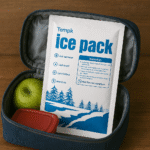
We provide rigid ladrillos de hielo, paquetes de gel, cubiertas de paletas aisladas, revestimientos de cajas, bolsas aisladas, Cajas EPP, cajas de envío frías, and water-injection packs for embalaje de cadena de frío. Tempk can discuss coolant geometry, insulated components, and case-level alternatives from a buyer's pallet drawing, carril, y necesidades de manejo. Because pallet performance depends on the complete assembly, buyers should establish the final configuration through appropriate thermal and mechanical qualification.
Send Tempk the pallet footprint, altura, case map, full and partial payload patterns, condición requerida del producto, lane stages, handling equipment, capacidad de acondicionamiento, necesidades de seguimiento, pronóstico, y plan de regreso. Request production-intent components for a full-scale design study before commercial release.