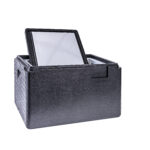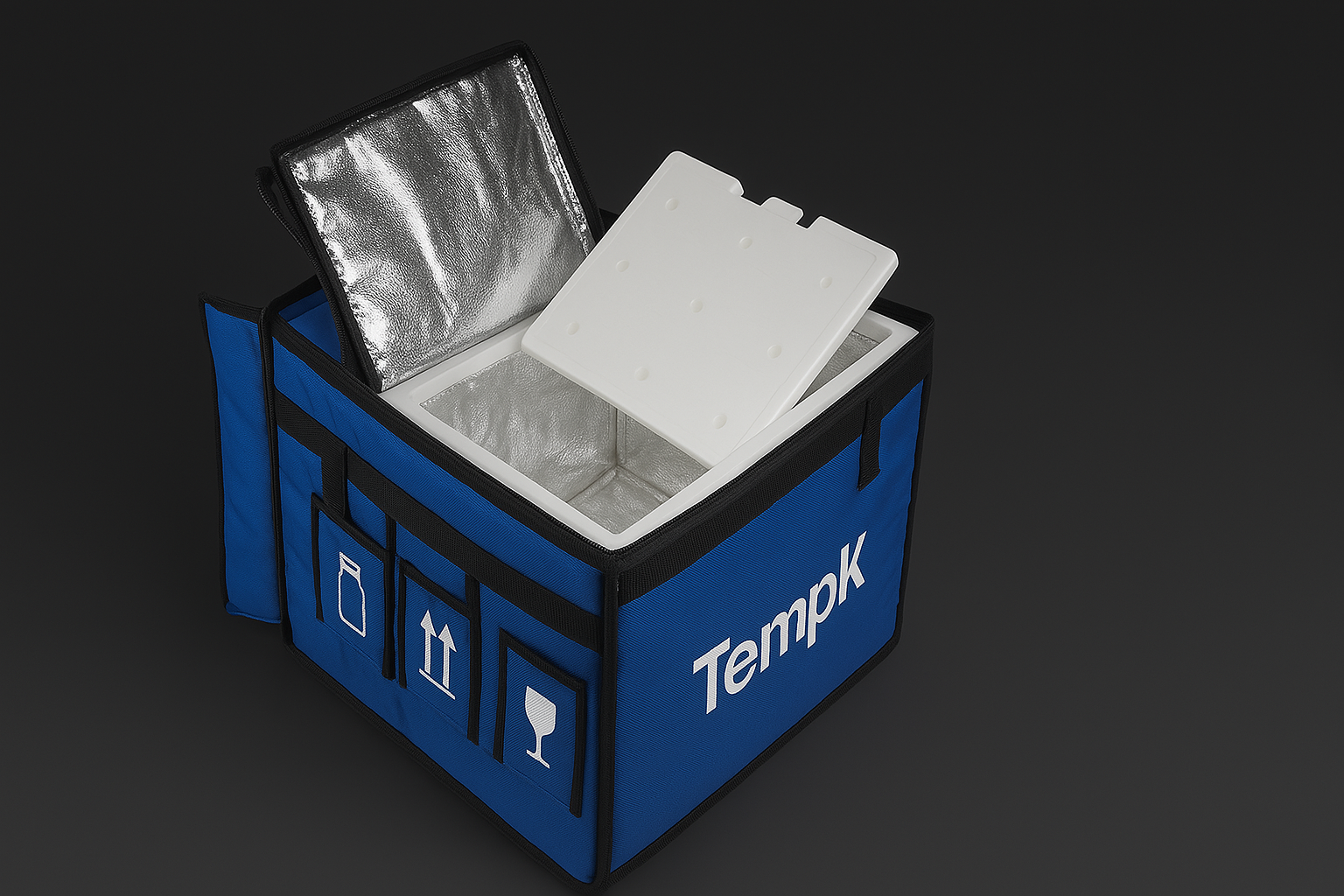
Contenedor de envío térmico VIP para protección de carga útil: From Product Risk to an Approved Packout
The right VIP contenedor de envío térmico for payload protection is a complete arrangement that preserves the goods' required temperature, condición física, and identification through the intended service. Vacuum insulation alone cannot establish those outcomes. Buyers should first define what makes the payload acceptable, then design the interfaces around it, require relevant thermal and handling evidence, and confirm that dispatch and receiving teams can reproduce the process. This approach also creates a sound basis for comparing customization, consistencia de producción, and reuse without relying on unsupported hold times or treating every producto sensible a la temperatura as the same application.
Make the product's acceptance criteria the purchasing brief
Begin at the destination. The receiver needs usable goods, not simply a cold container. Ask the product owner which conditions would require rejection, investigación, or a hold. Temperature may be central, but package integrity, orientación, fuga, contaminación, readable identification, or damage to a functional feature may also matter.
Write these conditions separately. A single statement such as protect the payload is too broad to evaluate. Separate the thermal requirement from mechanical and other requirements so that each has an owner and an appropriate evidence source. This also prevents a successful temperature trial from obscuring an unresolved handling problem.
Use the product's documented requirements rather than adopting a familiar industry range. Kits de diagnóstico, productos alimenticios, materiales biológicos, and industrial goods are not interchangeable temperature classes. Some applications may also involve specific transport or containment rules. The responsible technical or compliance team should determine what applies to the actual contents and route.
Describe the primary package accurately. Record its real dimensions, sensitive features, orientación requerida, and any restriction on contact or modification. Removing a carton or rearranging a product to improve fit may alter protection that the cargador térmico was never intended to provide. Obtain product-owner approval before changing that layer.
A hypothetical example makes the distinction clear. A fragile cartridge shipment could remain within its thermal requirement while connectors become damaged by movement inside the insert. Adding more coolant would not resolve that failure. The brief needs an intact-product criterion and a design that controls the relevant contact and forces.
Finalmente, define the intended service and operating range. Identify supported order sizes, condiciones de la ruta, manejo, and destination capabilities. A box selected without those boundaries cannot be meaningfully compared with another proposal because the suppliers may be solving different problems.
Design the interfaces that determine real protection
A VIP panel helps restrict heat transfer through its evacuated structure. The complete shipper adds joints, a lid, protective layers, refrigerante, and a payload arrangement. These parts interact, so the design should be reviewed as an assembly rather than as a collection of independently attractive components.
Pay attention to where the payload meets other materials. A separator may reduce coolant contact but also change thermal response. A restraint may limit movement but concentrate force over a fragile feature. A liner may contain liquid while changing moisture behavior. Each interface should have a defined function and be evaluated for that function.
Protect the insulation itself. Panel barriers should not be cut, perforado, or exposed to unsuitable contact during loading. Provide designed clearance from sharp edges and a supported arrangement for sensors or other accessories. A protective shell is valuable when it helps preserve the function of the inner system, not just its appearance.
Verify usable space after every required component is installed. incluir refrigerante, inserciones, revestimiento, and monitoring equipment where relevant. The empty chamber's volume does not establish how many primary packages can be loaded correctly. Review the actual arrangement with representative product packaging before finalizing dimensions.
Loading and unloading should both be considered. Operators need enough access to place the goods without forcing them against the insulation or coolant. Receivers need a removal sequence that does not pull on fragile features or overturn the remaining contents. Ease of use is a protection issue when awkward handling can damage the payload.
Partial loads require a defined arrangement. Less product can change thermal mass, movimiento, and available space. Do not let a full-load qualification become an invitation to ship any smaller order with arbitrary filler. Identify the supported range and the approved way to handle exceptions.
Ask for evidence in the order the risks arise
A performance claim should connect to the purchasing brief. Begin by checking whether the report describes the same container, refrigerante, carga útil, and preparation as the quotation. Then review whether the exposure and measurements address the intended use. Only after that does a pass result become useful.
| Pregunta de aprobación | Pruebas a examinar | Razón para hacer una pausa |
|---|---|---|
| Is the configuration identifiable? | Component list, disposición, y versión | The tested sample differs from the proposal |
| Is the thermal requirement addressed? | Exposure profile, mapa de sensores, and full results | Only a generic duration or central reading is supplied |
| Is the payload physically protected? | Relevant loaded-unit assessment | Evidence concerns an empty shell or unrelated load |
| Can the process be reproduced? | Preparation and packing instructions | Success depends on undocumented intervention |
| Are production changes controlled? | Inspection and notification arrangements | Substitutions can occur without technical review |
The table is intended to structure a purchase decision, not prescribe the same testing program for every product. Use it to identify which question is still unanswered. A supplier's honest explanation of a gap can be more useful than a broad claim that appears to cover everything.
Thermal testing should describe external exposure, condiciones iniciales, preparación de refrigerante, disposición de carga útil, measurement locations, y criterios de aceptación. Read the complete traces where appropriate. A final temperature or single duration statement may hide important differences between locations or omit the conditions under which the result was obtained.
Mechanical and distribution evidence has a different purpose. ASTM D4169 addresses shipping-unit performance under distribution hazards; thermal methods such as ASTM D3103 address package insulation performance. The applicable method should match the service, with scope selected by a competent team. Mentioning a standard does not establish universal qualification or hazardous-material compliance.
Consider how handling can affect later thermal behavior. A displaced insert, obstructed lid, or damaged panel protection may change the system. The evaluation plan should examine relevant interactions rather than treating every test as an isolated event on a pristine package. The appropriate sequence depends on the actual risks.
Substitute payloads need an explanation. Matching total weight does not automatically reproduce thermal response, mass distribution, contacto, or fragility. A development surrogate may be appropriate for one question but not another. Identify the remaining checks needed with actual product packaging before approving routine use.
Prove the preparation process at the dispatch site
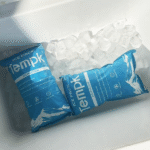
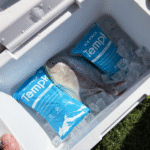
Coolant is a controlled component, not a generic accessory. Its identity, cantidad, preparación, and placement should match the supported arrangement. Paquetes a base de agua, other PCMs, y hielo seco are different options with different implications. Select among them using the payload's requirements, not the assumption that colder means better.
Review conditioning capacity before adopting the design. The dispatch site needs suitable equipment, espacio, and a way to distinguish prepared inventory from material still being conditioned. A laboratory process may not be practical at routine volume. Where the operating method changes, assess the impact before relying on the original result.
Herramientas útiles para tomar decisiones
Comprueba los detalles antes de elegir el embalaje.
Estas herramientas rápidas pueden ayudarle a comparar el riesgo de la ruta, necesidades de dimensionamiento, opciones de refrigerante, y detalles del embalaje antes de solicitar una cotización.
Resistencia a la caída del material aislante
Revise la resistencia a caídas y los factores de manipulación antes de elegir materiales aislantes..
Comprobar resistenciaCalculadora de bolsa de hielo
Estimación de la cantidad de bolsas de hielo en gel para envíos refrigerados y planificación práctica de rutas.
Estimar las bolsas de hieloComprobador de riesgos de ruta
Revise las condiciones del carril antes de seleccionar el embalaje para requisitos operativos reales..
Comprobar riesgo de rutaThe product's starting condition is equally important. A passive VIP package should not be assumed to perform the work of a product-cooling system. Establish the starting state through the approved product process and account for staging before closure. Uncontrolled preparation can consume the protection that was intended for the journey.
Packing instructions should make component selection clear. Similar-looking inserts or paquetes de refrigerante can create mistakes when several variants share a work area. Use identifiers and an approved configuration reference that operators can follow. Define a stop-and-review action for missing components or an order outside the supported range.
Dry ice requires an additional review where proposed. The cargo package needs an appropriate gas-release arrangement, and current transport, transportador, manejo, and product-compatibility requirements must be addressed. The vacuum sealed inside a VIP panel is distinct from the cargo atmosphere. Do not modify panels or closures after evaluation to improvise a vent.
A practical process trial should use representative staff and equipment. Record hesitation, rehacer, and any special intervention by the development team. These observations can reveal that the design needs clearer instructions or a simpler arrangement before it is ready for scale. Do not hide them behind a successful temperature chart.
Define receiving, escucha, and exception ownership
Monitoring records evidence; it does not provide thermal protection. Select the device and measurement location according to the product risk and the decision it must support. Review operating range, calibration needs, acceso a datos, and how records will remain associated with the shipment and configuration.
Distinguish qualification measurements from routine monitoring. Qualification may need several locations to understand limiting conditions. Routine monitoring can use an approach justified by that understanding and the quality process. A convenient central logger should not automatically be treated as proof of every item's condition.
The receiver needs a defined sequence. Transfer goods to the appropriate environment, preserve relevant records, inspect according to the product procedure, and escalate questionable conditions to the responsible function. Exact steps vary by application, but delivery confirmation alone does not establish product acceptance.
An alert needs an owner. Identify who can act during transit or at receiving and which actions are actually supported. Do not assume that a connected device guarantees intervention, especially on a service where the shipment cannot be accessed safely or promptly. Plan the route to work within its supported conditions rather than relying on rescue.
Cuando algo sale mal, preserve context. The investigation should know the payload, container version, refrigerante, preparación, ruta, and available observations. Avoid making a release decision from a current temperature alone, because it does not reconstruct previous exposure. The product owner's established process should govern disposition.
Clear responsibility also supports improvement. Procurement can address component consistency, operations can correct packing deviations, and logistics can review service failures. Without that separation, organizations may repeatedly change the box to solve problems caused elsewhere in the process.
Approve production and reuse on the same technical basis
The selected sample should become a controlled production reference. Identify the dimensions, componentes, interfaces, and work instructions that matter to performance. Ask how the supplier checks those characteristics and communicates changes. A shared product name is not enough to establish that every delivered unit matches the evaluated version.
Customization should solve a stated constraint. A revised chamber, tapa, coolant compartment, or insert may improve fit or operation, but it can also change the evidence basis. Review the effect before approval. Cosmetic continuity does not make a technically changed package equivalent to the original.
Para reutilizar, define the route back to ready inventory. Returned assets may need cleaning, el secado, inspección, correct reassembly, reparar, o jubilación. Distinguish uncertain or damaged components from approved stock. A clean exterior does not prove that a panel or closure retains its intended function.
Compare costs and environmental effects only after candidates meet equivalent protection requirements. incluir preparación, embalaje, freight effects, receiving work, regresa, limpieza, reparar, y perdida. Use observed operating information where available and label assumptions clearly. Reusable does not automatically mean lower cost or lower impact in every network.
The final decision should be an approved packout with known boundaries, not just a selected container. A VIP thermal shipping container for payload protection earns its value when product requirements, interfaces, evidencia, and everyday execution remain connected from development through repeated shipments.
Questions that can change the purchase decision
When is a simpler insulated package a better choice?
A simpler package may be preferable when it meets the actual product and route requirements with a more manageable preparation and handling process. Compare complete configurations on equivalent acceptance criteria. VIP should address an identified constraint, such as thermal performance within a particular layout, rather than be selected solely because it is described as advanced insulation.
Can stronger restraint make a thermal packout worse?
It can change the system in ways that need review. A restraint may alter contact, espaciado del refrigerante, volumen utilizable, or force distribution. The answer depends on the actual design and payload. Evaluate the component for both its intended mechanical function and its effect on the thermal arrangement instead of assuming that tighter packing is always safer.
What should be checked when a supplier changes a component?
Determine whether the change affects fit, comportamiento térmico, mechanical protection, preparación, limpieza, o identificación. Compare the new component with the controlled configuration and assess whether existing evidence remains applicable. The required review should follow the significance of the change, but notification should occur before an unapproved substitution becomes routine supply.
Does an undamaged container prove an undamaged payload?
No. The exterior provides useful handling information, but the payload may experience movement, localized contact, humedad, or thermal exposure without obvious shell damage. Receiving checks should follow the product's approved criteria and available evidence. The shipping design should also identify internal vulnerabilities so that protection does not depend on exterior appearance alone.
Acerca de Tempk
Y tempk, we bring VIP insulation, opciones de refrigerante, and configurable payload layouts into the same packaging discussion. Those capabilities are most useful when the product's vulnerable interfaces and the route requirements are clearly defined. Share the actual primary package and supported order range so the proposed arrangement can be assessed as a complete system. Confirm its evidence, preparación, and production details before treating the selected design as an approved solution for routine shipments.
Ask Tempk to compare suitable configurations against your payload acceptance criteria, not only a target container volume.