Décisions de vente en gros de glacières, de l'échantillon à l'échelle
A cool box wholesale decision is complete only when the buyer can answer five questions: What exactly goes inside? What conditions will the closed and opened box face? Which evidence is needed? What will each delivered unit cost to own? How will production remain consistent? Capacity and price are important, but neither protects a buyer from poor payload fit, vague thermal claims, retards de nettoyage, or undocumented material changes.
The practical route from inquiry to scale is a series of controlled decisions. Begin with an operating brief, screen constructions, normalize commercial offers, test representative units, and convert the approved result into a specification. This article shows how those pieces connect for food, vente au détail, champ, et distribution sensible à la température.
Grille 1: define the job before contacting suppliers
Write the requirement in operational language. Name the payload and its primary packaging, quantity per trip, expected starting condition, longest travel and waiting time, environnement du véhicule, nombre d'ouvertures, méthode de nettoyage, and return route. If the goods have a required temperature range, obtain it from the product owner or approved documentation. Do not substitute a familiar chilled range for a product-specific instruction.
Define capacity with dimensions. Provide the length, largeur, and height of payload cartons and packs de liquide de refroidissement, plus the required orientation. Gross liters are useful for broad filtering but not for packout approval. The lid shape, internal taper, wheel arches, paniers, séparateurs, and wall thickness can reduce usable space.
Also define the human interaction. Is the unit lifted by one or two people? Does it move on a trolley? Must it fit under a packing bench? Can staff see that the lid is latched? Is it opened at several stops? These questions expose requirements that a thermal specification misses.
A concise brief might contain three columns: requis, préféré, and unacceptable. “Interior must drain and dry under the site's normal process” is a requirement. “Brand color preferred” may be negotiable. “Unprotected brittle internal corners” may be unacceptable. This structure makes supplier trade-offs visible early.
Grille 2: select a construction family
Use the brief to choose a shortlist rather than browsing every model. A foam-only EPP box may suit a lightweight reusable route where its surface and cleaning method are acceptable. A rigid plastic shell can offer impact protection and a smooth liner. A VIP-enhanced design may preserve payload volume when wall space is constrained, but panels must be protected and system performance verified. Glacières médicales may provide geometry intended for defined coolant arrangements, yet the complete packout still needs application review.
| Decision condition | Construction direction to explore | Do not assume |
|---|---|---|
| Frequent knocks and vehicle handling | Protected rigid shell or resilient molded construction | Material name guarantees drop performance |
| High reuse with daily washing | Accessible interior, compatible surfaces, replaceable seals | “Washable” defines a sanitation process |
| Tight external size with demanding thermal target | High-performance or hybrid insulation | Thin wall proves a duration |
| Lightweight manual carrying | EPP or other mass-efficient design | Low empty mass means safe loaded handling |
| Controlled medical shipment | Defined passive system with coolant positions | Generic cooler is qualified for every product |
| Brand activation or retail display | Existing mold with controlled color and graphics | Custom appearance has no MOQ or lead-time effect |
The purpose of the table is to direct questions, not choose the product automatically. Demander des dimensions internes et externes, component description, dessins, déclarations matérielles, liste d'accessoires, and representative samples. Examine the complete box at corners, interfaces du couvercle, handle attachments, gasket channels, and drain details.
Treat terms such as HDPE, mousse à haute densité, qualité alimentaire, robuste, and long hold time as starting points. Each needs a definition tied to the actual unit. Food-contact compliance depends on the exact substances and intended conditions, while thermal duration depends on the complete configuration and test.
Grille 3: decide what proof is proportionate
Proof should match consequence. A cooler for sealed drinks at a company picnic does not require the same package as a regulated medicine. Néanmoins, every purchase benefits from accurate drawings, identification du matériau, critères de fabrication, and functional samples.
Pour contact alimentaire direct, request evidence applicable to the material, colorant, composant, marché, type de nourriture, et conditions. NOUS. FDA information makes clear that regulatory status depends on the substances and authorized use. EU plastic food-contact controls include composition and migration requirements. A broad certificate with no connection to the ordered model may not answer the buyer's question.
For temperature-critical shipments, evaluate the passive system: récipient, isolation, charge utile, liquide de refroidissement, conditionnement, arrangement, fermeture, et mode d'emploi. A useful report identifies the ambient profile, capteurs, étalonnage, critères d'acceptation, sample configuration, et les résultats. ISTA 7E can support thermal transport testing for parcel environments. WHO guidance also addresses qualification and monitoring for time- et médicaments sensibles à la température. These references support disciplined testing; they do not create a universal claim.
Ask what the evidence proves and what it does not. A material report does not establish a hold time. A chamber result does not prove performance after uncontrolled lid openings. A thermal qualification does not establish food-contact status. A quality-system certificate does not confirm that every unit meets lid-fit tolerances.
Grille 4: normalize cost before negotiating
Price discussions are productive only after suppliers quote the same scope. Create a bid sheet that separates the base container, lid and gasket, paniers, séparateurs, liquide de refroidissement, impression, emballage individuel, cartons d'exportation, palettes, outillage, échantillons, essai, et pièces de rechange. State the trade term and destination so freight and duties can be added consistently.
Unit cost changes with quantity, but MOQ is not purely a production issue. Custom pigment, printed decoration, purchased hardware, conditionnement, and resin batch sizes may each create a different minimum. Ask which element controls the threshold and whether a standard color or label can reduce it.
Landed cost should include cube. External and packed dimensions determine freight, espace d'entrepôt, and route capacity. Pour les programmes réutilisables, include washing labor, water and energy where material, espace de séchage, fret de retour, perte, réparation, et stock de sécurité. Do not credit an assumed number of reuses before a pilot demonstrates recovery and condition.
Imagine two suppliers. Supplier A offers a lower unit price but ships fully assembled coolers with poor pallet density and no replacement gaskets. Supplier B is slightly higher but provides a protected nesting method, matériel remplaçable, and stable repeat-order documentation. The winning offer depends on freight, use life, and downtime, not the first line of the quotation.
Negotiation should focus on cost drivers. Ask whether existing molds, shared components, standard colors, consolidated accessories, or staged releases can reduce risk. Avoid removing a gasket, coolant retainer, or inspection step merely to hit a target price without assessing the operational effect.
Grille 5: pilot the whole work cycle
Approve neither a rendering nor one hand-finished sample. Obtain representative units and run them through receiving, stockage, chargement, levage, transport, ouverture, déchargement, lavage, séchage, et retour à vide. Include different operators and realistic payload mass.
Outils de décision utiles
Vérifiez les détails avant de choisir l'emballage
Ces outils rapides peuvent vous aider à comparer le risque d'itinéraire, besoins de dimensionnement, choix de liquide de refroidissement, et les détails de l'emballage avant de demander un devis.
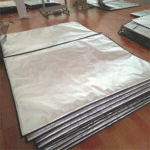
Doublure de boîte & Dimensionnement des couvertures de palettes
Vérifiez la logique de dimensionnement du revêtement de boîte et du couvercle de palette pour les projets d'emballage isotherme.
Dimensionnement estiméVérificateur de risque d'itinéraire
Examinez les conditions des pistes avant de sélectionner l'emballage en fonction des exigences opérationnelles réelles..
Vérifier le risque d'itinéraireGénérateur de liste de contrôle de conformité
Créer une liste de contrôle pratique pour l'examen des emballages, expédition, et documentation.
Construire une liste de contrôlePendant le pilote, measure or observe:
- payload fit and packing errors;
- time to load and confirm closure;
- carrying posture and handle comfort;
- vehicle stacking and restraint;
- lid behavior during repeated stops;
- fuite, drainage, and retained water;
- cleaning effort and odor;
- label visibility and scan success;
- surface damage and hardware loosening;
- empty return space and recovery rate.
Temperature-sensitive applications need an approved test protocol and suitable monitoring. Use realistic ambient and opening conditions where relevant, control coolant conditioning, and assess results against product-specific criteria. Freeze-sensitive vaccines illustrate why “colder” is not always safer; applicable program guidance and packout instructions must control coolant selection and placement.
A pilot should deliberately seek weaknesses. Load the least convenient common carton. Test a nearly empty multi-stop condition. Wash the unit repeatedly. Inspect the lowest box in a transport stack. These conditions reveal whether the design is robust beyond the ideal demonstration.
Document decisions and open issues. A pilot failure does not always mean discarding the model. It may show that a basket, closure indicator, revised label, or work instruction solves the problem. Any material change to the thermally evaluated configuration, cependant, needs a formal impact assessment.
Grille 6: turn the approved sample into a controlled product
The master specification should identify the model and revision, dessins, matériaux approuvés, couleur, dimensions critiques, liste des composants, workmanship limits, étiquettes, conditionnement, and inspection methods. Store an approved sample under controlled conditions and define how it is used for appearance comparison.
Create a defect classification suited to the operation. A sharp interior edge, nonfunctional latch, contaminating odor, or missing traceability code can be more serious than a small cosmetic mark. Define sampling and escalation. Receiving staff should know what to quarantine and what evidence to photograph or retain.
Change control protects the approved result. Require supplier notification before changes to resin, contenu recyclé, pigment, mousse, VIP arrangement, joint, adhésif, matériel, moule, processus, source de composants, ou lieu de production. The buyer should decide whether a drawing review, document update, fit check, essai de nettoyage, ou une requalification est nécessaire.
For fleets, plan parts and retirement. List replaceable components and inspection intervals. Define when cracks, dommages au joint, odeur, distorsion, or untraceable repairs remove a unit from service. If a box supports a qualified shipping process, the return-to-service decision should follow the relevant quality procedure.
Grille 7: manage performance after launch
Supplier approval is not the end. Track defects by lot, modèle, et itinéraire. Record loss, cleaning turnaround, réparations, payload complaints, and packout deviations. Review whether the box still matches the network as products, véhicules, and customer stops change.
Use data to separate product, processus, and network causes. A temperature event may result from incorrect coolant conditioning, a long customs delay, ouvertures répétées, fermeture incomplète, or damaged insulation. A cracked handle may reflect overload, attachment design, ou une manipulation brutale. Good investigation avoids automatically blaming either the user or supplier.
Schedule periodic checks based on risk. These may include visual condition, dimensions critiques, fonction de fermeture, gasket inspection, lisibilité de l'étiquette, and performance verification. A stable program also controls packing instructions: des photos, diagrammes, état du liquide de refroidissement, orientation de la charge utile, and closure steps should remain aligned with the approved configuration.
Sustainability reporting should use measured fleet facts. Track completed trips, récupération, réparation, perte, reverse-logistics distance, et parcours de retraite. Material recyclability in theory is not the same as a local collection and processing path. Honest measurement supports better design decisions on the next purchase.
Questions fréquemment posées
How many wholesale cooler samples should a buyer test?
Il n'y a pas de numéro universel. One sample can screen fit and basic usability, but it cannot reveal production variation. Use multiple representative units for a pilot, with the number and tests based on order size and consequence of failure. Critical thermal work may require a formal protocol and repeated runs defined by qualified personnel.
Is nominal capacity enough for a quotation?
Non. Provide payload and coolant dimensions, orientation, and required quantities. Ask for usable internal dimensions and a packout drawing. Nominal liters may include spaces that cannot accept the payload or may be consumed by baskets, séparateurs, murs effilés, and cooling components.
What is the difference between an insulated box and a qualified shipper?
Un boîte isotherme is a component or container that slows heat transfer. UN expéditeur qualifié is a controlled system whose specific box, liquide de refroidissement, charge utile, préparation, arrangement, and test conditions have been documented against acceptance criteria. Qualification applies to the defined configuration, not every possible use of the box.
Can custom branding be added after thermal approval?
Often cosmetic labels or printing have little thermal effect, but the change still needs review. Thick plates, shell modifications, couleurs sombres, embedded tags, new adhesives, or altered surfaces can affect handling, nettoyage, or heat exposure. Use change control to determine whether document review or testing is necessary.
Which price should procurement report internally?
Report at least the factory unit price, landed acquisition cost, and expected operating cost under stated assumptions. Pour des flottes réutilisables, show return, nettoyage, perte, réparation, and safety-stock assumptions. This prevents a low purchase price from being mistaken for the lowest-cost program.
Conclusion
Wholesale success comes from passing each decision gate with enough evidence. Define the payload and route, shortlist complete constructions, set proof requirements, compare normalized landed cost, and pilot the whole operating cycle. Then lock the approved configuration into specifications, inspection, et changer de contrôle. Managing the fleet after launch closes the loop and makes the next order better informed.
À propos du tempk
Tempk, associé à Shanghai Tempk, fournitures emballage chaîne du froid categories including plastic and Boîtes EPP, glacières médicales, Options d'isolation liées au VIP, et choix de liquide de refroidissement. These categories can support different balances of payload space, manutention, réutilisation, et conception thermique. Tempk's role in a procurement discussion is to help identify relevant configurations and inputs; the buyer should still align evidence, emballage, and qualification with the particular product and distribution lane.
CTA: Send Tempk your operating brief, dimensions de la charge utile, destination, volume de commande, and evidence requirements to build a comparable wholesale proposal.