Mis à jour 30 Décembre 2025
La chaîne du froid déplace les vaccins, fruits de mer et kits de repas à travers les continents tout en les gardant au froid. Un PPE isolé robuste et résistant aux produits chimiques (Polypropylène expansé) box is the workhorse behind this supply chain. These reusable containers can keep vaccines between 2–8 °C or frozen foods at –18 °C for up to 72 heures, and hybrid designs with vacuum insulated panels extend performance to 96 heures. Because the boxes are lightweight, chemically inert and reusable hundreds of times, they offer better protection and sustainability than disposable foam coolers. This guide explains the material science, avantages, critères de sélection et 2025 trends to help you choose the right solution.
Cet article répondra:
What is a chemical resistant heavy duty insulated EPP box?
How does chemical resistance improve safety and durability?
Which industries benefit most from these boxes in 2025?
Comment sélectionner, pack and maintain an EPP box to maximize reuse?
What are the latest trends and innovations shaping EPP packaging in 2025?
What Is a Chemical Resistant Heavy Duty Insulated EPP Box?
Polypropylène expansé (PPE) is a closed cell bead foam known for its exceptional strength to weight ratio, résistance aux chocs, thermal insulation and energy absorption. Contrairement au polystyrène fragile, each polypropylene bead traps air inside a sealed cell, giving the foam resilience and low thermal conductivity. According to the British Plastics Federation, EPP provides outstanding energy absorption, résistance aux chocs multiples, buoyancy and water and chemical resistance, and the material offers a high strength to weight ratio and 100 % Recyclabalité. Densities can range from 15 à 200 grams per litre and are molded into strong, lightweight shapes.
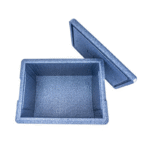
UN chemical resistant heavy duty insulated EPP box is a reusable container made from this foam. Its sealed cells block heat transfer and absorb impacts, while the polypropylene chemistry resists oils, acides, solvents and alkaline solutions. Industrial tests rate EPP as “good” against chemicals like acetic acid, acetone and sodium hydroxide. The material remains stable from –40 °C to +110 °C and melts only above 160 °C, allowing sterilization with hot water without deformation. With less than 0.3 % moisture absorption and the ability to bounce back after repeated impacts, a well built EPP box can withstand 500 réutiliser les cycles.
Core Material Properties and Chemical Resistance
EPP combines several properties that make it ideal for cold chain packaging and chemical resistant service:
| Propriété | Preuve | Pourquoi ça compte |
| Impact and energy absorption | EPP’s closed cell structure provides excellent energy absorption and multiple impact resistance. | Prevents damage from drops or vibrations during transport and extends the box’s lifespan. |
| Isolation thermique | The foam traps air in each bead, resulting in low thermal conductivity and the ability to hold temperatures from −40 °C to +110 °C. | Keeps vaccines within 2–8 °C or frozen seafood at –18 °C for 72 hours and up to 96 hours with hybrid panels. |
| Chemical resistance | Polypropylene chains resist swelling or degradation when exposed to oils, greases, acids and solvents. Tests show good resistance to acetic acid, acetone, alkali and acids. | Protects shipments from spills and contamination, especially for pharmaceuticals and food. |
| Résistance à l'humidité | EPP’s non porous surface absorbs less than 0.3 % humidité. | Maintains insulation even in humid conditions and prevents microbial growth. |
| Réutilisabilité & Recyclabalité | The foam’s resilience allows 500 or more reuse cycles. Le PPE est 100 % recyclable and can be reprocessed without significant performance loss. | Reduces total cost of ownership and supports sustainability programs. |
| Lightweight strength | Densities of 15–100 kg/m³ mean EPP offers high strength at low weight, providing a high strength to weight ratio. | Lowers shipping costs and improves handling. |
How does this help you? If you ship sensitive products that must stay cold while withstanding rough handling, a heavy duty EPP box delivers peace of mind. Its chemical resistance prevents leaks from degrading the foam and contaminating contents, while the insulation keeps goods within required temperature ranges. Because the box can be cleaned and reused hundreds of times, you recover your investment quickly compared with disposable coolers.
Production and Material Science in Simple Terms
EPP starts with tiny polypropylene beads infused with a blowing agent. These beads are pre expanded with steam like popcorn, aged to stabilize internal pressure and then molded under heat and pressure. During molding, the beads fuse without glue to form a solid foam block. You can imagine thousands of miniature balloons welded together—the trapped air provides insulation and cushions shocks. The resulting foam is flexible yet strong and maintains its shape after repeated impacts. Because it’s thermoplastic, the material can be remelted and recycled at end of life【447297896061516†L213-L214】.
EPP’s closed cell structure also means it does not absorb water. Traditional foams such as expanded polystyrene (PSE) crack and crumble after a few impacts, but EPP rebounds. Its temperature resilience (–40 °C à +110 °C) allows you to transport both frozen and hot goods. When sterilizing the box, you can use hot water because the material does not soften until around 160 °C. These characteristics combine to create a container that is chemical resistant, durable and safe for food contact.
Conseils pratiques et suggestions
Match wall thickness to journey time: Pour les voyages sous 24 heures, a standard EPP box with gel packs may suffice. For 48–72 hour journeys, choose a box with walls at least 1.5 inches thick and consider adding dry ice or vacuum insulated panels (Vips). Hybrid EPP/VIP systems can extend hold times beyond 96 heures.
Pré-refroidir tout: Chill your products, refrigerants and the box itself before packing. Fill void spaces with additional gel packs to minimize air circulation.
Utiliser des capteurs: Attach a temperature logger or Bluetooth sensor to track conditions during transit. This helps with regulatory compliance and provides data for continuous improvement.
Nettoyer après chaque utilisation: Because EPP’s surface is non porous and chemical resistant, it is easy to clean with mild detergent. Inspect for cracks and track the number of reuse cycles.
Exemple du monde réel: A pharmaceutical distributor switched to EPP boxes and eliminated vaccine spoilage, reducing annual losses from USD 1.2 million to zero over 18 mois. The company tracked each container’s usage and sanitized them between shipments, demonstrating the return on investment.
Which Industries Benefit from Chemical Resistant EPP Boxes?
Heavy duty EPP boxes are used across pharmaceuticals, nourriture & boisson, commerce électronique, electronics and automotive packaging. Their ability to maintain narrow temperature ranges, resist chemical contamination and absorb impacts makes them versatile. Let’s look at how different sectors use them and how you can apply them.
Applications spécifiques à l'industrie
| Industrie | Exigences clés | How a chemical resistant EPP box helps | Conseil pratique |
| Médicaments | Maintain 2–8 °C and comply with Good Distribution Practice (PIB). Prevent contamination from spills. | Holds temperature for 72–96 hours with gel packs or VIP inserts; integrates Bluetooth or RFID sensors for real time monitoring; resists moisture and chemical spills, preserving sterile conditions. | Pour les essais cliniques, choose hybrid EPP/VIP boxes and attach Bluetooth loggers to track excursions. |
| Nourriture & Commerce électronique | Keep food below 4 °C; minimiser les déchets; maximize delivery efficiency. | Insulates for up to 72 heures; foldable or stackable designs save space; moisture resistant surfaces prevent condensation. | Pour les kits repas, use stackable or foldable boxes and pre cool gel packs. Fill void spaces to reduce air circulation. |
| Électronique & Automobile | Protect sensitive equipment from shocks, huiles et solvants; réduire le poids d'expédition. | EPP absorbs impacts and regains shape; chemical resistance shields components from oils. | Custom mould internal inserts for electronics and clean boxes after each trip to remove oily residue. |
Pourquoi c'est important pour vous: If you operate in any of these sectors, chemical resistant EPP boxes reduce losses from temperature excursions, spills and breakage. Because they are reusable and lightweight, they also lower shipping and replacement costs. In pharmaceuticals and food, regulators require temperature stability and hygiene; EPP boxes help you meet those standards. In electronics and automotive, the foam’s energy absorption and chemical resistance protect high value components from shocks and oils.
Case Studies and Examples
Essai pharmaceutique: A clinical trial logistics provider switched from disposable EPS coolers to hybrid EPP/VIP boxes with Bluetooth sensors. The real time data allowed them to intervene before any temperature excursions, garantir la conformité et la sécurité des patients.
Meal kit delivery: An online grocery retailer used foldable EPP boxes to deliver meal kits. The collapsible design reduced return shipping volume by 40 %, and moisture resistance prevented condensation from damaging labels.
Electronics shipping: A tech manufacturer created custom EPP inserts for circuit boards. The lightweight design cut shipping costs, and the closed cell foam resisted oils used in manufacturing. Reusable boxes decreased packaging waste by 60 % over twelve months.
How to Choose and Maintain a Heavy Duty EPP Box
Selecting the right EPP box depends on shipment duration, fragilité du produit, return logistics and regulatory requirements. Here’s a simplified decision guide to help you determine the best configuration for your needs:
Quick Selection and Maintenance Guide
| Selection Criterion | Choix recommandé | Pourquoi ça compte | Self Assessment Question |
| Durée d'expédition | • < 24 h: standard EPP box with gel packs | ||
| • 48–72 h: thick EPP box (≥1.5 in wall) with dry ice or VIP panels | |||
| • > 72 h: hybrid EPP/VIP system | Matching insulation to transit time ensures goods remain within safe temperatures. | Combien de temps votre envoi sera-t-il en transit? | |
| Fragilité du produit | Use custom shaped boxes with inserts for fragile items. | Inserts prevent movement and breakage during transport. | Does your cargo require cushioning or partitions? |
| Logistique de retour | Choose foldable or stackable boxes to reduce return volume and save warehouse space. | Collapsible designs reduce shipping and storage costs. | Do you plan to return and reuse the container? |
| Conformité réglementaire | Attach temperature loggers and ensure boxes meet cGMP/GDP standards. | Supports audits and prevents costly excursions. | Do you need to document temperature history for regulatory audits? |
| Nettoyage et réutilisation | Clean with mild detergent; inspect for damage after each trip. | Maximizes lifespan and maintains hygiene. | Is your team trained on cleaning and inspection procedures? |
Packing and Handling Best Practices
Pré-refroidir tout: Refrigerate the products, refrigerants and the box to reduce the initial heat load.
Don’t skimp on refrigerants: Use more gel packs or dry ice than you think necessary; underestimating can lead to temperature excursions.
Remplir les espaces vides: Use void fillers or additional refrigerants to minimize air flow and temperature gradients.
Sceller correctement: Assurez-vous que les loquets et les joints sont fermés. Foldable boxes may require extra attention at hinges.
Monitor and log: Attach Bluetooth or RFID loggers to record conditions during transit.
Clean and inspect: Après chaque utilisation, wash the box with mild detergent; EPP’s chemical resistance makes it easy to remove residues.
Auto-évaluation interactive
To help you choose the right EPP box, répondez aux questions suivantes:
- How long is your shipment in transit? (UN) <24 h (B) 24–48 h (C) 48–72 h (D) >72 h
- Are your products fragile or contain liquids that could spill? (Y/N)
- Will you return and reuse the container multiple times? (Y/N)
- Do regulations require you to record temperature throughout the journey? (Y/N)
- Do you have facilities to clean and sanitize containers after use? (Y/N)
Basé sur vos réponses, refer back to the selection table: choose thicker boxes and hybrid systems for longer durations, custom inserts for fragile goods, foldable designs for return logistics, temperature loggers for compliance and ensure cleaning protocols are in place.
2025 Latest Developments and Trends in Chemical Resistant EPP Packaging
The EPP insulation box market is evolving rapidly as sustainability and technology converge. Archive Market Research estimates the EPP insulation box market at around US$2 billion in 2025 avec un projet 7 % compound annual growth rate to 2033. Plus largement, the global cold chain packaging market is valued at USD 34.08 milliards en 2025 and is predicted to reach approximately USD 95.31 milliards 2034 à un TCAC de 12.15 %. Another analysis projects the market to grow from USD 34.28 milliards en 2025 en USD 100 milliards 2035 (TCAC 11.3 %). Food applications account for roughly 60 % of the EPP insulation box market, while pharmaceuticals represent about 25 %. Voici les principales tendances qui façonnent 2025 et au-delà:
Aperçu des derniers progrès
Systèmes d'isolation hybrides: Combining vacuum insulated panels (Vips) with EPP foam delivers up to five days of temperature stability. This enables long haul or remote deliveries without dry ice.
Capteurs intelligents: Built in Bluetooth or RFID trackers send alerts when temperatures drift outside safe ranges, enhancing compliance and preventing spoilage.
Programmes de logistique circulaire: Take back schemes collect used boxes, clean them and remold the material into new containers. Recycling EPP reduces raw material demand and supports corporate sustainability goals.
Logistique basée sur l'IA: Artificial intelligence platforms optimize routing, predict equipment failures and enable smart labels that change color if temperature conditions are breached. AI analytics improve efficiency while maintaining product integrity.
Engagements de durabilité: Corporations pursue eco friendly, reusable packaging to meet extended producer responsibility (EPR) règlements. EPP’s recyclability and durability make it attractive for these goals.
Pression réglementaire: Stricter food safety and pharmaceutical guidelines mandate validated packaging and temperature monitoring.
Croissance du marché réutilisable: The reusable cold chain packaging market is expected to grow from USD 4.97 milliards en 2025 en USD 9.13 milliards 2034 (TCAC 6.98 %).
Aperçus du marché et tendances régionales
North America dominance: Dans 2024 L’Amérique du Nord a tenu bon 36 % du marché de l'emballage sous chaîne du froid, driven by strong demand from pharmaceuticals and processed foods. The insulated container and box segment accounted for over 58 % de la part de marché.
Fastest growing region: Asia Pacific is projected to be the fastest growing market due to rising incomes and expanding cold chain infrastructure. This region’s well established pharmaceutical industry and e commerce boom fuel adoption.
Changements de matériaux: While EPS dominated the 2024 marché, the shift toward reusable materials like EPP and VIPs indicates a long term move away from single use plastics. Companies are investing in bio based phase change materials and recyclable insulation.
Investissement et innovation: Venture capital and large logistics firms are funding startups that develop smart packaging, AI enabled tracking and subscription based rent a box models.
Points pratiques à retenir: Stay ahead of evolving regulations; integrate IoT sensors for real time visibility; partner with suppliers that offer take back schemes. These moves enhance compliance, reduce waste and signal sustainability leadership.
Questions fréquemment posées
What chemicals are EPP boxes resistant to? EPP resists oils, greases, acids and many solvents. Tests show good resistance to acetic acid, acetone and alkaline solutions, making it suitable for messy shipments and laboratory reagents.
How long can a chemical resistant EPP box maintain temperature? A standard EPP box keeps contents cold for around 72 hours with gel packs and up to 96 hours when fitted with VIP panels. Pre cooling and sufficient refrigerants extend hold time.
Combien de fois une boîte EPP peut-elle être réutilisée? A well designed EPP box can be cleaned and reused 500 or more times. Track usage and inspect for damage to maximize lifespan.
Is an EPP box safe for food and pharmaceuticals? Oui. EPP is non toxic, résistant à l'humidité et aux produits chimiques, et ne supporte pas la croissance microbienne. It can be sterilized with steam or hot water thanks to its high melting point.
Les boîtes en PPE peuvent-elles être recyclées? Le PPE est 100 % recyclable and can be reprocessed without significant performance loss. Cependant, current infrastructure recycles only about 15–20 % of post consumer EPP; take back programs improve recovery.
Résumé et recommandations
Chemical resistant heavy duty insulated EPP boxes offer a unique combination of durability, isolation et durabilité. The material’s closed cell structure provides outstanding energy absorption, thermal insulation and chemical resistance, while densities as low as 15 kg/m³ keep boxes lightweight. A single box can maintain 2–8 °C or –18 °C for 72–96 hours and endure 500 réutiliser les cycles. Because EPP is chemically inert and non porous, it resists oils, acids and solvents. Its recyclability and reusability support circular economy goals. Le marché de l’emballage sous chaîne du froid est en forte croissance (devrait atteindre USD 95 milliards 2034), and EPP’s role will expand as companies seek sustainable, isolation haute performance.
Plan d'action
Évaluez vos besoins: Déterminer la durée de l'expédition, fragilité du produit, regulatory requirements and return logistics. Use the selection table to choose the right wall thickness, inserts and hybrid systems.
Investissez dans des capteurs: Incorporate Bluetooth or RFID trackers to monitor temperature and location in real time, helping you comply with GDP/CGMP regulations and avoid spoilage.
Implement reuse programs: Faire le ménage, inspect and track each box after use. Consider folding or stackable designs to reduce return shipping volume.
Préparez l'avenir: Stay informed about upcoming packaging regulations and sustainability initiatives. Explore hybrid insulation, AI enabled logistics and circular programs to remain competitive.
Connectez-vous avec des experts: Work with packaging specialists to design custom inserts or hybrid EPP/VIP solutions tailored to your products. Look for suppliers who offer take back and recycling programs.
À propos du tempk
Tempk specializes in high performance cold chain packaging solutions. Our EPP boxes are lightweight, durable and provide superior thermal insulation and impact resistance compared with traditional foams. They maintain stable temperatures for sensitive cargo such as food and pharmaceuticals and can be customized for size, densité et image de marque. The foam’s remarkable durability and impact resistance mean each box withstands repeated handling. We are committed to sustainability through reusable designs, take back programs and integration of smart sensors to enhance traceability.
Appel à l'action: To discuss how Tempk’s chemical resistant EPP solutions can safeguard your products and reduce costs, contactez nos experts. We’ll help you design a reusable packaging system that meets your regulatory, environmental and logistical needs.