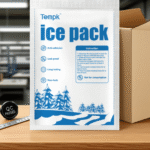
Industrial ice box factory price should help you predict value, not create confusion. If you are sourcing passive cold-chain packaging for food, médicaments, laboratoires, healthcare outreach, or industrial chilled delivery, the quote only becomes useful when it is tied to route time, charge utile, stress ambiant, insulation design, and handling conditions. Without that context, industrial ice box factory price is just a surface number.
The good news is that you can make factory quotes much easier to compare. Once you understand what really drives industrial ice box factory price, you can separate serious suppliers from generic sellers, lower avoidable risk, and buy a box that actually fits your operation.
Cet article vous aidera à comprendre:
- What industrial ice box factory price really includes
- Why two similar-looking boxes can have very different costs
- Which materials and standards affect long-term performance
- How to compare EXW, FCA, and other trade terms
- Quoi 2026 market and sustainability trends mean for sourcing
What really drives industrial ice box factory price?
**Industrial ice box factory price is driven by performance requirements more than appearance.** Size matters, but size alone does not explain price. A short-route box with standard water packs and basic structure can be much cheaper than a route-validated box designed for higher ambient exposure, Contrôle de température plus stricte, or repeated reuse.
Public WHO benchmark data makes this visible. Product pages published in 2025 show small long-range passive carriers at around USD 40, freeze-preventive carriers around USD 52, and larger cold boxes around USD 138 en USD 150, depending on capacity, design class, and published trade terms. These figures are not a universal market list, but they clearly prove that validated passive-cooling performance and product class change price rapidly. ([extranet.who.int][1])
Core price drivers
| Conducteur | Lower-cost specification | Higher-cost specification | Ce que cela signifie pour vous |
|---|---|---|---|
| Tenir le temps | Itinéraire court | 24–48+ hour route | More insulation and coolant are usually needed |
| Contrôle thermique | Basic chilled use | Tight controlled range | Better engineering and testing |
| Structure | Light-duty shell | Industrial reinforced shell | Lower breakage and longer life |
| Cooling media | Packs d'eau | PCM or engineered buffers | Meilleur contrôle, higher system cost |
| Validation | Basic claim | Formal thermal evidence | Better purchasing confidence |
| Documents | Simple datasheet | Full report pack | Easier approval in serious supply chains |
Why should you look beyond the factory quote?
**The right buying metric is total usable cost, not just industrial ice box factory price.** A low EXW quote can become expensive when you add export handling, inland pickup, thick outer cartons, field failures, reorders, ou expéditions rejetées. This is why experienced buyers compare quote structure and trade terms at the same time.
ICC states that Incoterms are eleven three-letter trade terms that clarify tasks, frais, and risks between seller and buyer in contracts for the sale of goods. If your industrial ice box factory price is quoted EXW, you may still own a large part of the logistics burden. ([ICC – International Chamber of Commerce][2])
Hidden cost areas many buyers miss
- Sample-to-mass-production inconsistency
- Coolant packs not included in the quote
- Export carton upgrades
- Poor pallet utilization
- Higher damage due to weak shell design
- No replacement parts or pack support
- Weak supplier documentation
How do materials affect industrial ice box factory price?
**Materials change both thermal performance and service life.** Shell resin affects impact resistance. Liner material affects cleanliness and interior finish. Insulation affects heat gain. Coolant selection affects stability inside the payload chamber. None of these choices should be evaluated in isolation.
WHO product data offers practical examples of real passive-cold-chain material stacks, including CFC-free polyurethane insulation with HDPE external material and HIPS lining in one 2025 product listing. WHO specifications also say cold-box casing materials should resist UV degradation, joints should be water- and vapor-proof, and low-GWP foaming agents are preferred. ASTM C1303, entre-temps, addresses prediction of long-term thermal resistance for closed-cell foam insulation, which is useful when buyers want performance that stays stable over time rather than fading after aging. ([extranet.who.int][8])
Water packs or PCM?
For many standard chilled routes, water packs remain practical and cost-effective. But when freeze prevention or tighter thermal control matters, PCM or engineered buffer systems can make sense. WHO freeze-preventive specifications explicitly allow water-based and PCM-based buffers, which shows why more advanced designs usually raise industrial ice box factory price but can reduce thermal risk in sensitive applications. ([extranet.who.int][9])
Which quality and test standards matter most?
**A credible quote should connect to a quality system and a test approach.** ISO explains that ISO 9001:2015 provides a framework for quality management and is widely used for supplier approval, international partnerships, and process consistency. That does not prove a box is thermally excellent, but it does help show the factory has repeatable management discipline. ([国际标准化组织][10])
For thermal and transit development, ISTA says its 7-Series protocols can be used to compare relative performance of package designs, and Standard 7E is designed for thermal transport packaging used in parcel delivery environments. WHO large cold-box specifications also reference transport-test standards such as ASTM D999 and ASTM D4169, reinforcing the idea that industrial ice box factory price should be judged against route realism and testing depth. ([ista.org][11])
Document checklist before you approve a supplier
- Product specification sheet
- Material summary
- Insulation details
- Test ambient profile
- Payload definition
- Coolant type and quantity
- QC process summary
- Trade term and base-price year
- Lead time and MOQ
- Warranty or replacement terms
How should you negotiate industrial ice box factory price?
**Negotiate design efficiency, not blind cuts.** The best savings usually come from simplifying the platform, not weakening it. You can lower cost by standardizing footprints, removing unnecessary accessories, using common colors, improving forecast visibility, or combining volume across similar SKUs.
Smart ways to reduce cost
- Use one shell platform for several payload sizes
- Shift from custom colors to standard resin colors
- Bundle annual demand into a single negotiation
- Simplify accessory count
- Improve pallet loading density
- Decide early whether the box is reusable or semi-disposable
Quels sont les plus gros 2026 tendances?
Industrial ice box factory price in 2026 sits inside a market that is asking for more proof and less waste. GCCA reported cost pressure in refrigerated logistics, including labor and electricity increases in Q4 2024. The European Commission says the Packaging and Packaging Waste Regulation entered into force on February 11, 2025 and generally applies 18 des mois plus tard, pushing businesses toward less packaging waste and lower use of primary raw materials. WHO cold-box guidance also emphasizes durable design and lower-GWP thermal approaches. ([Alliance mondiale de la chaîne du froid][4])
At the buyer level, this means three things:
- You will be asked to justify packaging efficiency more clearly.
- You will be expected to compare total value, pas seulement le prix unitaire.
- You will gain more bargaining power if your RFQ is precise.
FAQ
How often should the exact keyword appear in my buying page?
Use industrial ice box factory price naturally in the title, ouverture, major subheads, FAQ, and conclusion. Do not force it unnaturally.
What is a fair industrial ice box factory price?
A fair price is one that matches your route, charge utile, durée, durability target, and document needs. Fair is defined by fit, not by being the absolute lowest.
Can I use vaccine carrier benchmark data for industrial buying?
Oui, as a directional benchmark for passive cold-chain design classes and public price transparency, but not as a one-to-one substitute for your exact product.
Should I ask for validation on every order?
Ask for validation when the route is long, the product is sensitive, the environment is hot, or the shipment value is high.
Summary and recommendation
Industrial ice box factory price is best evaluated as a full-system value indicator. When you compare quotes by thermal target, tenir le temps, shell strength, stratégie de refroidissement, trade term, and documentation depth, you make a stronger buying decision and reduce downstream failure risk.
The easiest next step is to standardize your RFQ. Define your product, masse de charge utile, longueur de l'itinéraire, profil ambiant, handling method, and annual demand. Once suppliers quote against the same specification, industrial ice box factory price becomes easier to compare and much harder to manipulate.
À propos du tempk
Et tempk, we believe passive cold-chain packaging should be selected with route logic, Pas de supposition. We focus on practical matching between temperature target, durée, charge utile, and handling environment so buyers can avoid paying for the wrong performance or underbuying the right one.
**CTA:** Share your target temperature range, durée de l'itinéraire, annual volume, and trade preference so the right industrial ice box factory price can be evaluated against real operational needs.
- Passive cold chain packaging guide
- Industrial insulated container customization
- EXW vs FOB sourcing guide
- How to compare thermal validation reports
- PCM vs water pack buying checklist