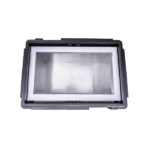
A strong insulated container liner manufacturer should help you solve a real transport problem, not simply sell a large-format insulating product. Dans 2026, serious buyers are choosing manufacturers based on application fit, technical clarity, production repeatability, and material-efficiency direction. Price still matters, but price without control is not a strong sourcing strategy.
What this guide will help you answer
- What an insulated container liner manufacturer should be able to do
- How large-format liners work in pallet, en gros, and staging applications
- Which validation, qualité, and compliance signals matter
- How current market and sustainability trends affect supplier choice
- How to build a smarter manufacturer scorecard
- Start with the application, pas le catalogue
The best supplier choice begins with a clear use case. Are you protecting palletized goods during staging? Adding a thermal buffer to containerized cargo? Using a reusable warehouse cover? Supporting a sensitive cold chain load? Each use case creates a different design requirement.
That is why catalog size is not the most important factor. A smaller manufacturer with deeper application understanding may be better than a larger one with many products but weak guidance. The first thing to compare is how each supplier defines your problem.
How large-format liners create value
Large-format insulated liners can reduce heat exposure, variations de température douces, and add a practical buffer around loads that are sensitive to ambient conditions. In some applications, the main value is thermal. In others, the real value is operational: faster installation, easier staging, or better load consistency.
Reflective layers often play an important role, especially when radiant exposure is high. But they should be understood correctly. The Department of Energy explains that radiant barriers reduce heat gain by reflection and do not have inherent R-value on their own. That means reflective large-format liners must still be judged as whole systems with real installation and use conditions in mind. (The Department of Energy’s Energy.gov)
Common application types
Use validation logic before you commit
If a large-format liner is important to the shipment outcome, you should ask how its performance has been evaluated or how the manufacturer expects it to be evaluated. ASTM D3103 supports evaluation of thermal insulation performance of distribution packages, while ASTM D4169 provides a laboratory basis for expected distribution hazards. ISTA thermal methods and Standard 20 offer additional structured thinking around qualification and real-world transport profiles. (ASTM International | ASTM)
This matters because a liner that looks good in a product photo may be awkward in a real warehouse or less effective than expected when staging, chargement, and delays are added. A good manufacturer helps connect the product to the application and the test logic.
Review supplier systems and process control
ISO says ISO 9001 is a globally recognized quality management standard, tandis que l'ISO 14001 is the main environmental management framework. ISO also shows that ISO 14001:2026 is under publication for April 2026. These frameworks matter because large-format liner programs depend on repeatability, changer de contrôle, and structured improvement over time. (国际标准化组织)
If your application supports food or healthcare-sensitive products, supplier discipline becomes even more relevant. WHO’s guidance for temperature-sensitive pharmaceuticals, IATA’s temperature-control rules, FDA’s food transportation requirements, and FDA’s CGMP framework all point toward the value of documented control in packaging systems tied to product integrity. (世界卫生组织)
Comprendre le 2026 market before choosing a manufacturer
The current market explains why sourcing is getting stricter. NOUS. e-commerce sales reached an estimated $1.2337 billions de billions dans 2025 et 16.4% of retail sales, which keeps pressure on packaging efficiency across fulfillment and distribution systems. En même temps, the EU’s PPWR entered into force on 11 Février 2025 and begins general application in mid-2026, driving broader attention to packaging waste reduction and lower use of primary raw materials. (Census.gov)
EPA adds the core business principle: source reduction is the environmentally preferred strategy, and lightweighting and redesign are increasingly common business trends. In large-format liner sourcing, that means buyers increasingly ask how much protection is being achieved per unit of material, espace, and labor. (EPA des États-Unis)
Build a manufacturer scorecard that reflects real value
A useful manufacturer scorecard should combine product, processus, and application thinking. You want to know whether the manufacturer can make the liner, install the liner, repeat the liner, and improve the liner program over time.
Manufacturer scorecard
Questions fréquemment posées
- What is the first thing to ask an insulated container liner manufacturer?
Ask how the liner is meant to solve your exact transport or staging problem.
- Does reflective material alone make a good large-format liner?
- Non. Structure, couverture, installation, and the real environment all matter.
Should I ask about validation if my product is not pharma?
Oui. Validation thinking helps reduce risk in any meaningful thermal packaging program.
- Why do management systems matter for liners?
Because repeatability and change control matter when you are sourcing at scale.
What is the biggest 2026 sourcing trend?
Buyers want manufacturers that combine operational efficiency, material-efficiency thinking, and clearer technical reasoning.
Résumé et recommandation
The right insulated container liner manufacturer is one that understands your application, supports validation logic, controls production, and can explain how the liner fits a more efficient packaging future. Dans 2026, that is what turns a supplier into a dependable partner.
Your next step should be to run a structured comparison of two or three manufacturers using real application criteria such as install speed, packaging density, system clarity, and process maturity.
À propos du tempk
Et tempk, we focus on insulated liner systems for cold chain and large-format transport with attention to real handling, repeatable manufacturing, and practical installation. We believe a strong liner program should protect the load while reducing avoidable complexity in the warehouse and supply chain.
A useful next step is to evaluate your current large-format liner program for hidden cost in handling, fret, and material use, then compare that against a more application-focused alternative.