Emballage passif à température contrôlée: How to Select a Verifiable Shipping System
Passive temperature controlled packaging protects a product for a defined period without relying on an electric cooling or heating unit inside the shipping package. It uses insulation to slow heat transfer and preconditioned thermal media to absorb or release heat. That simple principle supports many parcel, pharmaceutique, diagnostic and food shipments. It does not mean the empty box is temperature controlled, that the coolant automatically selects the correct temperature, or that a declared number of hours applies to every route.
The most useful way to choose a passive shipper is to evaluate three linked questions: What heat or cold exposure will the route impose? What complete loaded packout can resist that exposure? What evidence shows people can reproduce its performance? The answers determine insulation choice, thermal media, capacité utilisable, qualification and operating cost more reliably than a catalog comparison of materials.
Decide whether a passive system fits the distribution process
A passive system carries a finite amount of thermal energy prepared before dispatch. It is usually a strong candidate when transport exposure is bounded, the payload is compatible with a standardized loading pattern, and the warehouse can control coolant conditioning. Parcels that move through carrier networks without a continuous power supply are an obvious use case, but passive solutions are not limited to short distances. Properly designed and qualified passive shippers can be considered for longer routes within their documented operating conditions.
Active temperature-control equipment uses powered refrigeration or heating. It may be preferable when payload volumes are large, journey duration is highly uncertain or the necessary passive coolant mass is impractical. Active systems introduce requirements for energy supply, entretien, equipment custody and servicing. A refrigerated truck carrying insulated passive packages is a combination of environmental control and local thermal buffering; it does not make every boîte isotherme an active system.
UN pallet thermal cover is another separate entity. It can reduce heat gain or exposure during certain handling intervals, but a cover alone cannot demonstrate that every carton on a pallet remains in a specified temperature band. Monitoring devices are separate again: they produce evidence at measurement points but do not add cooling capacity. Distinguishing these controls prevents RFQs that request one component and expect the performance of an entire transport operation.
Match insulation architecture to shipping geometry and return logistics
Insulation slows heat movement through the enclosure, but the heat path includes the walls, couvercle, coutures, coins, joints and openings. A material datasheet cannot characterize all those paths. The outer footprint, espace interne utilisable, payload weight and box handling also affect which architecture is practical.
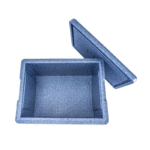
Mousse EPS is a familiar rigid récipient isolé material that may suit one-way distribution where the chosen design and material handling process fit the application. Its selection should consider durability in the shipping lane, risque de casse, closure quality and the destination’s recovery options. PPE is used in durable molded containers and can suit returnable operations when cleaning, inspection and reverse logistics are actually available. Its structural durability does not mean the same packout automatically remains thermally qualified forever.
Panneaux isolés sous vide (Vips) can reduce heat transfer through well-integrated panel areas. Cependant, bords, joints and structural protection remain relevant, and panel damage can compromise expected performance. A VIP-enhanced shipper often presents a different balance among thermal protection, volume utilisable, cost and inspection requirements. A buyer should not compare the published thermal conductivity of a VIP with the whole-box performance of an EPS system and conclude the relative shipment duration directly.
Sacs isolés et doublures can be easier to integrate into certain distribution formats or return streams. Their flexible geometry, lignes de pliage, closure method and support structure can cause different thermal behavior from a rigid molded box. They still need complete-system testing for the proposed payload and route.
| Packaging architecture | Decision strength | Boundary to verify |
| EPS insulated carton | Straightforward rigid one-way packaging | Mechanical damage, waste handling and complete-packout test results |
| Boîte isolée Epp | Durable format for a controlled reuse network | Collection, nettoyage, closure condition and inspection after cycles |
| Expéditeur VIP | Reduced heat transfer through suitable panel regions | Protection des panneaux, edge losses, integrity checks and cost |
| Insulated bag or liner | Flexible integration and compact logistics where appropriate | Shape control, seam and closure performance, loaded thermal profile |
| Active or controlled transport alternative | Managed temperature supply for selected demanding lanes | Power, manutention, entretien, custody and contingency process |
Architecture selection is an optimization problem. A heavier, better-insulated wall can increase freight cost and reduce internal capacity; a reusable format can save packaging purchases yet add significant reverse-logistics expense. Évaluer le cost and operability of the loaded shipment, not just the purchased enclosure.
Choose thermal media by the product limits, not the word “cold”
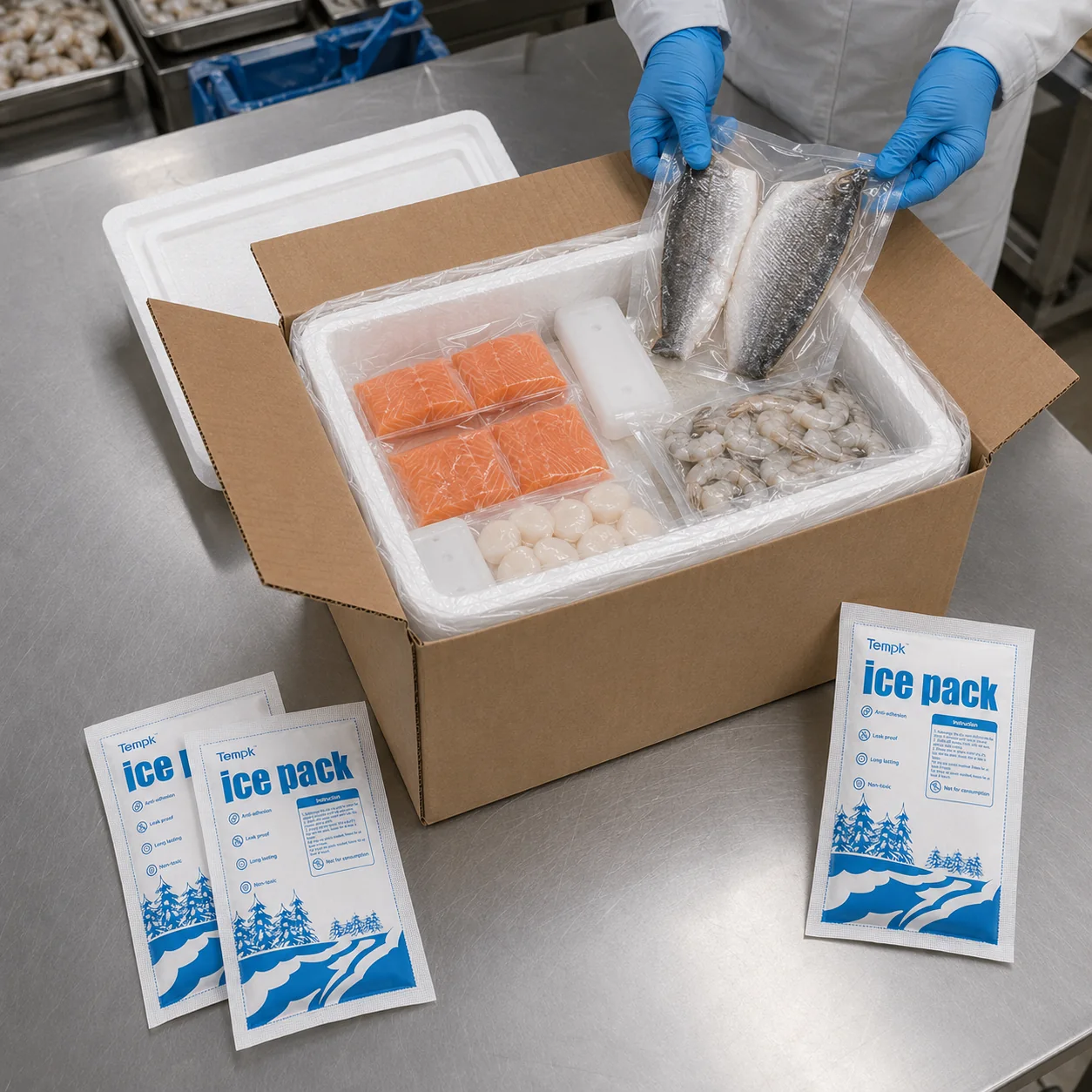
The thermal medium creates another important distinction. Packs de glace en gel, water-based bricks and other refrigerant formats provide useful thermal mass, but their behavior depends on formulation, conditionnement et placement. Matériaux à changement de phase (PCMS) are chosen for their behavior while changing phase within a particular operating region. Not every gel formulation is a PCM designed for a tightly defined band, and a nominal PCM phase point does not equal the temperature at every product location.
The product specification establishes both upper and lower limits. A cooled pharmaceutical may be vulnerable to freezing, while a frozen food payload has different physical and quality objectives. Some cosmetic products are harmed by excess heat and by freezing. Accordingly, selecting a thermal medium solely by maximum cooling duration can increase a different failure risk.
A correct comparison should consider the coolant’s energy capacity in the relevant state, actual starting condition, masse, superficie, position, contact barriers and relation to the loaded payload. More frozen mass may improve resistance to warm exposure but increase local cold risk. A formulated PCM may simplify a particular temperature strategy yet require tighter sourcing and conditioning controls. Neither decision can be confirmed without testing the complete intended configuration.
Conditioning is a manufacturing step, not a vague instruction
Passive systems depend on energy loaded into the media before shipping. That requires infrastructure and a reproducible procedure. Define where packs are conditioned, their ready-state criterion, how long they may sit in a staging area, how they are identified and what happens if a batch is prepared incorrectly. “Freeze overnight” is not a controlled specification because equipment, pack geometry and loading can vary.
The shipper and payload also have starting temperatures. A preconditioned coolant placed in a hot box around warm cartons may follow a different initial trajectory from the same coolant used with the specified chilled components. The allowed assembly time and lid-open exposure should therefore appear in the operating work instruction, not only in the laboratory notebook.
À grande échelle, conditioning capacity becomes a major purchasing parameter. A warehouse may need enough refrigerator or freezer space, circulation, staging locations and staff time to prepare daily volume. The lowest-price coolant option may cost more in energy, labor and rejected shipments if its preparation is difficult to control.
Design around the real usable load and its hot and cold spots
The nominal volume of an empty insulated container is not the usable shipping capacity after coolant, plateau, séparateurs, monitor and cushioning are installed. Suppliers should provide drawings of the complete loaded assembly, with external footprint, internal clearances and practical carton count. Weight constraints and access requirements also matter for manual handling and parcel-carrier acceptance.
Outils de décision utiles
Vérifiez les détails avant de choisir l'emballage
Ces outils rapides peuvent vous aider à comparer le risque d'itinéraire, besoins de dimensionnement, choix de liquide de refroidissement, et les détails de l'emballage avant de demander un devis.
Liquide de refroidissement & Référence PCM
Comparez les options de liquide de refroidissement et de PCM lorsqu'un itinéraire nécessite une prise en charge supplémentaire de la température.
Comparez les optionsGénérateur de liste de contrôle de conformité
Créer une liste de contrôle pratique pour l'examen des emballages, expédition, et documentation.
Construire une liste de contrôleVérificateur de risque d'itinéraire
Examinez les conditions des pistes avant de sélectionner l'emballage en fonction des exigences opérationnelles réelles..
Vérifier le risque d'itinéraireA full box and a sparse box can behave differently. Payload mass changes the system’s thermal response; air spaces alter heat movement; contact area with cooling media shifts; and an internal divider can move a sensitive carton closer to a lid or side wall. If order sizes vary, qualification should consider justified minimum and maximum configurations. In some operations, a small number of standardized shipper sizes gives more control than repeatedly improvising filler materials in one oversized box.
Hot and cold locations do not necessarily coincide. A lid corner might reach the upper limit first in a warm challenge, while a carton beside a frozen brick might reach the lower limit first at startup. An engineering study may use several probes to identify those locations and then determine where routine monitoring offers meaningful evidence. A single central temperature trace cannot establish that every interface in the box had the same temperature.
This distinction is particularly important for freeze-sensitive medical goods. An insulated wall may slow external heating very well while direct contact with an overly cold refrigerant creates a local cold excursion. Better insulation does not automatically cure incorrect coolant choice or geometry.
Translate the transportation lane into a defensible test profile
Start the route clock when the shipment becomes dependent on its protective packout, usually after assembly and closure, and stop it when the payload enters suitable controlled storage. Include origin staging, vehicle collection, tri, centres de transfert, customs when relevant, missed deliveries and receiving delay. A route described as “next-day” may impose a substantially different exposure window from the nominal time in motion.
Warm and cold ambient challenges should be considered separately. A summer lane tests cooling reserve and resistance to heat ingress; a winter lane can challenge minimum temperatures, especially when refrigerants begin colder than the product. For mixed seasonal networks, one packaging recipe may need a documented seasonal variant. A temperature trace recorded at the container wall or in the chamber is the ambient challenge, not necessarily the product temperature.
Norme ISTA 20 establishes a framework for expéditeur isolé qualification, and ISTA Standard 7E provides standard thermal profiles developed for parcel-delivery exposures. These are tools for testing a defined shipping system. They do not provide a universal safe duration for every product or route, nor do they establish an individual pharmaceutical product’s acceptability after a deviation. A route-specific profile may also be justified if the organization has credible lane evidence and a controlled test method.
A meaningful performance claim therefore sounds conditional: the specified shipper, liquide de refroidissement, payload and packing instruction met a stated product condition during a stated thermal challenge. The phrase “maintains temperature for 72 hours” without test conditions is incomplete, even if a graph looks reassuring.
Review evidence from component to operation
Supplier evaluation should distinguish several kinds of documents that are commonly blended in marketing descriptions.
UN material datasheet can describe foam, film, gel or panel characteristics. UN component test can establish properties of an individual pack or panel. UN complete-packout thermal test demonstrates a particular assembly under a particular challenge. UN qualification package may include the rationale for design selection and representative test coverage. UN shipment logger record shows measured temperatures at its instrument locations in routine distribution. UN process or quality record shows whether operators followed an approved procedure and what happened when they did not.
None of those artifacts substitutes completely for the others. For regulated medicine distribution, the European Union’s GDP guidelines require risk-aware transport management and careful attention to product-defined temperatures, emballage adapté, route extremes and excursions within the relevant EU scope. A generic “GDP approved box” claim without an identified evaluation and quality-system context should be challenged.
A useful evidence request contains the configuration revision, nomenclature, loaded-fit drawing, spécification du liquide de refroidissement, POS de conditionnement, profil thermique, sensor placement rationale, résultats mesurés, acceptance criteria and scope limitations. Buyers should ask what changes would trigger review: new foam density, changed PCM supplier, revised carton height, different gel mass, altered pack orientation or an additional distribution center can each affect the approved design.
Account for the true cost of running the system
Cost per empty box is seldom cost per accepted shipment. Add coolant purchase or replenishment, énergie de conditionnement, espace de stockage, travail d'emballage, payload capacity lost to insulation, outbound freight weight and cube, temperature instrumentation, inspection and likely exception handling. Pour des emballages réutilisables, include return freight, nettoyage, stockage, perte, damage and the number of successful cycles actually achieved.
Environmental decisions also need a full system boundary. A returnable container may reduce disposal in a dense closed network; the same container can incur unnecessary return transport when retrieval is difficult. “Recyclable” requires local access to appropriate recovery infrastructure, while “reusable” requires a practical collection and inspection loop. Avoid claiming universal carbon savings without a scope and supporting assessment.
Consider two hypothetical distribution models. The first sends individual refrigerated parcels to many unrelated customers. It may favor a compact single-use solution that can be packed consistently. The second delivers repeatedly between the same depots and has assured returns. It might justify an EPP returnable system even if its purchase price is higher. Both still need thermal evidence for their payloads; the difference is the operating model, not a universal materials ranking.
Turn the specification into a controlled purchase
For a useful quotation, provide the exact product limits, dimensions et masse de la charge utile, minimum and maximum fill states, transit timeline with delays, exposition ambiante saisonnière, destination acceptance process and target reuse model. Ask each supplier to return a loaded packout drawing, stated conditioning procedure and the test envelope supporting its claim. Require disclosure of what has not been evaluated.
Supplier controls should address material revisions, contrôle dimensionnel, identité du liquide de refroidissement, traçabilité, cohérence de l'échantillon à la production, agreed substitutes and change notification. A design that passed during a highly supervised trial may be unsuitable for a high-volume warehouse if the procedure is too easy to misread. Select an arrangement staff can actually execute without relying on undocumented judgment.
Tempk publicly offers insulated bags, EPP/VIP medical boxes, packs de glace en gel, briques de glace, PCM-related media and custom packout-planning support. These are possible building blocks; they are not a guarantee that every combination meets a product’s temperature condition or formal qualification requirements. Share your shipment specification and seek a sample and evidence plan tied to the actual route.
The passive-system decision in one sentence
The right passive temperature controlled packaging is the lowest-complexity complete packout that demonstrably protects the defined product through the defined exposure window and can be repeated under controlled instructions. When the necessary thermal mass, espace utilisable, uncertainty or handling burden becomes unreasonable, improve the route controls or compare active alternatives instead of simply adding more ice or insulation.