Dans la logistique de la chaîne du froid, choisir le bon contenant fait la différence entre des livraisons fraîches et une détérioration coûteuse. UN boîte EPP réutilisable—fabriqué à partir de polypropylène expansé—vous offre une résistance légère, une isolation thermique exceptionnelle et des avantages environnementaux qui surpassent les matériaux jetables. En comprenant comment fonctionnent ces boîtes et pourquoi elles sont importantes, vous découvrirez des moyens d'améliorer la qualité des produits, réduire les déchets et respecter les réglementations exigeantes en matière de développement durable. Mis à jour le Décembre 2 2025, ce guide s'appuie sur les dernières recherches et données du monde réel pour vous aider à prendre des décisions éclairées.
Qu'est-ce qu'une boîte EPP réutilisable et comment sa mousse à cellules fermées maintient-elle les températures froides?
Comment une boîte EPP réutilisable se compare-t-elle à l'EPS et à l'EPE en termes d'isolation, durabilité et coût?
Quelles industries bénéficient le plus des boîtes EPP haute densité et comment les utilisent-elles ??
Quels conseils pratiques peuvent maximiser la durée de vie et les performances de votre boîte EPP réutilisable?
Quelles tendances et innovations du marché façonnent l’emballage de la chaîne du froid 2025?
Qu'est-ce qu'une boîte EPP réutilisable et comment ça marche?
UN boîte EPP réutilisable est un poids léger, conteneur isotherme moulé à partir de mousse de polypropylène expansé. Pendant la production, les billes de polypropylène sont chauffées à la vapeur, puis fusionné en une forme rigide. Ce processus crée un structure cellulaire fermée où de minuscules poches d'air sont emprisonnées dans des parois en plastique solides, offrant les avantages suivants:
Excellente isolation thermique: Les poches d'air ralentissent le transfert de chaleur, permettant aux boîtes EPP de maintenir des températures froides pendant 72–96 heures lorsqu'il est associé à des plaques eutectiques. Les fiches techniques citent la conductivité thermique autour 0.25–0,26 W/m·K, avec des valeurs R proches 3.9 à 21 °C.
Rapport résistance/poids élevé: La mousse EPP est légère mais solide. Il peut résister aux chutes de 1.5 m, avec une résistance à la compression comprise entre 11–15 livres par pouce carré à 10 % compression, ce qui le rend idéal pour les manipulations brutales.
Large plage de température: Le PPE reste stable de –40 °C à +110 °C, ce qui signifie qu'une boîte peut servir à la fois à des vaccins congelés et à des livraisons de repas chauds.
Faible absorption d'eau et résistance chimique: Les cellules fermées absorbent moins de 5 % de volumes, résister à l'humidité, huiles et nombreux produits chimiques. Cela aide à prévenir la moisissure et préserve l’isolation.
Réutilisabilité et recyclabilité: Une boîte EPP typique peut être réutilisée sur 500 fois et est entièrement recyclable. Par comparaison, Les conteneurs EPS sont à usage unique, alors que les box EPE durent souvent moins de dix voyages.
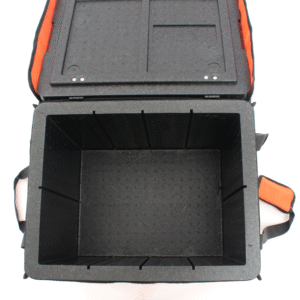
Lorsque vous ouvrez une boîte en PPE, tu vois un treillis en mousse rigide entourant une cavité creuse. Cette conception emprisonne l'air pour l'isolation tout en offrant une résistance structurelle. Les fabricants peuvent personnaliser le densité (15–100 kg/m³) pour équilibrer poids et durabilité. Les qualités haute densité prolongent le temps d'isolation mais pèsent légèrement plus.
Propriétés des matériaux et performances thermiques
| Propriété | Polypropylène expansé (PPE) | Polystyrène élargi (PSE) | EPE/PUR & Autres | Sens pratique | |
| Densité (kg/m³) | 15 - 100 (personnalisable) | 15 - 30 (généralement réparé) | Variable | Le PPE de densité plus élevée supporte des charges plus lourdes sans déformation. | |
| Conductivité thermique (W / m · k) | 0.25–0,26 | ~0,036 | 0.034 - 0.04 | Des valeurs inférieures signifient une meilleure isolation; Les parois épaisses du PPE et l'air emprisonné améliorent la résistance thermique. | |
| Résistance aux chocs | Haut; rebondit après compression | Faible; fragile | Moyen | Les boîtes EPP survivent aux chutes et aux manipulations brutales, réduire les pertes de produits. | |
| Absorption d'eau | < 5 % volume | 2–4 % volume | Varie | La faible absorption d'humidité empêche la moisissure et maintient l'isolationAbsorption d'eau | <5 ,tr” >. |
| Plage de température | –40 °C à +110 °C | –30 °C à +70 °C | –60 °C à +80 °C | L'EPP reste stable dans les conditions de congélation et de stérilisation. | |
| Réutilisabilité | 500 + cycles | Usage unique | Typiquement <10 usages | La longue durée de vie réduit le coût total de possession et les déchets. | |
| Recyclabalité | 100 % recyclable | Difficile de recycler | Limité | Soutient les objectifs d’économie circulaire100 ,td” >. |
Conseils pratiques pour une utilisation optimale
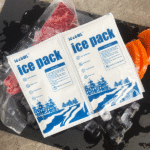
Préconditionner avec du liquide de refroidissement: Refroidissez les plaques eutectiques ou les packs de gel pendant la nuit et prérefroidissez votre boîte EPP avant de la charger.. Cela amorce l’isolation et prolonge le temps de maintien.
Charger efficacement: Remplissez l'espace vide avec des séparateurs ou des remplisseurs thermiques pour réduire le volume d'air et minimiser les fluctuations de température..
Sceller hermétiquement: Choisissez des boîtes avec rainures et clips encastrés; une bonne étanchéité améliore l'isolation en 30 % <ul” >.
Surveiller les températures: Utilisez des capteurs IoT pour suivre la température interne, humidité et emplacement. La surveillance en temps réel vous aide à prendre des mesures correctives si des écarts se produisent.
Nettoyer et désinfecter: Lavez la boîte avec un détergent doux après chaque voyage. La résistance chimique du PPE permet des nettoyages répétés sans dégradation.
Cas du monde réel: Un distributeur pharmaceutique a adopté des boîtiers EPP compacts équipés de capteurs IoT et de plaques eutectiques. Plus d'un an, l'entreprise a réalisé 72– Stabilité de la température pendant 96 heures, réduire la détérioration des vaccins 1,2 million de dollars américains à zéro et éliminé 15 % rejet de fruits de mer en raison d'excursions de température. Réutiliser les cartons plus de 500 fois enregistré à peu près 60 % des frais d'emballage.
Comment une boîte EPP réutilisable se compare-t-elle à l'EPS, EPE et autres matériaux?
Lors de la sélection d'un conteneur pour la chaîne du froid, tu pèses souvent PPE contre PSE (polystyrène élargi), EPE (polyéthylène expansé) et Pur (polyuréthane). Comprendre les différences vous aide à choisir la bonne solution.
Performance et durabilité: La résilience du PPE et son rapport résistance/poids élevé lui permettent de résister à une manipulation brutale sans se fissurer.. Le PSE est fragile et se brise facilement, tandis que l'EPE offre un bon amorti mais moins d'isolation thermique et de rigidité structurelle. Le PUR offre une excellente isolation mais est lourd et difficile à recycler.
Rétention thermique: Les boîtes EPP combinées à des plaques eutectiques maintiennent des températures froides pendant 72–96 heures. Les conteneurs EPS ne peuvent conserver le froid que pendant 24–48 heures. L'EPE et le PUR offrent des performances de milieu de gamme mais nécessitent souvent des parois plus épaisses.
Impact environnemental: La pression réglementaire éloigne les entreprises de la mousse à usage unique. Les règles de l'Union européenne exigent que les emballages soient recyclables avant 2030. L'EPP est un thermoplastique unique, facile à recycler et exempt d'agents gonflants chimiques.. Le PSE finit souvent dans les décharges en raison de la contamination, et le PUR peut libérer des fumées toxiques s'il est mal éliminé.
Coût et coût total de possession: Alors que les cartons EPP coûtent plus cher au départ, ils peuvent être réutilisés des centaines de fois. En combinaison avec des modèles de suivi ou de location IoT, les délais de récupération se réduisent à moins de huit cycles d'expédition. Sur la vie de la boîte, vous économisez sur les coûts de remplacement et évitez les frais d'élimination des déchets.
Flexibilité et personnalisation: La mousse EPP peut être moulée sous de nombreuses formes et peut intégrer des poignées, Tags RFID, enregistreurs de température et couleurs. EPS offre une personnalisation limitée; L'EPE est principalement constitué d'enveloppes flexibles. Le PUR est difficile à modeler dans des formes complexes.
Principaux à retenir
Durabilité: Les boîtes EPP absorbent les chocs et résistent mieux à la déformation que l'EPS ou l'EPE.
Longévité thermique: Ils gardent froid pendant 72–96 heures avec plaques eutectiques.
Réutilisabilité: Une durée de vie de 500 voyages De plus, la recyclabilité réduit les coûts et les déchets à long terme..
Conformité réglementaire: L'utilisation de PPE recyclable vous aide à répondre aux mandats de durabilité tels que les exigences de l'UE en matière d'emballage..
Mousse EPP haute densité: Force et résilience améliorées
La mousse EPP haute densité équilibre la résistance aux chocs, résistance et recyclabilité meilleures que l'EPS ou l'EPE. La densité varie de 15–100 kg/m³, avec des notes allant jusqu'à 260 kg/m³ pour applications spécialisées. Chaque perle est fusionnée sous chaleur et pression, créant des poches scellées qui emprisonnent l'air et amortissent les vibrations. Qualités haute densité (40–60 kg/m³) offrent une résistance et une isolation maximales mais pèsent légèrement plus.
Les propriétés mécaniques reflètent cet équilibre. L'absorption d'énergie typique est 20-40 kj/m; la résistance à la compression est 0.3–2,5 MPa, et l'absorption d'eau est inférieure à 0.3 %. Ces boîtes restent stables de –40 °C à +110 °C, ce qui les rend adaptés aux vaccins ultra froids ou aux livraisons de repas chauds.
Où brillent les boîtes EPP réutilisables? Applications industrielles
Logistique des aliments et des boissons: Fraîcheur Sans Déchet
Les boîtes EPP sont largement utilisées pour les fruits de mer frais, viande, livraisons de produits laitiers et de kits repas. Leur isolation élevée maintient les articles périssables dans les plages de température requises pendant le transport du dernier kilomètre et à travers le pays.. Les détaillants en alimentation utilisant des boîtes EPP compactes avec plaques eutectiques maintiennent la température pendant jusqu'à 96 heures, garantir que les produits restent frais même lorsque les délais de livraison sont imprévisibles. Les entreprises de restauration apprécient la durabilité et la facilité de nettoyage des boîtes., ce qui les rend idéaux pour une utilisation répétée.
Produits pharmaceutiques et biotechnologie: Répondre aux exigences réglementaires
Vaccins, insuline, les anticorps monoclonaux et les produits de thérapie génique nécessitent un contrôle strict de la température. Les boîtes EPP offrent l'isolation constante et la résistance aux chocs nécessaires pour transporter ces objets sensibles en toute sécurité.. Ils accueillent des capteurs IoT et des trackers GPS, assurer une visibilité et une conformité en temps réel. Directives réglementaires telles que la FDA 21 CFR 600.15 et les bonnes pratiques de distribution de l'UE mettent l'accent sur les emballages validés. La pharmacie et la biotechnologie représentent 45 % du chiffre d’affaires de l’emballage sous chaîne du froid en 2024, mettant en évidence la demande de conteneurs réutilisables fiables.
Commerce électronique et kits de repas: Expédition légère et durable
L'essor des services d'épicerie et de préparation de repas destinés directement aux consommateurs a stimulé la demande d'emballages fiables pour la chaîne du froid.. Les boîtes EPP réutilisables sont légères, réduire les frais d'expédition, mais suffisamment solide pour protéger les ingrédients fragiles. Leur réutilisation séduit les consommateurs soucieux du développement durable et améliore la perception de la marque.. Le marché de l’emballage pour la chaîne du froid en Asie-Pacifique connaît une croissance de 12 % TCAC, créer des opportunités pour les entreprises qui adoptent des solutions EPP.
Logistique spécialisée et utilisations industrielles
Au-delà de l'alimentation et des produits pharmaceutiques, Les caisses EPP servent au transport de produits chimiques, échantillons de laboratoire et électronique de grande valeur. Leur conception personnalisable permet des cloisons, inserts absorbant les chocs et fermetures sécurisées. Les chaînes d'approvisionnement industrielles utilisent des emballages EPP pour protéger les adhésifs sensibles à la température., peintures et résines. Parce que le PPE tolère des températures allant jusqu'à +110 °C, les boîtes peuvent être stérilisées ou utilisées dans des autoclaves.
Avantages spécifiques à l'industrie
| Industrie | Exemple d'utilisation | Bénéficier à vous |
| Médicaments | Boîtes de vaccins et expéditeurs de produits biologiques | Maintient 2 à 8 °C ou des plages ultra froides; facile à nettoyer, répondant aux normes réglementaires. |
| Nourriture & Restauration | Livraison de repas, fruit de mer, aliments surgelés | Garde les repas chauds ou froids; réduit la détérioration; la conception légère améliore la maniabilité. |
| Commerce électronique & Épiceries | Boîtes d'expédition personnalisées | Maximise l’efficacité de l’espace; la réutilisabilité séduit les consommateurs soucieux de l’environnement. |
| De plein air & Loisirs | Glacières de pique-nique et de camping | Garde les aliments frais pendant des heures; facile à transporter. |
| Logistique Industrielle | Plateaux de fardage et de transport réutilisables | Protège les instruments de précision et l'électronique; réduit les déchets et les coûts. |
Maximiser la durée de vie de votre boîte EPP réutilisable
La performance à long terme dépend d’une utilisation et d’un entretien appropriés. Suivez ces directives pour vous assurer d'obtenir le meilleur rapport qualité-prix:
Choisissez la bonne densité et la bonne taille
Faire correspondre la densité à la charge utile: Pour charges lourdes ou longs trajets, sélectionner une mousse haute densité (40–60 kg/m³) pour une résistance et une isolation maximales. Les charges plus légères peuvent bénéficier d’une densité moyenne pour gagner du poids.
Bonne taille: Choisissez une boîte qui s'adapte parfaitement à votre produit pour minimiser l'espace vide et améliorer la stabilité de la température..
Pensez aux modèles pliables: Les boîtes pliables en EPP permettent d'économiser jusqu'à 60 % d'espace lorsqu'il est vide, améliorer l'efficacité de la logistique inverse.
Associez-le à des liquides de refroidissement appropriés
Différents produits nécessitent différents supports de refroidissement:
Packs de gel ou matériaux à changement de phase (PCMS) pour produits pharmaceutiques réfrigérés et aliments frais. Ceux-ci maintiennent une température de 2 à 8 °C pendant des périodes prolongées.
Glace sèche pour produits surgelés à –20 °C ou moins.
Panneaux isolés sous vide ou refroidissement actif pour les produits biologiques ultra froids (< –60 °C).
Assurez-vous que votre liquide de refroidissement correspond à la plage de température requise et ne remplit pas trop la boîte.. Laissez de l'espace pour la circulation de l'air pour éviter les points chauds.
Assurer une bonne étanchéité et une bonne ergonomie
Sélectionnez des boîtes avec des couvercles et des joints affleurants ou à charnières pour minimiser les fuites d'air..
Utilisez des boîtes avec des poignées ou des sangles ergonomiques pour une livraison confortable du dernier kilomètre.
Personnalisez les inserts ou les séparateurs pour sécuriser les flacons et éviter tout déplacement pendant le transport.
Mettre en œuvre des programmes de retour et de nettoyage
Programme de retour: Encouragez les clients à retourner les cartons en leur offrant des dépôts ou des incitations. Les systèmes de dépôt peuvent récupérer jusqu'à 80 % de boîtes, réduire considérablement les déchets.
Protocoles de nettoyage: Laver les boîtes avec du savon doux et de l'eau entre les utilisations; La surface non poreuse du PPE empêche la croissance bactérienne.
Surveillance de l'usure: Inspecter les boîtes pour déceler des fissures ou des déformations. Retrait des unités endommagées dans les filières de recyclage.
Outils de décision et guides interactifs
Les plateformes modernes de chaîne du froid proposent des outils interactifs pour vous aider à choisir le bon emballage:
Calculateur de taille: Entrez les dimensions du produit et la durée de température requise pour déterminer la taille et la densité optimales de la boîte..
Liste de contrôle d'auto-évaluation: Répondre aux questions sur la fragilité des produits, plage de température, durée du voyage et objectifs de durabilité; recevoir les configurations EPP recommandées.
Surveillance du sélecteur d'ajout: Choisissez des capteurs et enregistreurs de données IoT en fonction des exigences réglementaires et du budget.
Ces outils améliorent l'engagement des utilisateurs et vous garantissent de sélectionner une solution adaptée à vos besoins..
Exemple pratique: Une start-up de kits repas a utilisé un calculateur de taille pour concevoir des boîtes EPP haute densité personnalisées. Les boîtes gardaient les ingrédients en sécurité pendant 48 heures et réduit les frais d'expédition en éliminant les éléments de remplissage vides.
2025 Paysage et tendances du marché
Perspectives du marché des boîtes d’isolation EPP
Une étude de marché montre que le secteur des boîtes isolantes en PPE vaudra 2 milliards de dollars américains 2025 et grandir à un 7 % taux de croissance annuel composé (TCAC) à travers 2033. Les moteurs de croissance incluent la livraison de courses en ligne, expéditions de biotechnologie et initiatives de développement durable. L’Amérique du Nord et l’Europe représentent environ 100 millions d'unités par an, tandis que l'Asie-Pacifique contribue environ 40 millions d'unités et connaît la croissance la plus rapide. Innovations telles que des formulations de mousse améliorées, plaques eutectiques avancées et empilable, boîtes pliables renforcent l’avantage concurrentiel d’EPP.
Tendances du marché de l’emballage de la chaîne du froid en 2025
Selon les renseignements du Mordor, le marché mondial de l'emballage sous chaîne du froid s'établissait à 32,29 milliards de dollars américains en 2025 et devrait atteindre 48,93 milliards de dollars américains d'ici 2030, reflétant un 8.67 % TCAC. Les appareils de surveillance de la température constituent le segment à la croissance la plus rapide, en expansion à 12.95 % TCAC. Réglementations telles que les règles de l’UE en matière d’emballages et de déchets, exigeant une recyclabilité totale en 2030, accélèrent la transition du PSE vers des solutions biosourcées et réutilisables. Les systèmes d'emballage hybrides combinant isolation passive et capteurs intelligents se développent à 10.32 % TCAC, tandis que l’expansion rapide de la fabrication pharmaceutique en Asie-Pacifique entraîne une 12 % TCAC.
Façonnage des technologies innovantes de la chaîne du froid 2025
UN 2025 un rapport répertorie plusieurs avancées transformant la logistique de la chaîne du froid:
Optimisation des itinéraires basée sur l'IA: Des algorithmes analysent le trafic, météo et fenêtres de livraison pour ajuster les itinéraires, réduire la consommation de carburant et améliorer la fiabilité.
Blockchain pour la traçabilité: Des registres immuables enregistrent chaque étape du parcours d’un produit, améliorer la conformité et la confiance des consommateurs.
Réfrigération à énergie solaire: Les solutions solaires pour la chaîne du froid gagnent du terrain dans les régions où l’électricité est limitée, réduire les déchets et élargir l’accès.
Capteurs IoT et packaging actif: Les nouveaux conteneurs intègrent des capteurs pour surveiller la température, humidité et localisation en temps réel.
Matériaux écologiques: Les entreprises adoptent des emballages plus écologiques, y compris des mousses compostables et des additifs biosourcés au polypropylène.
Tendances en matière de développement durable et attentes des consommateurs
La durabilité n’est plus une option. UN 2025 Une enquête auprès des consommateurs a révélé que 75 % des consommateurs accordent la priorité à l’hygiène et à la sécurité alimentaire, 67 % insister sur la durée de conservation, 57 % valeur facilité d'utilisation, 55 % se soucier de la durabilité et 51 % prendre en compte l'impact environnemental lors du choix de l'emballage. Ces préférences expliquent pourquoi les emballages réutilisables gagnent du terrain. Les cadres réglementaires tels que Responsabilité élargie du producteur (EPR) les frais et ceux de l’UE Règlement sur les emballages et les déchets d’emballages (PP) encourager les entreprises à concevoir des produits recyclables, réutiliser les emballages et investir dans les infrastructures de recyclage.
Tendances clés pour 2025 inclure:
Réutilisabilité améliorée: Les entreprises remplacent les emballages secondaires par des caisses et des bacs durables, réduire les déchets à usage unique et maintenir l’efficacité opérationnelle.
Montée des matériaux recyclables: Les États investissent dans les infrastructures de recyclage pour répondre à la demande de contenu recyclé post-consommation.
Intégration de technologies d'emballage intelligentes: Capteurs IoT, l'analyse des données et les puces RFID surveillent l'humidité, paramètres de température et de manipulation, accroître la transparence et réduire les pertes.
Objectifs de durabilité spécifiques aux matériaux: Les entreprises fixent des objectifs ciblés pour chaque classe de matériaux, reconnaître que les objectifs généraux sont moins efficaces.
Modèles d'économie circulaire: Les programmes réglementaires tels que les frais PPWR et EPR encouragent financièrement la conception et les choix de matériaux durables..
Aperçus du marché et nouveaux processus
Le marché de la mousse de polypropylène expansé était valorisé à 2,2 milliards de dollars américains 2025 et devrait atteindre 5,1 milliards de dollars américains d'ici 2035. Les constructeurs automobiles utilisent la mousse EPP dans leurs systèmes de sièges pour améliorer la résistance aux chocs et la recyclabilité.. Les fabricants d'électronique ont réduit les bris d'écran de 35 % après utilisation de mousse EPP dans les modules de transport. En Europe, les ventes de conteneurs thermiques à base de PPE ont augmenté 21 % année après année dans 2025. Avancées en matière d’efficacité de production, comme une ligne de traitement lancée en avril 2025 qui a réduit le temps d'expansion des billes d'EPP de 18 %—réduire les coûts et augmenter la disponibilité.
Les méthodes de recyclage chimique en cours de développement pourraient réduire davantage les coûts des matières premières et améliorer la durabilité. As AI, la blockchain et l'IoT deviennent la norme dans la logistique de la chaîne du froid, choisissez des boîtiers EPP pouvant intégrer des capteurs et des étiquettes numériques. Gardez un œil sur les émergents matériaux compostables pour faire court, voyages sans retour.
Questions fréquemment posées
Q1: Combien de temps une boîte EPP réutilisable peut-elle garder les marchandises au frais?
Une boîte EPP réutilisable maintient les températures froides pendant 72–96 heures, surtout lorsqu'il est associé à des plaques eutectiques et à un pré-refroidissement approprié. Des panneaux isolés sous vide ou des éléments de refroidissement actifs peuvent prolonger cette durée.
Q2: Combien de fois puis-je réutiliser une boîte EPP?
Avec une manipulation et un nettoyage appropriés, vous pouvez réutiliser une boîte EPP plus que 500 fois sans perte significative de performances.
Q3: Le PPE est-il plus écologique que le PSE?
Oui. Le PPE est 100 % recyclable et exempt d'agents gonflants nocifs, alors que le PSE finit souvent dans les décharges et présente de faibles taux de recyclage.
Q4: Les boîtes EPP sont-elles adaptées aux produits pharmaceutiques et aux vaccins?
Absolument. Les boîtes EPP offrent une isolation constante, peut intégrer des capteurs et résister aux procédures de décontamination, conforme aux directives de la FDA et de l'UE pour les produits biologiques.
Q5: Quelle est la période d’amortissement pour passer aux boîtes EPP réutilisables?
Avec modèles de location et suivi IoT, les délais de récupération peuvent descendre jusqu'à moins de huit cycles d'expédition. Les économies à long terme proviennent de taux de remplacement inférieurs et d’une réduction de la détérioration.
Q6: Comment les tendances du marché affectent-elles ma stratégie d'emballage?
Avec une demande croissante de boîtes EPP 7 % TCAC et le marché plus large de l'emballage pour la chaîne du froid, en expansion à 8.67 % TCAC, une adoption précoce vous donne un avantage concurrentiel. Des tendances telles que la logistique de l'IA, La surveillance de l'IoT et les règles strictes de recyclabilité façonneront l'environnement opérationnel grâce à 20307 ,p” >.
Résumé et recommandations
UN boîte EPP réutilisable allie performances thermiques, durabilité, réutilisabilité et durabilité pour offrir une valeur inégalée à la logistique de la chaîne du froid. Les points clés comprennent:
Isolation et résistance supérieures: La mousse à cellules fermées emprisonne l'air, offrant une faible conductivité thermique et une résistance élevée aux chocs. Les boîtes maintiennent la température pendant 72–96 heures avec des liquides de refroidissement appropriés.
Longue durée de vie et recyclabilité: Avec plus de 500 réutiliser les cycles et une recyclabilité totale, Les boîtes EPP réduisent considérablement les coûts et les déchets par rapport au PSE à usage unique..
Avantages en matière de réglementation et de durabilité: Les mandats de recyclabilité de l’UE et les objectifs ESG des entreprises favorisent les emballages en PPE réutilisables.
Croissance du marché et innovation: Le marché des coffrets EPP est valorisé à 2 milliards de dollars américains 2025 et grandit à 7 % TCAC. Tendances telles que le routage IA, Capteurs IoT, la réfrigération solaire et les mousses compostables remodèlent la logistique de la chaîne du froid.
Étapes suivantes
Évaluez vos expéditions: Analyser les besoins en température, conditions de manutention et logistique de retour. Si vous expédiez fréquemment des denrées périssables sur de longues distances, Les boîtes EPP réutilisables offrent une valeur immédiate.
Adoptez une surveillance intelligente: Intégrez des capteurs IoT et des dispositifs de suivi pour obtenir une visibilité en temps réel et optimiser les itinéraires.
Transition vers des systèmes réutilisables: Découvrez des modèles de location ou des réseaux mutualisés qui permettent de partager des box EPP et de raccourcir les délais d'amortissement.
S'engager avec les fournisseurs: Travaillez avec des fournisseurs d'emballages pour personnaliser les solutions EPP : choisissez la densité, taille, des fermetures et un branding qui répondent à vos besoins. Envisagez les conceptions pliables et l'intégration de l'IoT.
Rester informé: Suivez les tendances du marché, mises à jour réglementaires et innovations telles que les mousses compostables et les matériaux avancés à changement de phase.
À propos du tempk
Rotation est un fournisseur leader de solutions pour la chaîne du froid axé sur l'innovation et la durabilité. Nos produits incluent des performances élevées boîtes EPP réutilisables, plaques eutectiques, capteurs de température et systèmes de livraison du dernier kilomètre. Avec des décennies d'expérience dans l'industrie, nous concevons des solutions qui répondent à des réglementations alimentaires et pharmaceutiques strictes tout en réduisant l'impact environnemental. Nos boîtes EPP sont conçues pour 500 + réutiliser les cycles et sont entièrement recyclables. Nous améliorons continuellement nos matériaux en incorporant du contenu recyclé et une technologie intelligente. Que vous expédiiez des vaccins vitaux ou des fruits de mer gastronomiques, Rotation livre fiable, emballage économique et écologique.
Appel à l'action
Prêt à améliorer les performances de votre chaîne du froid? Contact Rotation pour discuter de la coutume boîte EPP réutilisable solutions et découvrez comment notre technologie peut protéger vos produits tout en faisant progresser vos objectifs de développement durable.