This guide is written for procurement, qualité, and cold chain owners who need audit-ready evidence. It connects manufacturer selection to standards, validation profiles, et 2026 market forces that are changing packaging requirements.
Executive summary for reusable gel pack temperature sensitive manufacturer
A reusable gel pack temperature sensitive manufacturer should be judged as part of a system, not as a commodity vendor. The best suppliers behave like “thermal component manufacturers” with data, traçabilité, and change control. En pratique, a reusable gel pack temperature sensitive manufacturer should treat every pack lot as a controlled output of a documented process. The worst suppliers sell packs that look the same but behave differently by lot.
Dans 2026, reusable cold chain packaging is being pushed by both regulation and logistics growth. European Union packaging rules for packaging and packaging waste apply from 12 Août 2026, while policy goals emphasize waste reduction and lower virgin material use.
For temperature-sensitive healthcare cargo, International Air Transport Association sets handling expectations through its Temperature Control Regulations and requires labeling that shows the external transportation temperature range for time and temperature-sensitive shipments.
Decision shortcuts that reduce sourcing risk:
- Tie every pack discussion to a temperature band and a lane exposure profile, not “hours of hold.”
- Verify reuse controls and segregation rules, because GDP expects controlled re-use of cool-packs.
- Prefer suppliers who support standardized thermal qualification, because comparability protects you from marketing claims.
Reusable gel pack temperature sensitive manufacturer basics
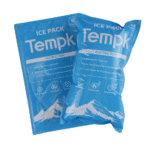
A reusable gel pack temperature sensitive manufacturer usually produces sealed polymer pouches filled with a water-based gel refrigerant. If your shipper is high value, treat the reusable gel pack temperature sensitive manufacturer as a critical supplier, not a packaging afterthought. Safety data sheets for common packs describe water as the main component and sodium polyacrylate as a gelling polymer, packaged in a plastic film.
From a cold chain perspective, a gel pack is never “the solution” by itself. It works with insulation, outer shippers, and packing geometry that controls heat flow into the payload. EU GDP guidance even calls out “cool-packs” in insulated boxes and warns that product should not touch them directly.
That single line changes how you qualify suppliers. Your reusable gel pack temperature sensitive manufacturer must provide consistent dimensions, predictable conditioning behavior, and seams that do not fail after repeated cycles. If packs leak, you create both a thermal risk and a hygiene or contamination risk.
Reusable gel pack temperature sensitive manufacturer pack families
Buyers say “gel pack,” but manufacturers may offer different thermal behaviors. The goal is stable compliance within labeled limits, pas de froid maximum. EU GDP states that required storage conditions should be maintained during transportation within the limits described by manufacturers or outer packaging.
| Pack family | Typical fill / conception | Best-fit use | Mode de défaillance commun | What to ask your manufacturer |
|---|---|---|---|---|
| Water-based gel refrigerant packs | Eau + polymer thickener in a film pouch | Chilled systems when you control conditioning | Payload freezing from misconfiguration | Conditioning SOP, seam integrity tests, fill-mass tolerance |
| Rigid coolant blocks | Rigid container with refrigerant media | Reuse in totes, rugged handling | Weight and dimensional penalties | Drop durability, conseils de nettoyage, retirement criteria |
| Phase change packs | PCM designed to transition near setpoint | Narrow-band control near target range | Wrong PCM setpoint for the lane | Phase transition spec, lot-to-lot consistency, aide à la validation |
Reusable gel pack temperature sensitive manufacturer and temperature bands
Start with temperature bands because they determine pack selection and conditioning. UN 2025 IATA reference table lists controlled room temperature as fifteen to twenty-five degrees Celsius and refrigerated cold chain as two to eight degrees Celsius, showing how these service levels are applied operationally.
A professional engineering discussion referencing United States Pharmacopeia (USP) adds that controlled room temperature is maintained around twenty to twenty-five degrees Celsius, with allowed excursions between fifteen and thirty under mean kinetic temperature constraints.
When you brief a reusable gel pack temperature sensitive manufacturer, use this format: “Product label band + lane season + temps de séjourner + delivery method.” It forces engineering thinking and reduces “one-size-fits-all” quotes.
Market trends shaping reusable gel pack temperature sensitive manufacturer demand
Le 2026 market for reusable cold chain packaging is being shaped by three converging trends: packaging regulation, growth in temperature-sensitive logistics, and higher expectations for traceability and data.
Regulation is a visible driver. When you sell across borders, a reusable gel pack temperature sensitive manufacturer must support documentation that travels with the product and survives audits. The European Commission notes major packaging waste and highlights the scale of packaging’s material footprint, alongside policy goals to minimize packaging and reduce primary raw material use.
The legal timing matters too. Règlement (UE) 2025/40 applies from 12 Août 2026, which is close enough that many 2026 tenders must already reflect new compliance expectations.
Logistics growth is the second driver. An IATA report on air cargo facilities describes rapid expansion of e-commerce and increasing investment in temperature-controlled storage and compliant handling for pharmaceutical trade and cold chain perishables.
Traceability is the third driver. That same IATA report links facility upgrades to digitalization and tracking, which raises the baseline expectation that supply chains can measure, explain, and improve thermal outcomes.
Reusable gel pack temperature sensitive manufacturer implications from packaging policy
EU packaging policy aims for recyclability, increased recycled plastics, and lower virgin materials. It also notes restrictions on certain single-use plastics and introduces substance-of-concern controls, including PFAS restrictions when thresholds are exceeded.
For a reusable gel pack temperature sensitive manufacturer, these pressures show up as buyer requirements with a compliance tone. You should expect increased requests for material declarations, documentation for “reusable” claims, and evidence that reuse is supported by a real system.
Reusable gel pack temperature sensitive manufacturer and modern SEO risk
If this page is part of your acquisition funnel, your content choices can create business risk. Google guidance says rankings aim to prioritize helpful, fiable, people-first content, and it calls out keyword stuffing as a spam practice.
That’s why ranking today is tied to utility. Decision tools, listes de contrôle, and scenario logic help users and also align with E-E-A-T qualities Google describes.
Compliance and validation for reusable gel pack temperature sensitive manufacturer programs
A reusable gel pack temperature sensitive manufacturer is evaluated through your distribution and qualification obligations. Your internal SOPs should name the reusable gel pack temperature sensitive manufacturer as a controlled vendor in your quality system. The manufacturer’s job is to provide consistent packs and the evidence you need to show control during storage and transportation.
Reusable gel pack temperature sensitive manufacturer and EU GDP expectations
European Medicines Agency describes GDP as minimum standards that help maintain medicine quality and integrity throughout the supply chain. It also states that medicines must be stored in the right conditions at all times, including during transportation.
The EU GDP guideline gets very specific for temperature-sensitive products. It requires transportation planning that keeps temperature conditions within acceptable limits, and it calls for procedures to investigate and handle temperature excursions.
Pour les packs de gel, the most load-bearing GDP text is about cool-packs in insulated boxes. It states that cool-packs must not touch product directly, staff must be trained on seasonal assembly and reuse, and there must be a system to control reuse so incompletely cooled packs are not used. It also requires segregation between frozen and chilled packs.
Reusable gel pack temperature sensitive manufacturer and standardized thermal profiles
Most shippers fail due to system interaction, not because any single component is “bad.” That is why standardized test profiles matter for defensible qualification. International Safe Transit Association describes Standard 20 as a design and qualification process for insulated shipping containers, developed by pharma experts, and it includes Standard 7E global thermal profiles.
ISTA also describes Standard 7E profiles as built from real-world shipping lane temperature data, supporting a standardized methodology for demonstrating container performance. For buyers, this reduces vendor cherry-picking and increases comparability across designs.
In manufacturer selection, ask how the supplier controls any change that affects thermal behavior. A change in fill mass, film thickness, or pouch geometry can change the thermal time constant and may trigger requalification in conservative environments.
Reusable gel pack temperature sensitive manufacturer and air cargo handling
IATA’s Temperature Control Regulations provide handling and transportation requirements for pharmaceutical products. IATA also describes a mandatory time and temperature-sensitive shipment label that indicates the external transportation temperature range and clarifies shipper responsibility for correct label application.
This affects supplier qualification because passive systems often rely on gel packs or PCM packs. If your label says “refrigerated,” excursions and mishandling become visible through monitoring and customer complaint channels.
Reusable gel pack temperature sensitive manufacturer and quality systems in 2026
Healthcare supply chains are tightening quality system expectations. Un États-Unis. Food and Drug Administration document notes that a final rule amending 21 Partie CFR 820 is effective February 2, 2026 and aligns the Quality Management System Regulation with ISO 13485:2016 from the International Organization for Standardization.
Even if gel packs are “just packaging,” this trend increases audit scrutiny on packaging component suppliers. A reusable gel pack temperature sensitive manufacturer that can show disciplined quality management reduces your downstream risk and investigation burden.
How to evaluate a reusable gel pack temperature sensitive manufacturer
Evaluating a reusable gel pack temperature sensitive manufacturer is easier when you separate “proof” from “promises.” Most teams improve results when the reusable gel pack temperature sensitive manufacturer participates in pilot design reviews. You want documents that support quality claims, data that supports thermal claims, and operational controls that support reuse claims.
Reusable gel pack temperature sensitive manufacturer evidence request checklist
Use this list as an RFI, RFQ appendix, or audit pre-read. Keep answers in a controlled vendor file so you can justify selection later.
- Material and safety package: SDS for gel fill plus film and additive declarations. Many commercial gel packs identify water and sodium polyacrylate, and they describe non-hazardous status under common systems.
- Process consistency: pouch sealing method, leak test method, and acceptance criteria. Spills can create slip hazards and contaminate packaging, even when the material is non-hazardous.
- Traçabilité: lot coding and the ability to trace product to a production run and material lot. GDP emphasizes documented quality systems and records at the time operations are undertaken.
- Conditioning and packing SOPs: rules for chilling or freezing and seasonal assembly instructions. EU GDP explicitly expects training and procedures for seasonal configurations and reuse.
- Qualification support: evidence tied to standardized profiles or risk-based route planning, rather than “our pack lasts X hours.”
Reusable gel pack temperature sensitive manufacturer questions for refrigerated shipping
Refrigerated shipping is not about maximum cold. It is about preventing warm excursions without freezing the payload at contact points. EU GDP’s “no direct contact” expectation is the simplest high-impact control you can implement.
Ask the manufacturer:
- What tolerance controls exist for fill mass and finished dimensions?
- What conditioning targets do you recommend for refrigerated systems, et pourquoi?
- What reuse-cycle count is realistic in warehouse handling, and how do you retire packs?
- What evidence do you have for seam durability after repeated freeze-thaw events?
Reusable gel pack temperature sensitive manufacturer scorecard table
Use this scorecard to compare suppliers on evidence, not just price. It also gives you a clean audit trail for why one supplier was selected.
| Catégorie | À quoi ressemble le « bien » | Evidence to request | Score (one to five) |
|---|---|---|---|
| Performance thermique | Predictable behavior across seasons and profiles | Configuration test results aligned to standardized profiles | |
| Sécurité des matériaux | Transparent composition and packaging materials | FDS, film declarations | |
| Système qualité | Changer le contrôle, CAPA discipline, traçabilité | Change control SOP, lot trace example | |
| Reuse controls | Clear conditioning rules and segregation practices | Reuse SOP, training materials | |
| Logistics support | Stable lead times and contingency capacity | Service levels and supply plan | |
| Regulatory fluency | Understands GDP and air cargo labeling needs | Validation support kit, temperature-band tracking |
Practical scenarios and case study for reusable gel pack temperature sensitive manufacturer
Scenario-driven design is the difference between a “successful pilot” and a scalable program. A reusable gel pack temperature sensitive manufacturer can only be measured fairly when the scenario matches your real lane risks. GDP requires you to keep required storage conditions during transportation and to report and investigate temperature excursions when they occur.
Reusable gel pack temperature sensitive manufacturer scenario for vaccines and biologics
Centers for Disease Control and Prevention explains that storage and handling errors can lead to wasted vaccines and financial loss, and that temperature exposure outside recommended ranges can reduce potency. It also warns that marketing claims about being “CDC-compliant” can mislead buyers because the agency does not validate private products or services for compliance.
In this scenario, select a reusable gel pack temperature sensitive manufacturer who can support conservative designs. You will want consistent packs, strict conditioning, and packing designs that keep coolant away from the payload surface.
Reusable gel pack temperature sensitive manufacturer scenario for controlled room temperature products
Many “ambient” products still have defined expectations. A professional engineering discussion referencing USP defines controlled room temperature around twenty to twenty-five degrees Celsius, with controlled excursions.
Ici, your reusable gel pack temperature sensitive manufacturer may supply stabilizing packs that act as thermal mass. Validate these systems against realistic staging times and delivery exposure, because spikes can occur in last-mile custody.
Reusable gel pack temperature sensitive manufacturer scenario for perishable food and meal kits
Food shipments amplify leak perception and sanitation risk. A gel pack SDS notes that spilled gel can create slippery conditions, which is a safety and cleanup issue even outside regulated pharma.
For these lanes, prioritize seam integrity, puncture resistance, and cleaning instructions. Also consider whether your reuse program can actually control cleaning and returns at scale.
Reusable gel pack temperature sensitive manufacturer case study
Case study type: composite example based on common cold chain patterns and the cited standards.
A biologics distributor shipped refrigerated parcels using inconsistent conditioning and mixed-pack inventories. Summer deviations and occasional freezing events triggered investigations and reshipments. The team chose a reusable gel pack temperature sensitive manufacturer who provided conditioning SOPs, dimensional tolerances, and testing support aligned to standardized thermal profiles.
The program introduced segregation between frozen and chilled packs, plus assembly training for seasonal configurations. Those controls align directly with EU GDP text on cool-pack reuse and segregation.
The largest operational value came from repeatability. Fewer deviations occurred, and when issues happened, lot traceability made investigations faster and more defensible.
Reusable gel pack temperature sensitive manufacturer ROI model and chart
Use the simple model below to compare total cost per successful delivery. Replace these labels with your cost numbers and your reuse-cycle reality.
| Inducteur de coûts | Single-use coolant programs | Reusable coolant programs | Pourquoi ça compte |
|---|---|---|---|
| Coût unitaire | Lower upfront, repeated purchase | Plus élevé dès le départ, amortized by cycles | Controlled reuse drives break-even |
| Logistique inversée | Minimal | Plus haut | Cleaning and returns must be designed |
| QA workload | Higher when inconsistent | Lower when controlled | GDP requires excursion handling |
| Pression des déchets | Increasing | Mitigated by reuse | EU policy direction is waste reduction |
Break-even intuition (illustrative): as reuse cycles rise, cost per delivery drops.
Relative cost efficiency by reuse-cycle level
- very low reuse: ▁
- low reuse: ▂
- moderate reuse: ▄
- high reuse: ▆
- very high reuse: ▇
This chart is intentionally simple. For serious decisions, model “cost per compliant delivery” and include deviation costs and reshipment risk.
FAQ for reusable gel pack temperature sensitive manufacturer
What should I request first from a reusable gel pack temperature sensitive manufacturer?
Request SDS, film materials, seal method, codage de lots, and conditioning guidance first. Then request evidence that the pack supports validated configurations under seasonal exposure. EU GDP emphasizes procedures, entraînement, and controlled reuse of cool-packs.
How do I avoid freezing product when using gel packs?
Prevent direct contact between coolant and payload, and control conditioning and assembly instructions. EU GDP explicitly states that cool-packs should be located so the product does not come into direct contact.
What validation approach is most defensible across suppliers?
Use standardized thermal profiles and a formal qualification process for the insulated shipping container and configuration. ISTA describes Standard 20 and Standard 7E as a structured path for design and qualification based on real-world temperature data.
Do I need to consider air cargo labeling when I buy gel packs?
If you ship healthcare cargo under time and temperature-sensitive handling, Oui. IATA describes mandatory labeling that indicates the external transportation temperature range and ties it to handling processes.
How does EU packaging regulation affect gel-pack sourcing in 2026?
Règlement (UE) 2025/40 applies from 12 Août 2026, and policy aims include reducing packaging waste and lowering virgin raw material use. The European Commission also notes restrictions on certain single-use plastics and PFAS when thresholds are exceeded.
How do I write this page so it ranks without spam signals?
Follow Google’s published guidance for people-first content and avoid keyword stuffing. Google’s spam policies define keyword stuffing as unnatural repetition intended to manipulate rankings. Build helpful tools like checklists and calculators that reflect real operational expertise.
Recommended schema types for this article
Google documentation covers structured data for Article and FAQPage. Use them to help search engines understand your content, but rich results are not guaranteed.
json
{
  "@context": "https://schema.org",
  "@type": "Article",
  "headline": "Reusable gel pack temperature sensitive manufacturer",
  "dateModified": "2026-02-11",
  "author": {
    "@type": "Person",
    "name": "Your Name"
  },
  "about": [
    "cold chain packaging",
    "reusable gel packs",
    "temperature-sensitive shipping"
  ]
}
json
{
  "@context": "https://schema.org",
  "@type": "FAQPage",
  "mainEntity": [
    {
      "@type": "Question",
      "name": "What should I request first from a reusable gel pack temperature sensitive manufacturer?",
      "acceptedAnswer": {
        "@type": "Answer",
        "text": "Request SDS, film materials, seal method, lot coding, and conditioning guidance first, then request validation evidence for your configurations."
      }
    }
  ]
}
Suggestions de liens internes
Use descriptive anchor text and link to your own supporting pages. This supports a reusable gel pack temperature sensitive manufacturer topical cluster. Replace these slugs with your site’s URLs.
- Gel pack conditioning and reuse SOP template →
/gel-pack-conditioning-reuse-sop - Cold chain packaging validation playbook →
/cold-chain-packaging-validation-playbook - Temperature excursion management workflow →
/temperature-excursion-management-workflow - Thermal profile testing primer →
/thermal-profile-testing-primer - Sustainable cold chain packaging roadmap →
/sustainable-cold-chain-packaging-roadmap
Interactive element ideas
Interactive components can lift conversion rates while improving user understanding:
- A “temperature band selector” that maps products to pack families and conditioning rules.
- A lane-risk intake form that outputs a test plan aligned to standardized thermal profiles.
- A total-cost calculator comparing single-use versus reusable programs by reuse cycles and returns.
Appel à l'action
If you are vetting a reusable gel pack temperature sensitive manufacturer now, build a one-page evidence request. Share it with your reusable gel pack temperature sensitive manufacturer before you discuss pricing, so scope is clear. Ask for SDS, traçabilité, conditioning SOPs, and standardized profile test support. Then run a pilot in a worst realistic seasonal lane, not the easiest one.