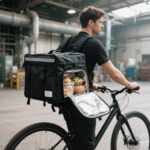
Un projet d'entreprise de sacs fourre-tout isothermes fonctionne mieux lorsque le produit semble utile, durable, et facile à conserver. Dans 2026, corporate buyers are moving away from one-time promotional items and toward reusable utility products that offer stronger brand exposure, better employee or customer value, and a more credible sustainability story. But success depends on more than printing a logo on a large lunch bag. Il faut la bonne taille, structure, confort de portage, contrôle de qualité, et documentation.
Cet article vous aidera à répondre:
- When an insulated tote bag enterprise project makes sense
- How to define the right structure, taille, and carry method
- Which technical details improve reuse and perceived value
- What enterprise buyers now expect on sustainability and compliance
- How to compare suppliers for a better long-term result
Why are enterprise buyers choosing insulated totes?
Because utility creates repeat brand exposure. A tote that carries lunch, épiceries, boisson, or chilled essentials can become part of daily life. That gives your brand more visibility than a short-lived event giveaway. It also supports programs such as employee wellness kits, client gifts, promotions au détail, conference packs, and commuter meal solutions.
Common enterprise use cases
| Program type | Objectif principal | Best product focus | Risk if done poorly |
|---|---|---|---|
| Employee wellness | Daily usefulness | Easy carry and easy cleaning | Low actual use |
| Client gifting | Premium impression | Better shape and finishing | Bag feels generic |
| Retail promotion | Repeat visibility | Strong branding and structure | Rapid wear-out |
| Event giveaways | Practical exposure | Balanced cost and usability | One-time disposal |
Que faut-il définir avant d'acheter?
Define the user experience first. If the bag is too heavy, too narrow, too floppy, or too hard to clean, the project will underperform no matter how good the logo looks.
Start with these questions:
- Who will carry it?
- What will they put inside?
- How heavy will that load be?
- Is shoulder carry or hand carry better?
- Does the bag need to stand upright?
- How often will the user clean it?
- Is the project more premium or more promotional?
- What freight and packaging limits apply?
- Quick specification guide
| Facteur de conception | Option de base | Meilleure option | Pourquoi ça compte |
|---|---|---|---|
| Méthode de transport | Thin handle | Wider reinforced handle | Meilleur confort |
| Base | Soft body only | Semi-structured base | Meilleure présentation |
| Isolation | Generic foam | Balanced layered build | Meilleure stabilité thermique |
| Doublure | Film de base | Easy-clean liner | Meilleure utilisation répétée |
| Marque | Impression simple | Sharper finish and placement control | Better brand impression |
What makes an enterprise tote feel better in real use?
Structure and comfort matter more than decoration. The best enterprise tote is one that opens easily, carries weight without twisting, and still looks tidy after repeated use.
Important design details include:
- handle width
- anchor reinforcement
- opening size
- body shape retention
- nettoyabilité du revêtement
- zipper or top-closure behavior
A premium-feeling tote often comes from simple engineering rather than expensive decoration. A straighter body, cleaner stitching, and better-balanced handle placement can raise perceived value immediately.
Leçon du monde réel: Many branded totes are abandoned because they feel awkward when full. Small changes in handle width and base support can have a bigger effect on actual use than changing the logo finish.
Which materials and compliance points matter?
Material choice affects comfort, durabilité, and brand credibility. Oxford or rPET outer shells can improve structure and appearance, while liner choice affects cleaning ease and user satisfaction. If the tote has food-contact relevance, buyers should request supporting documentation aligned with the EU food-contact framework under Regulation (CE) Non 1935/2004. (Sécurité alimentaire)
Quality and environmental systems also matter. ISO 9001 is helpful for process consistency, et ISO 14001 is a practical signal of environmental management maturity. For enterprise programs with repeat deliveries or multiple SKUs, these system indicators reduce sourcing uncertainty. (Organisation internationale de normalisation)
Why is sustainability more important in 2026?
The policy and market backdrop in Europe is pushing companies toward products and packs that are easier to justify. Le règlement européen sur les emballages et leurs déchets est entré en vigueur en février 11, 2025 et s'applique généralement à partir d'août 12, 2026, reinforcing the broader move toward recyclable packaging and lower waste. Even when an insulated tote is not “just packaging,” that environment still shapes enterprise purchasing behavior. (Environnement)
The same is true for supply-chain transparency. La directive européenne sur le devoir de diligence en matière de développement durable des entreprises est entrée en vigueur en juillet 25, 2024 and aims to foster responsible behavior across value chains. That means more companies now ask branded-product suppliers for clearer material and factory information. (Commission européenne)
RecyClass and CEFLEX also continue to push Europe toward more practical recyclability thinking. For enterprise tote projects, the safest direction is clear: use material stories you can explain, reduce needless complexity, and design for longer reuse. (Classe Recy)
- Comment comparer les fournisseurs?
Use one shared spec sheet and ask every supplier to answer the same questions:
- bag dimensions
- target load
- shell and liner options
- construction d'isolation
- méthode de marquage
- plan d'emballage
- processus d'inspection
- délai de livraison de l'échantillon
- prise en charge de la conformité
- Practical supplier tips
- Pour des cadeaux premium: ask for pack-out photos before bulk shipment.
- For large employee programs: ask for logo placement tolerance.
- For repeated-use retail programs: ask for handle reinforcement details.
- 2026 aperçu du développement et des tendances
- The strongest insulated tote bag enterprise trends in 2026 sont:
- More useful branded products
- Longer reuse over novelty
- More recycled or better-documented shells
- Less wasteful pack-out
- More supplier transparency
- Higher expectations for structure and comfort
- FAQ
Why are insulated totes stronger than basic promo bags for enterprise use?
Because they solve a real problem, which increases repeat use and repeat brand exposure.
- Ce qui compte le plus, style or daily usability?
Utilisabilité quotidienne. A stylish bag that is annoying to carry usually gets ignored.
Should enterprise buyers ask for sustainability support?
Oui, especially if the tote is part of a public-facing brand or ESG-related program.
What is the most common project mistake?
Approving the visual sample before testing real carry weight and practical usability.
Résumé et recommandation
A successful insulated tote bag enterprise program is built around real use. Choose a structure people want to carry, a liner people can clean, and a supplier that can keep bulk production consistent. Dans 2026, the strongest branded tote is the one that feels like a useful product first and a marketing item second.
Si vous voulez de meilleurs résultats, start by defining the user, la charge, and the reuse goal before you touch the artwork file.
À propos du tempk
Tempk develops insulated tote and thermal bag programs for enterprise buyers who need practical performance, clean branding, and dependable production. We focus on products that create longer-term value because people continue using them.
Appel à l'action: Build your next enterprise tote around comfort, durabilité, et répéter l'utilisation, and your branding results will improve naturally.