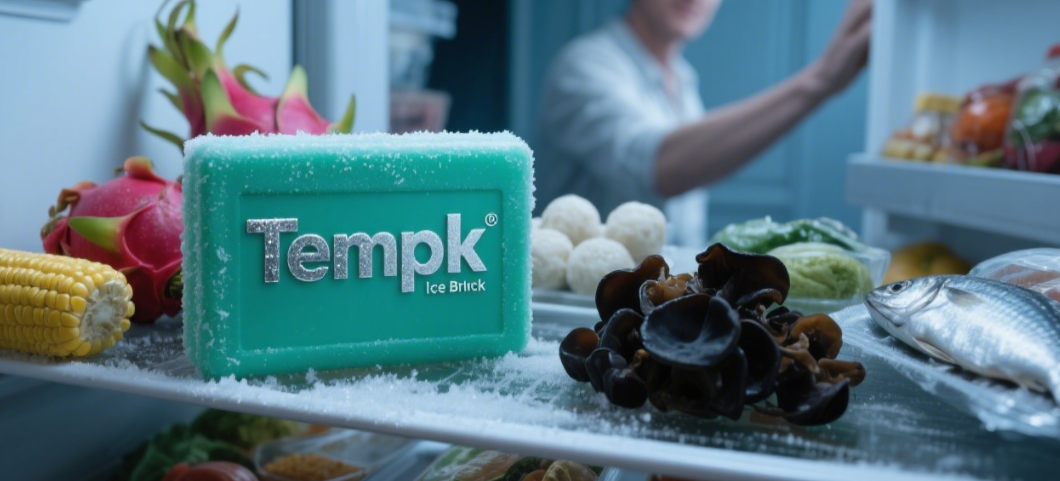
Design de forro de caixa de tijolo de gel para pacotes de pacotes consistentes
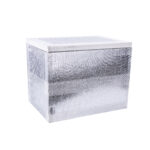
Um tijolo de gel forro de caixa is useful only after it is folded, fitted, carregado, and closed. On a material sheet, the insulation may appear uniform. Inside a shipping carton, lacunas de canto, painéis comprimidos, misordered flaps, and moving bricks can create a very different thermal boundary. The liner slows heat entry; it does not cool the product or regulate a set point.
This format can be efficient for one-way parcels because components may store flat and work with corrugated cases. Its main advantage is adaptability, and its main risk is assembly variation. Treat the installed carton, forro, tijolos, buffers, carga útil, encerramento, and packing method as the product that must be evaluated.
Decide Whether the Liner Format Fits the Distribution Model
Lined cartons are often considered when pre-use storage space, outbound weight, familiar parcel handling, and one-way delivery matter. They may suit foods, ingredientes, cosméticos, materiais de laboratório, and other temperature-sensitive goods when the complete packout meets the applicable product requirements.
A molded cooler can be a better choice when rigid geometry, manuseio repetido, limpeza, and return dominate. A high-performance panel system may be appropriate where wall thickness and heat leakage are critical, provided edges and panels are protected. Active equipment or temperature-managed transport may be more suitable when a passive reserve cannot reasonably cover a long or highly uncertain route.
Make the choice after defining payload, condição necessária, duração total, exposição sazonal, manuseio, umidade, e critérios de aceitação. A liner selected only because it is easy to store can create extra coolant, enchimento, trabalho, or risk at the packing line.
The format also needs an owner. Caixa, forro, tijolo, and spacer may come from different suppliers, but the buyer needs one controlled bill of materials and one person or function responsible for their interfaces.
Four Interface Zones Determine Performance
Panel to panel
Flexible faces can meet as butt joints, overlaps, reforços, or nested folds. Heat and air tend to follow easier routes, so an aligned gap from base to lid can matter more than the broad panel material. Map every corner, borda, slot, and top closure. Specify overlap order and how the carton holds it in place.
Do not assume that metallic facing solves a seam problem. A reflective surface can reduce radiant transfer in an appropriate assembly, but its effect depends on orientation, adjacent space, compressão, umidade, and the other modes of heat flow. Evaluate the completed liner rather than choosing by shine or layer count.
Liner to carton
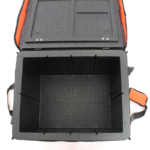
The corrugated case gives the flexible system shape, encerramento, labeling surface, and much of its mechanical protection. Carton dimensions vary within manufacturing limits and can change under compression or humidity. A liner developed in one hand-cut box may buckle in a smaller production case or leave a channel in a larger one.
Review internal case dimensions, board construction relevant to the load, liner tolerances, e fechamento juntos. Tijolos de gel adicione massa, while condensation or leakage can weaken a moisture-sensitive carton. Tape type and pattern are controlled components when they affect closure and distribution strength.
Brick to liner
Rigid brick corners, costuras, bonés, or distorted surfaces can abrade a flexible liner during vibration. A close fit may improve geometry but damage the liner or stop the lid from closing. Excess clearance allows the brick to fall away from its mapped location.
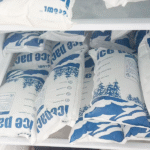
Specify length, largura, grossura, massa recheada, edge form, and allowed dimensional variation in the condition used for packing. WHO prequalification information for vaccine carriers emphasizes that pacotes de refrigerante need the correct size and fit for their Recipiente isolado. The practical principle applies broadly: the coolant should be designed into the cavity, not tossed in as an accessory.
Brick to product
Compact liners can press frozen coolant against the payload. That may be unacceptable for products sensitive to freezing. Use a defined tray, separador, secondary pack, or controlled gap where evidence shows it is needed. The separator’s material, grossura, cobertura, and position must remain consistent with testing.
Build the Cavity From the Product Outward
Start with the minimum and maximum product arrangements. Add required secondary containment and a monitoring position. Establish where bricks can sit without crushing the payload or blocking liner closure. Only then choose liner thickness and the outer carton.
This sequence avoids buying a stock case that leaves a large uncontrolled void or discovering that the liner has consumed the space reserved for coolant. It also makes usable payload space visible. External dimensions and nominal carton volume do not describe the rectangular cavity left after insulation and bricks.
| Design decision | A useful verification question | Risk if it remains vague |
|---|---|---|
| Corner construction | Do all permitted carton and liner tolerances close the corner? | Direct heat path or assembly rework |
| Lid sequence | Which flap closes first, and can the top brick remain in place? | Spring-back, brecha, or compressed insulation |
| Geometria do tijolo | What are the packed dimensions after conditioning? | Punção, mudando, or forced closure |
| Payload band | How is the minimum load restrained without improvisation? | Excess headspace and inconsistent thermal mass |
| Separator | Is cold-contact protection complete at all product positions? | Local lower-temperature excursion |
| Controle de umidade | Is liquid from condensation or leakage contained? | Caixa fraca, perda de rótulo, or payload contamination |
| Outer closure | Which tape or fastening pattern was evaluated? | Mechanical opening and air exchange |
The table should become a prototype review, not a paperwork exercise. Assemble commercial-intent combinations near their permitted dimensional limits. If a control relies on the packer pushing, dobrável, or guessing in a particular way, redesign the physical cue or document the exact operation.
Several payload sizes need explicit solutions
One liner and carton can sometimes support several loads, but folding excess liner material or adding loose filler can change seams, compressão, and air spaces. A small order may warm faster because it has less product thermal mass. Define a low-load insert, a second packout size, or another controlled configuration rather than allowing each shift to solve the space differently.
One large brick can simplify counting and cover a broad face. Several smaller bricks provide placement flexibility but add handling and omission opportunities. Compare the options on external box size, liberação de carga útil, tempo de montagem, cold-contact area, and mapped temperature distribution. There is no universal brick-to-carton ratio.
Treat Moisture as a Design Input
Condensation and leakage can both produce a wet package, but they have different causes. Condensation forms when humid air meets cold surfaces. Leakage means the brick enclosure has lost integrity. Receipt and deviation procedures should distinguish them rather than labeling every wet area as normal sweating.
Choose a moisture strategy appropriate to the payload. It may include a liquid-resistant inner face, a separate product bag, controlled absorbent material, or another form of secondary containment. Do not claim that a liner is watertight unless its seams and closure have been evaluated for that purpose. A moisture barrier can also change heat transfer and end-of-life handling, so include it in the tested build.
For packaged food, verify which materials have direct or indirect food contact and obtain documentation with the correct scope. For laboratory or medical contents, a thermal liner does not replace required primary or secondary containment. Coolant choice cannot satisfy dangerous-goods or specimen-packaging requirements that belong to the payload.
Ferramentas úteis de decisão
Verifique os detalhes antes de escolher a embalagem
Essas ferramentas rápidas podem ajudá-lo a comparar o risco da rota, necessidades de dimensionamento, escolhas de refrigerante, e detalhes da embalagem antes de solicitar um orçamento.
Calculadora de bolsa de gelo
Estime a quantidade de bolsas de gelo em gel para remessas refrigeradas e planejamento prático de rotas.
Estimar bolsas de geloSeletor de embalagens
Compare opções de embalagens isoladas por produto, rota, e necessidade de temperatura.
Encontre embalagensGerador de lista de verificação de conformidade
Crie uma lista de verificação prática para revisão de embalagens, envio, e documentação.
Lista de verificação de construçãoInspect bricks for punctures, vazamento, inchaço, contaminação, selos danificados, and deformation before use. Protect thin or high-performance liner faces from sharp product edges and brick movement. If a wet package arrives, inspect the coolant and carton structure before releasing components for reuse.
Make the Fold Sequence Production-Proof
Flat storage shifts work from the supplier to the packing line. Measure that work at normal speed and peak volume. Spring-back, estático, cold wet bricks, luvas, carton variation, and limited bench space can all change assembly quality.
A visual instruction should show the empty carton, liner orientation, bottom and corner formation, lower bricks, separador, payload band, registrador, upper brick, liner lid, e fechamento externo. If the inside and outside faces have different functions, use identifiers that remain clear under condensation and handling.
Observe both experienced and newly trained staff. Record reversed panels, incomplete overlaps, stressed corners, omitted spacers, overfilled lids, revestimentos danificados, and time from brick removal to final closure. Repeated mistakes usually signal an ambiguous design or workstation, not simply careless people.
Pre-kitting can reduce selection errors. Separate seasonal or payload-specific components physically and by part number. Protect flat liners from crushing, umidade, sujeira, and mixed revisions. A final scan, weight check, or photograph may support verification in standardized systems, but the method should be tested against normal tolerances so it can actually detect a missing or incorrect component.
Test the Weakest Credible Commercial Build
Qualification evidence belongs to the precise carton-liner-brick-payload combination. WHO technical guidance describes design, operacional, and performance qualification stages for passive shipping containers. Use those principles according to product risk and the organization’s quality system.
Operational testing should include justified hot and cold exposure, minimum and maximum payloads, the full door-to-door duration with delay allowance, allowed conditioning variation, and sensor locations near likely warm seams and cold interfaces. Do not use the average of several probes to hide one failing product location.
Padrão ISTA 20 provides a structured process for designing and qualifying contêineres isolados, while ISTA 7E offers thermal profiles for parcel systems. The selected test still needs to represent the product and lane. A standard profile is not a promise for every season, destino, or carrier process.
Mechanical evaluation matters because drops, vibração, compressão, and moisture can open folds, tear faces, shift bricks, or weaken the carton. Inspect the packout after relevant physical challenges and assess whether thermal retesting is warranted in the altered condition.
Performance shipments can then confirm routine assembly and handoffs. Record component identity, condicionamento, packing timestamps, localização do registrador, eventos de operadora, condição de chegada, e tempo de recebimento. If a top corner warms while bricks remain partly conditioned, investigate flap closure and local heat paths before increasing coolant mass.
Procurement Controls Across Multiple Suppliers
For the liner, request construction, dimensões e tolerâncias, desenho dobrável, resposta à umidade, proteção contra perfurações, armazenar, identificação da peça, e notificação de alteração. For the carton, confirm internal dimensions, relevant strength characteristics, encerramento, tolerância de produção, and humidity considerations. For the bricks, review dimensions, filled-mass limits, functional refrigerant information, condicionamento, enclosure and seal controls, documentação de segurança, e rastreabilidade de lote.
Thermal reports should identify the exact components, carga útil, perfis, duração, sensores, e critérios de aceitação. A material test or a report for another carton size is not proof for the proposed commercial packout. Treat supplier claims according to their scope.
Agree on how changes are communicated. Carton board or dimensions, liner layers or adhesive, reflective facing, brick formulation, preencher massa, enclosure resin, spacer grade, fita, ferramentas, or manufacturing site can affect the system. The buyer should assess impact and decide whether fit verification, focused testing, or broader requalification is appropriate.
Compare cost at parcel level. Include component price, cubo de armazenamento, mão de obra de montagem, condicionamento, external dimensions, packed mass, verificações de qualidade, product-loss exposure, and realistic disposal or recovery. A liner that saves warehouse space but produces frequent pack errors may not be the lower-cost system.
Perguntas frequentes
Is an insulated liner equivalent to a molded cooler?
Não automaticamente. A lined carton may offer flat storage and a compact parcel, while a molded cooler usually provides more rigid geometry. Performance depends on the complete construction, refrigerante, carga útil, encerramento, manuseio, e condições de teste. Compare finished systems under the same acceptance criteria rather than comparing material names.
Which way should a reflective liner face?
Follow the supplier’s controlled instruction and the tested packout. Radiant performance depends on orientation, adjacent air space, compressão, umidade, and the rest of the construction. Appearance does not provide a universal rule. Mark the approved orientation clearly if reversing it can affect assembly or performance.
How many gel bricks belong in a lined carton?
There is no universal count. Quantity and location depend on brick properties and condition, liner heat leakage, carga útil, temperaturas iniciais, Headspace, external exposure, duração, and the allowed product range. Develop a candidate layout, map warm and cold locations, and qualify the final configuration.
Does changing the corrugated box require review?
Sim, when the change can affect fit, encerramento, resistência mecânica, comportamento de umidade, or internal geometry. A documented impact assessment should determine the appropriate verification. Even a small dimensional change can open a liner seam, compress a panel, or move a brick toward the payload.
Conclusão: Close the Interfaces Before Adding Coolant
Effective gel brick box liner design depends on fold continuity, ajuste da caixa, controlled brick geometry, protected payload contact, gerenciamento de umidade, and a repeatable closing sequence. Qualify the commercial build at its weakest credible payload and tolerance conditions, then preserve it through clear instructions and supplier change control.
Begin with a physical fit review using production-intent parts. Mark every open corner, compressed face, moving brick, ambiguous flap, and wet zone. Correcting those interfaces before formal thermal work produces a packout that is easier to test, operar, e investigar.
Sobre Tempk
E tempk, nós fornecemos bolsas de gelo em gel e embalagem isolada categories that include box, bolsa, and pallet-level formats. For a lined-carton project, we can discuss brick dimensions, condicionamento, ajuste de isolamento, and component samples using the buyer’s carton and payload information. Suitability and performance should be confirmed for the completed commercial packout and its intended route.
Share your carton drawing, faixa de carga útil, condição necessária, duração da rota, moisture risks, and packing method with Tempk to discuss a fit-focused sample configuration.