Seleção de caixa refrigeradora de tijolos de gel para rotas de transporte reais
UM tijolo de gel cooler box should be selected for a defined job, not for a broad promise that it keeps things cold. Its performance comes from the pairing of enclosure and coolant, plus the payload, brick condition, espaçamento interno, encerramento, manuseio, and journey. O mesmo caixa isolada can be adequate for a short food-delivery loop and unsuitable for a controlled medical shipment.
Start by naming the use category and mapping the complete operating cycle. Then measure the loaded cavity, protect the product from warm and cold extremes, and test the commercial packout. This prevents a common mistake: buying a cooler first and forcing the route and payload to fit it later.
Name the Cooler Category in the Purchase Brief
“Cooler box” covers products with very different evidence and operating expectations. A consumer beverage cooler is designed for convenience. A reusable delivery tote may be managed within a closed grocery, catering, farmácia, or service route. A passive parcel shipper may be designed around a sealed journey. A qualified medical transport system is tied to specified components, preparação, cargas úteis, desafios, e critérios de aceitação.
These categories can share materials and appearance without being interchangeable. Adding frozen bricks to an everyday cooler does not turn it into a qualified system. Current CDC vaccine guidance distinguishes a qualified container and packout, tested under controlled conditions, from ordinary food or beverage coolers. Vaccine programs should follow their current product and program instructions; other healthcare products require their own quality assessment.
A useful purchase brief identifies:
The product and its approved or justified condition
Whether freezing, contato frio direto, umidade, or light is a concern
Minimum and maximum product loads
Total time from packing until controlled storage at receipt
Exposição sazonal, para, transferências, and credible delays
Whether the lid remains closed or opens during the route
Required handling strength, limpeza, retornar, and storage process
Monitoramento, rastreabilidade, and receiving responsibilities
This brief lets a supplier propose a format for an actual duty rather than comparing unrelated catalog capacities.
The Usable Cavity Matters More Than Nominal Volume
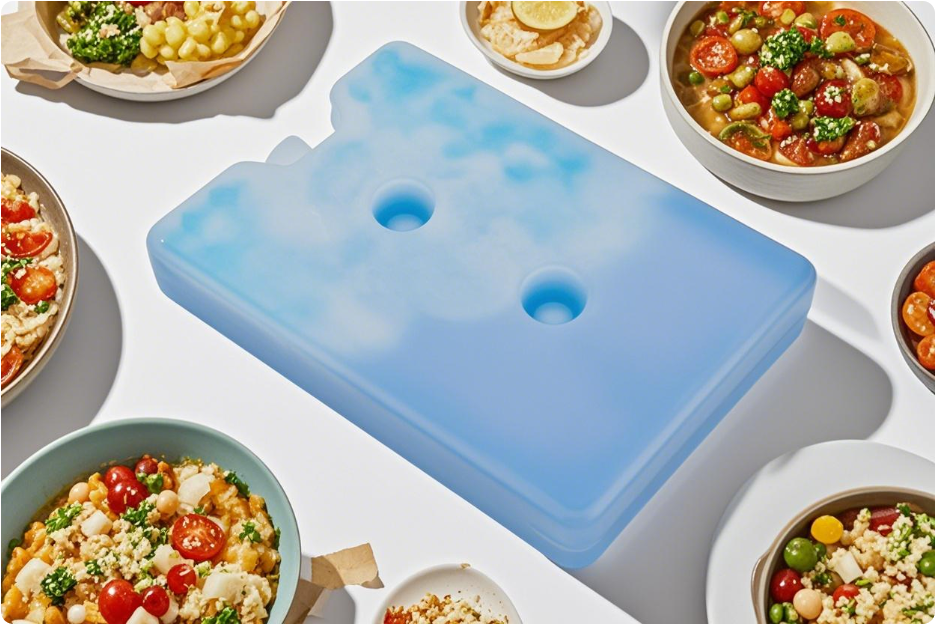
A capacity label does not show where products and bricks can safely sit. Molded wall taper, cantos arredondados, dobradiças, alças, lid recesses, drain features, cestas, and dividers reshape the interior. Insulation and liners consume additional space. A brick may also change slightly in shape after conditioning.
Build a payload envelope that remains clear after the complete brick array, separadores, registrador, and closure clearance are added. Measure a production-intent sample at the base, meio, e tampa. Check the lowest and highest permissible brick dimensions rather than assuming the nominal drawing represents every unit.
The lid deserves a physical trial. If the top layer requires force, it can crush product, bow a brick, compress insulation, or prevent full engagement. A package that looks closed while a corner gap remains has a different heat path from the tested assembly.
Cooler size also changes heat flow. A small box has a different relationship between external surface and payload volume from a large one. A tall cavity can develop vertical gradients; a wide lid presents a large upper boundary. Doubling volume and brick count does not recreate the same thermal behavior.
| Cooler duty | Enclosure features to examine | Coolant and payload concern | Evidence that supports a decision |
|---|---|---|---|
| Sealed one-way parcel | Low external cube, fechamento seguro, proteção externa | Duração, mudando, and minimum-load headspace | Full packout thermal and distribution test |
| Repeated local delivery | Durable body, accessible cleaning, fácil manuseio | Recondicionamento, aberturas de tampa, recuperação, e inspeção | Route simulation plus asset-control procedure |
| Controlled healthcare transport | Fixed bill of materials, controle de violação, rastreabilidade | Proteção contra congelamento, monitoramento, e controle de mudança | Product-specific qualification and quality approval |
| Distribuição de alimentos | Higiene, contenção, empilhamento, carregamento rápido | Product prechill, líquido, esmagamento, and variable fills | Food-safety review and representative route trials |
| Field collection | Portable closure, contenção secundária, custódia | Warm additions, changing load, and sample protection | Procedure-specific evaluation and monitoring plan |
The table is not a material ranking. A reusable rigid box can be efficient where vehicles return to one depot and burdensome for distant one-way delivery. A light parcel shipper may reduce freight but require stronger control of damage and disposal. Match the format to the operating loop.
Arrange Bricks to Control Both Ends of the Range
The brick array influences temperature distribution as much as total coolant mass. Side channels can create a clear central cavity, but bricks must be restrained from falling inward. A top layer can address lid exposure and make counting simple, yet it may overcool upper products. Top-and-bottom layers offer compact coverage while increasing cold-contact and pressure risks. A full perimeter occupies more payload space and can create a cold boundary around sensitive contents.
There is no universally correct position. Select an initial arrangement from the likely heat-entry paths and the product’s lower and upper limits, then map the actual result.
Manage early cold exposure
A frozen water-rich brick can leave the freezer with a surface below the allowable condition of some chilled products. Direct contact may produce a local cold excursion even when the average air temperature looks acceptable. Use a defined spacer, basket, manga, or alternate conditioning method when testing shows it is needed. The buffer’s material, grossura, cobertura, and placement become controlled parts.
Lowering the freezer set point to correct a late warm result can make this early risk worse. Da mesma maneira, adding bricks without data may increase freight and displace payload while creating more cold surface area.
Preserve late-route capacity
Warm performance depends on the rate of heat entry, the brick’s stored cooling capacity, massa térmica do produto, e tempo decorrido. Start product within its approved condition unless a validated process intentionally uses the shipper for pull-down. Warm products can consume reserve before the carrier collects the box.
Use void control to keep the load in the mapped position. A minimum order often presents the harder case because it has less thermal mass and more room for movement. Approve a defined low-load insert or another cooler size rather than leaving drivers to improvise with spare packaging.
Ferramentas úteis de decisão
Verifique os detalhes antes de escolher a embalagem
Essas ferramentas rápidas podem ajudá-lo a comparar o risco da rota, necessidades de dimensionamento, escolhas de refrigerante, e detalhes da embalagem antes de solicitar um orçamento.
Referência de material de isolamento
Compare as opções de materiais de isolamento para diferentes necessidades de embalagens da cadeia de frio.
Compare materiaisVerificador de risco de rota
Revise as condições da pista antes de selecionar a embalagem para requisitos operacionais reais.
Verifique o risco da rotaCalculadora de bolsa de gelo
Estime a quantidade de bolsas de gelo em gel para remessas refrigeradas e planejamento prático de rotas.
Estimar bolsas de geloDesign Around the Whole Use Cycle
The thermal journey begins before vehicle departure and may continue after proof of delivery. Document brick conditioning, preparação de caixa, carregamento do produto, preparação de despacho, transporte, aberturas, recibo, descarregamento, retornar, limpeza, e armazenamento.
Multi-drop routes deserve their own design. Every lid opening exchanges internal air with the environment, exposes the upper layer, and changes product mass. The final stop may combine the longest elapsed time with the lightest load. A sealed-lid duration cannot be transferred to that workflow without assessment.
Reproduce the expected opening pattern during development. Specify frequency, opening duration, product removal, condição ambiente, and whether bricks move. Organize orders so the driver does not search with the lid open. Smaller route modules or an inner flap may be useful, but they must be evaluated as part of the configuration.
Consider a pharmacy delivery route with several stops. The first packout uses one large cavity, and staff remove dividers as orders leave. By the final stop, two bricks have fallen toward the remaining product. The correct response is not necessarily more coolant. A fixed compartment system, stop-specific modules, or separate smaller boxes may preserve geometry and reduce lid-open time. The proposed correction still needs mapped testing.
Failed delivery and return are also boundary conditions. Define whether the box returns to controlled storage, remains in a vehicle, or is delivered later. Packaging reserve cannot replace a named escalation contact and a recovery procedure.
Build Evidence for the Exact Box-and-Brick Pair
Development testing should use the quoted cooler, brick part, separadores, payload or justified simulant, encerramento, and actual conditioning process. Place calibrated sensors at suspected warm and cold product locations, not only at the center. Include minimum and maximum loads and relevant hot and cold exposure.
WHO technical guidance describes design, operacional, and performance qualification for passive contêineres de transporte. Padrão ISTA 20 offers a structured process for insulated-container design and qualification, while ISTA 7E provides parcel thermal profiles. These references can support a protocol, but the chosen challenge still needs to reflect the product, rota, aberturas, e atrasar o risco.
Mechanical evaluation should represent expected drops, vibração, compressão, e manuseio. A cooler that performs while stationary may develop a lid gap after impact or allow bricks to migrate under vibration. Reusable assets should be tested and inspected in a condition representative of permitted wear, não só quando novo.
Field trials then test the surrounding operation. Link logger traces to departure, para, aberturas, atrasos, condição do pacote, e recibo. Um registrador registra a exposição; it does not actively cool the product. Sua precisão, calibração, intervalo, colocação, ativação, and review process should support the intended quality decision.
Receipt should be part of the protocol, not an informal handoff. Identify who checks the seal and box condition, stops or retrieves the logger, transfers the payload to controlled storage, and reports a deviation. A box left unopened at a reception desk is still consuming its thermal reserve. The receiving record helps separate packaging performance from a late internal handoff and gives the quality team context when a temperature trace requires assessment.
Reuse Is a Managed Return Loop
A durable box does not create a reuse program by itself. The program needs ownership of returns, capacidade de limpeza, espaço de secagem, inspeção, released inventory, peças de reposição, and a retirement decision. Unknown handling outside organizational control can compromise cleanliness or the qualified geometry.
Inspect sealing surfaces, engate da tampa, hinges or latches, wall and base damage, drain features, rótulos, and internal dimensions. Check bricks for cracks, vazamento, inchaço, deformação, contaminação, and loss of identification. Keep dirty returns, cleaned assets, quarantined items, and released stock separated.
Cleaning instructions should identify compatible agents, concentração, tempo de contato, rinsing where required, and complete drying. Chemicals or heat can damage plastics, revestimentos, adesivos, juntas, ou impressão. Difficult seams and hardware may need special attention.
Track completed dispatches and successful returns rather than assuming a service life from material type. Lifecycle cost and environmental value depend on actual recovery, inspection rejection, limpeza, empty transport, perda de ativos, e proteção do produto. A reusable label is a design intention, not operational evidence.
Supplier Questions That Expose Hidden Assumptions
Ask box and brick providers to respond to the same duty statement. Request internal and external drawings, manufacturing tolerances, insulation construction, detalhes de fechamento, brick filled-mass limits, refrigerant functional data, instruções de condicionamento, and safety or transport documentation relevant to the exact formulation.
Any thermal duration should come with its boundaries: exact box, tijolos, carga útil, condições iniciais, perfil ambiente, posições dos sensores, Critérios de aceitação, and point from which time was measured. A result from a different size or empty-box test can guide early screening but should not be treated as qualification for the proposed packout.
Review cleaning compatibility, leak and mechanical test methods, lot or asset identification, incoming packaging, continuidade de fornecimento, and change-notification terms. A cheaper brick with matching dimensions can still differ in fill mass, comportamento de fase, condutividade da casca, expansão, ou selagem. Assess substitutions through the buyer’s change process before routine use.
The sample-to-production handoff is critical. Use samples from the intended commercial specification and site where possible. Confirm that production tolerances leave enough assembly clearance and that the supplier will identify the first changed lot after an approved revision.
Perguntas frequentes
How long will a gel brick cooler box remain within range?
There is no responsible universal duration. Performance depends on the cooler construction, brick formulation and condition, carga útil, temperaturas iniciais, layout interno, perfil externo, aberturas, and allowed product range. Ask for test conditions and qualify the exact commercial configuration for the intended journey and delay allowance.
Can an ordinary cooler be used for medicine transport?
Do not assume that it can. The medicine’s approved conditions, rota, monitoramento, quality process, and applicable program guidance determine suitability. Vaccine programs should follow current public-health and product instructions, which distinguish qualified packouts from ordinary food or beverage coolers. Other medicines require a product-specific decision.
Should the box itself be preconditioned?
Preconditioning may be part of some tested packouts, but it should not be added informally. It changes labor, umidade, and starting thermal load. If the qualification used a specified box condition, operations should reproduce it. Se não, assess the proposed step before changing the approved process.
When should a reusable cooler be removed from service?
Use defined rejection criteria for cracks, panel damage, deformação, failed lid or gasket engagement, contaminação, odor, illegible identity, and dimensional change. Cycle count may support inspection planning, but actual condition and periodic performance evidence are more useful than appearance or age alone.
Conclusão: Select the Operating System, Not the Empty Box
The right gel brick cooler box has physical fit, ajuste térmico, e ajuste ao processo. Its cavity accepts a stable coolant-and-payload layout; its insulation and closure address the route; its condition can be reproduced; and its daily handling remains inside the tested design. Qualification and field monitoring then provide evidence for a defined use rather than a broad material claim.
Before comparing bulk quotations, assemble one production-intent sample with the real load. Measure clearance, carry it as operators will, open it according to the route, and identify every choice a packer or driver could make differently.
Sobre Tempk
E tempk, nós oferecemos bolsas de gelo em gel and insulated formats that include caixas mais frias, bolsas, and other temperature-control packaging. We can help buyers compare brick geometry with the usable cavity and discuss standard or customized component options for development. Limites do produto, condições da rota, limpeza, monitoramento, and final qualification remain specific to the buyer’s application.
Send Tempk your payload dimensions, condição necessária, journey and opening pattern, conditioning resources, and return plan to discuss a cooler-and-brick sample for evaluation.