


Amolecer e recongelar altera a qualidade
As banheiras podem parecer congeladas na entrega enquanto o produto já perdeu a textura lisa.
Cadeia Fria de Banheiras de Sorvete
As cubas de sorvete são mais robustas que os bolos decorados, mas eles ainda falham quando as tampas se soltam, caixas ficam molhadas, produto suaviza, ou a pressão do gelo seco danifica as embalagens de varejo. A embalagem deve manter uma rota congelada e proteger a pilha de cubas.
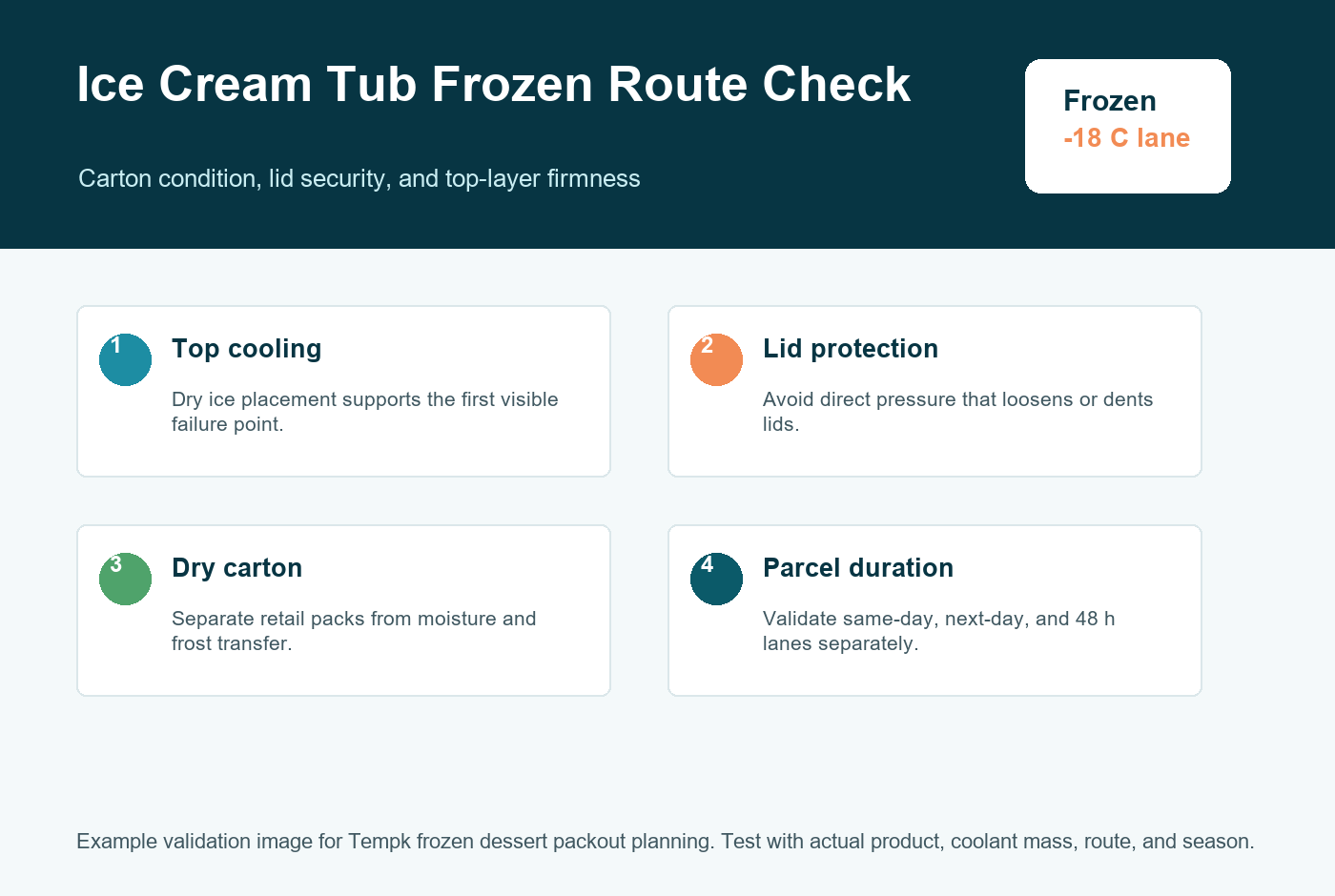
Risco do Produto
O pacote certo deve proteger a qualidade da chegada, não apenas mostra um rastreamento de registrador frio. Os pontos de risco abaixo determinam a massa de gelo seco, isolamento, suporte ao produto, ventilação, e recebimento de cheques.
As banheiras podem parecer congeladas na entrega enquanto o produto já perdeu a textura lisa.
Gelo seco, divisores, e outras banheiras não devem pressionar as tampas para fora da posição.
Geada e condensação podem enfraquecer as capas de papel, rótulos, e caixas externas.
A embalagem deve ser dimensionada para que haja proteção contra congelamento no momento esperado do recebimento.
Recomendação baseada em rota
Estas são faixas iniciais práticas para testes de rota. A massa final de gelo seco e a espessura do isolamento devem ser verificadas com a carga útil real, remetente, modo de operadora, rota, e recebendo padrão.
| Condição de envio | Pacote temporário recomendado | Iniciando a direção do gelo seco | Posição do gelo seco | O que validar |
|---|---|---|---|---|
| Entrega congelada no mesmo dia 8-18rota h, ambiente abaixo 22 C, banheiras ultracongeladas | Remetente EPS ou EPP, divisórias de banheira, forro, zona de gelo seco, e caixa externa ventilada | Sobre 1.5-2.5 kg de gelo seco por 2-5 kg de carga útil da cuba como intervalo de teste inicial. Use a calculadora de gelo seco para carga útil e rota reais. | Zona de gelo seco superior ou lateral com divisória; mantenha gelo seco e embalagens pesadas longe das tampas das banheiras. | Dureza da banheira, vedação da tampa, secura do rótulo, condição da caixa, e gelo seco restante |
| Rota de encomendas noturnas 18-36rota h, manuseio de depósito, ambiente 22-30 C | Remetente EPS/EPP mais espesso, pilha de banheira fixa, forro de umidade, divisor de gelo seco, e registrador | Sobre 3.0-5.0 kg de gelo seco para um teste de pacote pequeno. Ajustar pela contagem de banheiras, volume da caixa, nível de isolamento, e limites da operadora. | Layout de gelo seco superior e lateral com uma forte divisória e caminho de ventilação de gás. | Banheira mais quente, movimento da tampa, geada, molhamento da caixa, e gelo seco restante |
| Rota com clima quente ou propensa a atrasos 30-35 C ambiente, 36-48h risco, fim de semana é possível | Transportador isolado de alto desempenho, maior margem de gelo seco, caixa reforçada, expedidor ventilado, e registrador de rotas | Sobre 5.0-8.0 kg de gelo seco para testes prolongados. Confirme o headspace, regras de rótulo, e restrições da operadora antes do escalonamento. | Gelo seco perimetral com divisórias e sem pressão direta na tampa; mantenha as banheiras na posição vertical e estável. | Temperatura máxima, gelo seco restante na entrega atrasada, textura do produto, condição do rótulo, e compressão de caixa |
Massa de gelo seco é um ponto de partida, não é uma garantia. Ajuste pela temperatura do produto na embalagem, peso da carga útil, tamanho do remetente, material de isolamento, forma de gelo seco, duração da rota, perfil ambiente, e regras da operadora. O gelo seco não deve ser selado em um recipiente hermético, e remessas aéreas ou de encomendas podem exigir rotulagem e documentação específicas.
Estrutura do pacote
As embalagens de sobremesas congeladas precisam de suporte do produto e separação de gelo seco antes que o remetente seja selado. Comece com a condição do produto, força da embalagem de varejo, e ventando, em seguida, dimensione o gelo seco e o isolamento.
Processo de embalagem
O expedidor deve preservar um produto congelado, não resgatar aquele que já amoleceu. O bom manuseio antes da selagem reduz a necessidade de gelo seco e evita defeitos visíveis do produto.
Não deixe os recipientes em temperatura ambiente enquanto a embalagem estiver sendo preparada.
Mantenha as banheiras na posição vertical, reduzir o espaço vazio, e evite a pressão da tampa ao gelo seco.
Use divisórias e um forro para que as etiquetas e caixas não congelem ou molhem.
Revise a dureza, vedação da tampa, secura do rótulo, condição da caixa, traço de temperatura, e gelo seco restante.
Quando mudar o design
Melhorar o revestimento, divisor de gelo seco, e gerenciamento de umidade antes de alterar a temperatura da rota.
Reduza a pressão da pilha, adicionar divisórias, e afaste o gelo seco das tampas.
Aumentar a margem de isolamento, ajustar a massa de gelo seco, reduzir a duração da rota, ou altere o tamanho do remetente.
Recursos relacionados
Compartilhe o tamanho da banheira, formato de caixa, contagem de carga útil, temperatura do produto, tempo de rota, faixa ambiente, modo de operadora, e recebimento de cheques. Tempk pode ajudar a escolher o remetente, layout de gelo seco, divisores, ventilação, e etapas de validação.
Solicite uma revisão de rota congeladaSuporte a pacotes personalizados
Para tamanhos de caixa fixos, limites de carga útil, requisitos de marca, pistas sazonais, ou alvos de validação, A Tempk pode adaptar esta solução em um pacote personalizado de cadeia de frio.