حلول تغليف سلسلة التبريد: How to Select a Packout That Can Be Tested and Repeated
تغليف السلسلة الباردة solutions are most reliable when buyers stop treating them as a choice between boxes and start treating them as controlled packouts. A complete packout connects the product’s allowable condition to insulation, وسائط التبريد, ترتيب الحمولة, التعرض للطريق, تعليمات التجميع, monitoring and test evidence. If one of those elements changes, the shipment can behave differently even when the outer package looks the same.
This article uses a buyer decision framework rather than a product catalog. The goal is to help procurement, logistics and quality teams decide what must be specified, what evidence is meaningful and when a standard configuration should be escalated to route-specific testing or qualification.
First define what failure looks like
The fastest way to narrow a cold chain packaging choice is to define the failure that matters most. “Temperature-sensitive” is too broad. A shipment can fail because it becomes too warm, يتجمد, يذوب, experiences a short critical excursion, arrives wet, تسرب, loses structural protection or reaches the receiver without usable temperature evidence.
Different failures call for different controls. A refrigerated pharmaceutical payload may require strong freeze protection around the product even while the package has enough cooling reserve for hot weather. Frozen food may tolerate a wider temperature behavior than a biologic but have strict expectations for texture and arrival condition. A pallet of temperature-sensitive freight may need protection mainly during airport or dock exposure rather than full passive control for the entire route.
Before discussing materials, write down four things:
1. حالة المنتج: the labeled, specified or operational temperature requirement and any limits on freezing, ذوبان الجليد, moisture or light.
2. تعرض الطريق: وقت العبور المخطط له, التأخير المحتمل, موسم, transport mode and uncontrolled handoffs.
3. تعريف الحمولة: أبعاد, كتلة, thermal state, unit count and usable-space requirement.
4. Evidence requirement: simple sample comparison, اختبار الغرفة, formal qualification, route confirmation or regulated documentation.
This converts a vague sourcing request into an engineering and procurement problem that can be tested.
Use six variables to build the packout
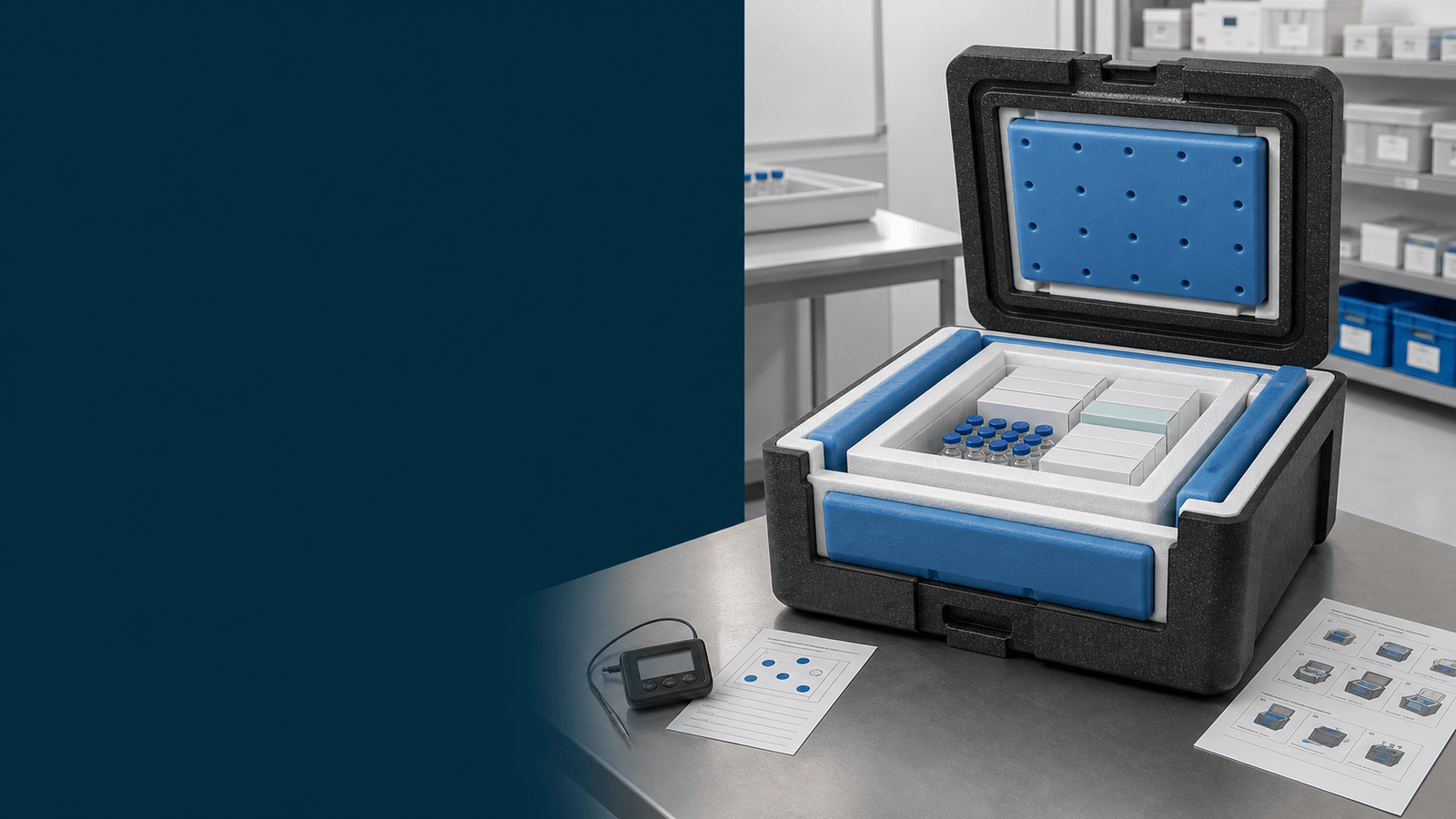
A practical cold chain packout can be reviewed through six variables: العزل, سائل التبريد, حمولة, الانفصال, route and process.
1. Insulation controls heat-flow rate
EPS, إي بي بي, بطانات معزولة, الأكياس الحرارية and VIP-based shippers all reduce heat transfer in different ways. Material properties matter, but system geometry matters too. سمك الجدار, طبقات, الإغلاق, زوايا, lids and thermal bridges can materially affect performance.
This is why a material datasheet should not be used as a substitute for a packout report. The datasheet explains the component; the test evaluates the assembled system.
2. Coolant provides thermal reserve
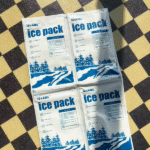
حزم هلام, عبوات الثلج المائية, طوب الجليد and phase change materials absorb or release energy as the system moves toward equilibrium with the environment. Dry ice supports much colder applications but introduces different handling and transport requirements.
A coolant’s nominal temperature or phase-change point does not equal payload temperature. The outcome depends on coolant mass, مساحة السطح, تكييف, العزل, payload and ambient profile.
For freeze-sensitive medicinal products, coolant contact is a major design issue. EU Good Distribution Practice states that cool-packs used in insulated boxes should be located so medicinal products do not directly contact them. The same principle is useful more broadly: a cold source should be arranged to protect the target range, not simply maximize local coldness.
3. Payload changes the energy balance
ثقيلة, preconditioned payload can provide more thermal mass than a light one. Payload geometry changes airflow and contact area. Empty space changes internal convection. A surrogate payload used in testing may be appropriate, but the report should explain why it represents the commercial load.
Usable internal volume therefore deserves as much attention as external box size. Adding insulation or coolant can improve thermal reserve while reducing payload efficiency and increasing freight volume.
4. Separation manages local hot and cold spots
المخازن المؤقتة, المقسمات, absorbent layers and product supports are not decorative extras. They can control direct coolant contact, stabilize geometry, manage condensation and maintain predictable spacing.
If the packout relies on a specific separator, its material and thickness should be part of the controlled configuration. Replacing it with “something similar” can invalidate the assumptions behind the test.
5. Route exposure defines the challenge
A route is a sequence of environments. انطلاق الالتقاط, الفرز, عبر قفص الاتهام, منحدر المطار, جمارك, warehouse dwell and last-mile delivery can each introduce different temperatures and delays.
The planned transit time is therefore only one input. A useful route profile also considers the most credible uncontrolled dwell, حار- and cold-season conditions, whether the package is opened, and how quickly the receiver moves the product into controlled storage.
6. Process determines repeatability
A packout only works operationally if people can assemble it the same way every time. تكييف المبرد, اتجاه الحزمة, ترتيب التحميل, tape or closure method, الحد الأقصى لوقت التجميع, logger position and staging rules should be clear enough for routine operations.
The strongest laboratory design can still fail if the warehouse process is ambiguous.
Select the packaging family by the job it must do
| عائلة التعبئة والتغليف | دور نموذجي | Best questions to ask before approval |
| بطانة كرتونية معزولة | Space-efficient parcel insulation | How is the liner closed, and how sensitive is performance to gaps or carton condition? |
| الشاحن EPS | Passive chilled or frozen parcel system | What density, سماكة, lid fit and tested configuration are supplied? |
| صندوق EPP قابل لإعادة الاستخدام | متينة, التوزيع القابل للإرجاع | What is the return, cleaning and damage-inspection process? |
| VIP medical shipper | Lower heat-transfer design for demanding payloads | How are panels protected, and what happens if a panel is damaged? |
| كيس حراري | Flexible last-mile or short-route protection | How are zipper, seam and opening losses controlled? |
| غطاء البليت الحراري | Protection during pallet staging and handoffs | Is the need short-term exposure reduction or continuous temperature control? |
This comparison should be used as a shortlist, not a final selection rule. A package family only becomes a solution after the coolant, payload and route are defined.
Ask for evidence in layers
Cold chain evidence is easier to judge when it is separated into layers instead of summarized as one claim.
Component evidence includes insulation specifications, coolant technical information, dimensions and construction details. It helps confirm what the system is made from.
أدلة الحزمة includes chamber tests or structured thermal studies that show how a defined configuration behaves under a defined ambient profile.
أدوات اتخاذ القرار مفيدة
تحقق من التفاصيل قبل اختيار التغليف
يمكن أن تساعدك هذه الأدوات السريعة في مقارنة مخاطر المسار, احتياجات التحجيم, خيارات المبرد, وتفاصيل التعبئة والتغليف قبل أن تطلب عرض أسعار.
بطانة الصندوق & تحجيم غطاء البليت
تحقق من منطق تحديد حجم بطانة الصندوق وغطاء منصة التحميل لمشاريع التغليف المعزولة.
تقدير الحجمسائل التبريد & مرجع PCM
قارن خيارات سائل التبريد وPCM عندما يحتاج المسار إلى دعم إضافي لدرجة الحرارة.
قارن الخياراتمولد قائمة التحقق من الامتثال
قم ببناء قائمة مرجعية عملية لمراجعة التغليف, شحن, والتوثيق.
بناء قائمة مرجعيةأدلة التأهيل connects the test method, معايير القبول, اختبار الملف الشخصي, payload and controlled configuration to an approval decision. معيار ISTA 20 and Test Standard 7E are examples of recognized industry frameworks for structured حاوية شحن معزولة qualification and standardized thermal profiles. They are useful methods, but they are not automatically required for every shipment or market.
أدلة الطريق comes from actual distribution or lane characterization. It helps confirm whether assumptions about dwell, ambient exposure and handling match real operations.
These layers should not be collapsed. A good material does not prove hold time. A chamber test does not prove every route. A logger record from one successful shipment does not prove performance after the packout changes.
Read hold-time claims as conditional statements
A statement such as “maintains temperature for 72 hours” should trigger questions, not immediate acceptance.
A defensible hold-time claim should identify the ambient profile, حمولة, تكوين المبرد, طريقة التكييف, sensor locations and acceptance range. If any of those details are missing, the claim may still be useful as an early comparison, but it should not be treated as universal route performance.
لفرق المشتريات, a simple rule works well:
Hold time = result + شروط.
Without the conditions, the number is incomplete.
This matters particularly when comparing suppliers. One supplier may test at a constant ambient temperature, another with a dynamic profile, and a third with a different payload. The longest published number is not necessarily the strongest evidence.
Decide when standard testing is enough and when the lane needs more
Not every shipment needs the same level of qualification. The evidence should match product risk, route variability and business consequence.
A low-risk, قصير, stable route may begin with a supplier-supported configuration and sample test. A high-value pharmaceutical payload, long cross-border lane or route with severe seasonal exposure may require more formal qualification and ongoing monitoring.
Escalate the evidence requirement when:
- The product has a narrow or asymmetric allowable range.
- Freezing is as damaging as overheating.
- The route includes uncontrolled airport or customs dwell.
- The payload is high value or difficult to replace.
- The shipper will be reused many times.
- The program is moving from samples to high-volume distribution.
- Customer or quality-system approval requires documented qualification.
- الحزمة, route or carrier has changed materially.
إرشادات منظمة الصحة العالمية النموذجية للوقت- and temperature-sensitive pharmaceutical products sets out principal requirements for safe storage and distribution while noting that local laws and regulations take precedence. في الاتحاد الأوروبي, GDP guidance requires a risk-based approach to transportation and states that temperature-sensitive products should use qualified equipment where needed to maintain the correct transport conditions. These are useful boundaries: qualification supports the intended use; it is not a universal certificate that makes one package suitable everywhere.
Monitoring supports decisions; it does not create protection
Temperature loggers are essential in many cold chain programs, but they serve an evidence function. They record exposure at the measurement point.
The monitoring plan should define why the logger is present, حيث يتم وضعها, how it is calibrated, what interval it records, who reviews the data and what action follows an excursion. A sensor placed next to coolant can answer a different question from a sensor at the payload center.
For pharmaceutical and vaccine programs, receiving procedures also matter. FDA current good manufacturing practice requires finished drug products to be stored under appropriate temperature, humidity and light conditions so that product identity, قوة, quality and purity are not affected. مراكز السيطرة على الأمراض 2026 Vaccine Storage and Handling Toolkit directs providers to product-specific manufacturer information for FDA-approved vaccines and emphasizes proper storage, handling and response to excursions. Packaging evidence must therefore connect to the product’s own approved or specified requirements.
Make sample approval transferable to bulk production
The step from a successful sample to a repeatable production program is where many packaging projects become fragile.
The buyer should identify which features are critical to thermal performance and lock them into the production specification. اعتمادا على النظام, this can include:
- مادة العزل, grade or density.
- Wall or panel thickness.
- الأبعاد الداخلية والخارجية.
- Coolant formulation and fill mass.
- Film or pouch construction.
- Separator material and thickness.
- غطاء, zipper or closure method.
- Coolant quantity and position.
- Carton specification.
- Packing sequence and orientation.
The supplier should also explain change control. If a material, dimension or coolant changes, who reviews the effect? Does the buyer receive notice? Does the change require testing?
للأنظمة القابلة لإعادة الاستخدام, add inspection criteria. Reuse is only safe when damage that can affect performance is detected and managed.
Put the right questions into the RFQ
A good RFQ reduces the risk of comparing incomparable quotations. Include the shipment requirement and ask suppliers to respond to the same evidence questions.
على الأقل, specify:
- Product and target temperature or condition.
- Freeze or thaw sensitivity.
- أبعاد الحمولة, mass and quantity.
- Required transit time and delay margin.
- طريق, season and transport mode.
- Preferred disposable or reusable format.
- Monitoring requirement.
- Required test or qualification evidence.
- Usable internal-space requirement.
- وضع العلامات, OEM or custom-size needs.
- Forecast and bulk order expectations.
Then ask the supplier to state the exact packout, عملية التكييف, أساس الاختبار, production-controlled features and any assumptions that remain open.
A simple decision example
Consider a distributor that needs to ship a refrigerated product on two lanes. Lane A is a predictable regional parcel route with staffed receiving. Lane B crosses a border, includes customs uncertainty and can experience both hot and cold seasons.
Using the same packout on both lanes may simplify purchasing, but it can create unnecessary cost on Lane A or insufficient margin on Lane B. A better approach is to define one controlled platform and test whether seasonal or route-specific coolant configurations are justified. That preserves operational consistency while acknowledging that the routes are not thermally identical.
This is also where total cost matters. A higher-performance shipper may reduce coolant mass, freight weight or failure risk, while a lower-cost box may require more coolant and warehouse freezer capacity. Unit price alone does not show the system cost.
The best cold chain solution is explainable
A cold chain packaging solution should be explainable in one chain of logic: the product has a defined requirement; the route creates defined risks; the packout addresses those risks; testing represents the intended conditions; production controls preserve the tested configuration; and monitoring or receiving procedures confirm what happened in distribution.
That is a stronger buying standard than “the box is insulated” or “the supplier says 72 hours.” It also makes future changes easier to manage because the team knows which assumptions matter.
Tempk supplies passive cold-chain components including gel packs, PCM والطوب الجليدي, أكياس وبطانات معزولة, EPP/صناديق VIP, أغطية البليت الحرارية and packout planning support. To compare options, share the target temperature, حمولة, مدة الطريق, التعرض الموسمي, preferred packaging format and evidence requirement. The useful output is a defined configuration that your team can sample, امتحان, approve and repeat.