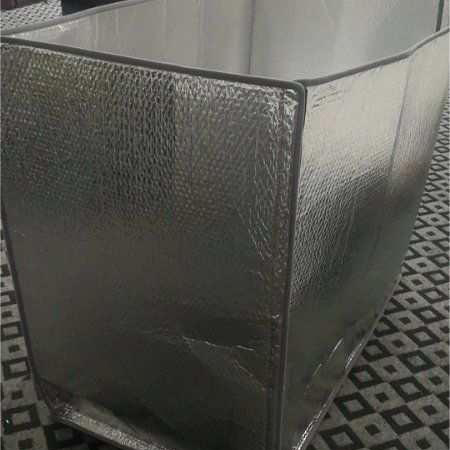
Thermal Cargo Covers for Industrial Chemicals: Build the Control Before Buying the Cover
أغطية البضائع الحرارية for industrial chemicals are easy to buy and surprisingly easy to misuse. A reflective, insulated shell may reduce the rate of heat gain or loss around a pallet, yet that capability is only useful inside a complete control: the product begins in the right condition, the route exposure is bounded, the cover fits, operators apply it correctly, dangerous-goods information remains available, and an exception plan takes over when delays exceed the passive layer's role. Starting with this control chain prevents a purchasing shortcut from becoming an unsupported temperature claim.
Begin With the Consequence, Not the Catalog
Write down what temperature can do to the specific product. The answer may involve viscosity that impairs unloading, crystals that require controlled reconditioning, فصل المرحلة, تدهور, pressure change, or a safety mechanism associated with a dangerous-goods classification. Do not choose among these possibilities from general industry knowledge. Use the current safety data sheet, manufacturer specifications, stability or process information, and the judgment of the product owner.
التالي, define the consequence of a limit being approached or exceeded. Could the shipment be evaluated and released through an approved quality process? Would it require sampling, إعادة صياغة, الحجر الصحي, أو التخلص منها? Could the condition affect safe handling? Is there a regulatory control temperature or other dangerous-goods provision? The consequence sets the level of evidence, يراقب, الطوارئ, and management attention.
The SDS is indispensable but not the entire transport decision. OSHA requires handling and storage information, including incompatibilities, in the safety data sheet framework for hazardous chemicals. Transport classification and mode-specific rules require separate competent review. في الولايات المتحدة. تجارة, PHMSA administers the Hazardous Materials Regulations. حل النزاع البديل, airline dangerous-goods processes based on IATA rules, and the IMO's IMDG Code may govern other movements. A cover supplier should not be asked to make that legal determination from a product name alone.
أخيراً, describe the thermal margin without inventing certainty. The product's required condition, حالة البداية, sensitivity to duration, توزيع الحمل, and credible ambient events form a risk envelope. If those inputs are unknown, the project is not ready for a performance promise. Procurement can still explore samples, but approval must wait for the technical questions.
The Minimum Control Chain Has Seven Links
First is preconditioning. The product and packaging must reach the intended starting state through a controlled process. A cover slows movement away from that state; it does not reliably pull a warm or cold pallet toward a desired condition.
Second is packaging integrity. الإغلاق, الأوعية الأولية, توسيد, combination packaging, pallet restraint, and any regulated overpack functions must already be correct. The thermal layer cannot compensate for a leaking drum, damaged intermediate bulk container, إغلاق فضفاض, or unstable load.
Third is fit. The approved cover must match the loaded geometry, including top cap, protrusions, حماية الزاوية, وقاعدة. Oversize fabric can leave air paths and handling hazards. An undersize cover can strain seams or expose the lower load.
Fourth is exposure control. The route owner maps docks, yards, معدات, التحويلات, تأخير, شمس, الهواء البارد, والاستلام. حيثما كان ذلك ممكنا, operational changes should reduce the exposure before insulation is asked to absorb it.
Fifth is verification. Finished-cover evidence should represent the pallet, حالة البداية, exposure sequence, طريقة التطبيق, and measurement objective. A material sample or staged marketing demonstration is not enough.
Sixth is execution. Trained operators inspect the packages and cover, apply the documented configuration, preserve required marks and labels, record handovers, and respond to damage.
Seventh is exception management. The team defines the point at which protected holding, التحكم في درجة الحرارة النشطة, المراجعة الفنية, or shipment stop replaces normal work. Without that link, the cover may merely delay recognition of an uncontrolled event.
Weakness in any link can dominate the result. A high-performing cover placed over an incorrectly conditioned load cannot recover the starting state. Excellent laboratory data do not compensate for an open closure at the terminal. The control must be reviewed end to end.
Choose the Smallest Solution That Covers the Credible Risk
Passive pallet coverage is one option in a hierarchy, not the default answer. Sometimes the best control is procedural: move the staging lane indoors, load at a protected dock, reserve a departure window, or create a delay escalation with the carrier. These changes remove exposure rather than slowing its effect.
A thermal cover is appropriate when the remaining exposure is bounded, the product has enough margin, and the configuration can be verified. It is particularly plausible for transfers and routes where a pallet-level buffer fits the operation. It becomes less persuasive as exposure length and uncertainty increase, product margin narrows, or access requirements repeatedly open the boundary.
A qualified passive shipping system offers a more integrated package, often combining insulation, defined payload arrangement, and thermal energy storage where appropriate. It still depends on preconditioning, حَشد, and the qualified conditions. It should not be confused with a loose غطاء البليت.
Active temperature-managed transport uses powered control and may be suitable when a stable environment must be maintained across longer or less predictable movement. Active equipment also requires correct setup, صيانة, تدفق الهواء, تحميل, يراقب, power or fuel management, والطوارئ. "نشيط" does not mean risk-free.
Some shipments require specific equipment or procedures because of their dangerous-goods classification. Certain self-reactive substances and organic peroxides can be subject to control and emergency temperature provisions. في تلك الحالات, do not use a generic passive-cover comparison to decide compliance. The responsible dangerous-goods team must apply the current rules for the mode and route.
The selection principle is conservative: use the least complex control that has enough verified authority over the credible event, but do not save complexity by transferring unknown risk to the product.
Use an Evidence Ladder to Test Supplier Claims
Supplier information arrives in different forms. Sort it by how closely it represents your decision rather than by presentation quality.
| مستوى الأدلة | What it can reasonably tell you | What it cannot establish alone | Buyer response |
|---|---|---|---|
| وصف الطبقة | Materials and intended functions | Finished-cover performance | Confirm construction and compatibility details |
| Material property test | Behavior of a sample under stated conditions | التماس, ملائم, قاعدة, and pallet effects | Check method, شروط, and production link |
| Finished empty-cover test | Workmanship and limited thermal behavior | Loaded-pallet response | Request payload-representative evidence |
| Loaded generic demonstration | Performance for one setup | المنتج الخاص بك, طريق, or acceptance criterion | Compare geometry, كتلة, يبدأ, حساب تعريفي, وأجهزة الاستشعار |
| Route-representative comparative test | Effect for a defined configuration and exposure | Unbounded delays or changed lanes | Document limits and implementation controls |
| Monitored operational use | Whether field conditions match assumptions at measured points | Every product location or future route | Trend exceptions and maintain change control |
This ladder does not mean every project needs the same study. It makes claims proportional. A short dock application for a robust product may need a different evidence package from a high-consequence export route. The responsible technical team should document why the selected level answers the decision.
When reviewing a report, look past the summary graph. Identify the exact cover construction, أبعاد البليت, load mass and thermal properties, شروط البداية, ambient program, radiant and airflow conditions, base arrangement, خريطة الاستشعار, device status, عدد أشواط, الانحرافات, وقاعدة القبول. Ask whether the tested item came from normal production. If the report omits a major boundary condition, do not fill the gap with optimism.
Avoid generic "يحافظ على درجة الحرارة ل" language unless the statement includes a defined range, يثبت, حساب تعريفي, measurement point, and acceptance method supported by reliable evidence. وحتى ذلك الحين, publish the limitation. A thermal duration is not a property of fabric alone.
Put Procurement Through Gates, Not a Feature Score
A feature matrix can rank suppliers while hiding a fatal mismatch. Use decision gates instead. A candidate advances only when it clears each gate relevant to the application.
Gate one is safety and legal fit. The configuration must preserve authorized packaging, اتصالات المخاطر, فحص الحزمة, التعامل, and mode-specific obligations. Cover materials and reuse procedures require review for chemical residues, incompatibility, اشتعال, electrostatic, الحماية من الحرائق, and facility rules where relevant. Unsupported labels such as "chemical proof" أو "anti-static" are not substitutes for defined evidence.
Gate two is physical fit. Evaluate the loaded pallet, not nominal dimensions. Check the top, قاعدة, الوصول للرافعة الشوكية, ضبط النفس, الإغلاق, protrusions, and operator reach. Confirm that required marks, تسميات, وثائق, and inspection points remain accessible in the approved way.
أدوات اتخاذ القرار مفيدة
تحقق من التفاصيل قبل اختيار التغليف
يمكن أن تساعدك هذه الأدوات السريعة في مقارنة مخاطر المسار, احتياجات التحجيم, خيارات المبرد, وتفاصيل التعبئة والتغليف قبل أن تطلب عرض أسعار.
بطانة الصندوق & تحجيم غطاء البليت
تحقق من منطق تحديد حجم بطانة الصندوق وغطاء منصة التحميل لمشاريع التغليف المعزولة.
تقدير الحجممولد قائمة التحقق من الامتثال
قم ببناء قائمة مرجعية عملية لمراجعة التغليف, شحن, والتوثيق.
بناء قائمة مرجعيةمقاومة سقوط المواد العازلة
مراجعة مقاومة السقوط وعوامل المناولة قبل اختيار المواد العازلة.
تحقق من المقاومةGate three is thermal relevance. Construction and evidence must address the dominant exposure. A reflective outer surface may help with radiant gain but does not eliminate conduction and convection. Insulation can slow heat flow but cannot create an unlimited duration. Seams and openings should be included in the finished evaluation.
Gate four is operational repeatability. Representative personnel apply, مسح, يفتح, refit, يتحرك, and remove sample covers. Record steps that are slow, ambiguous, or likely to be skipped. If the correct result depends on a laboratory technician's careful wrapping, redesign the product or process.
Gate five is supply control. تحديد الأبعاد, طبقات, seam and closure construction, صنعة, هوية, الوثائق, and allowed variation. Ask how production materials are controlled and how changes are notified. Decide what is checked at receipt and what is periodically verified.
Gate six is end-of-use control. For single-use covers, establish waste and contamination handling. For reusable covers, define identification, يعود, الفصل, تنظيف, تجفيف, تقتيش, repair limits, والتقاعد. A reusable item that cannot be safely returned from a chemical consignee is not a functioning reuse system.
Commercial terms come after these gates. سعر, كمية الطلب, مهلة, التخصيص, and inventory still matter, but they should be requested as supplier-specific facts rather than invented benchmarks. Compare total operating cost across the intended volume and route, including testing, تَعَب, تخزين, يعود, تنظيف, خسارة, ومعالجة الاستثناءات.
Design the Delay Response Before the First Shipment
Imagine a hypothetical pallet of sealed chemical containers is approved for a regional lane using a fitted cover. The route study and comparative test support the normal dock and transit exposure, and monitoring is included during launch. A vehicle then breaks down near a transfer point, and the expected recovery falls outside the approved exposure window.
A weak procedure tells the driver to "keep the cover closed" and wait. That treats slowing heat exchange as indefinite protection. A stronger plan names the coordinator, identifies nearby protected holding options, states what shipment and logger information must be reported, sets a time for technical escalation, and prevents unauthorized removal or opening. The product owner decides whether to continue, transfer to managed equipment, يعود, or hold for evaluation.
The cover still provides value during the response by slowing the rate of change. Its value is resilience time, not a promise that the event no longer matters. The monitoring record, ambient context, معلومات استقرار المنتج, and approved disposition process then support the decision.
Build similar responses for a torn cover, missing closure, blocked label, wet surface, suspected leak, فشل المسجل, unplanned customs hold, delivery refusal, or change of transport mode. Some events are thermal; others are safety or compliance issues that require a different chain of command. Operators should be able to identify the category without diagnosing the chemical.
After an event, review whether the original assumptions were wrong or execution failed. Update the route profile, تعليمات الناقل, تصميم الغلاف, تمرين, يراقب, or selection of transport control. Do not quietly redefine the successful use case to include the excursion.
Keep the Pallet Visible to the Safety System
The most serious cover failure may have nothing to do with temperature. A covered pallet can hide a stain, swollen package, shifted drum, incorrect label, or unauthorized combination. The pre-cover inspection must therefore be explicit, and handover procedures should preserve condition checks.
Required dangerous-goods marks and labels communicate hazards to people who did not design the thermal program. Do not place convenience ahead of that communication. If an access panel, نافذة, or duplicate marking is proposed, competent personnel must confirm that the arrangement satisfies current applicable requirements. شركة طيران, الناقل, ميناء, and facility procedures may add practical constraints.
The cover itself can become contaminated. A responder needs to know which chemical area it came from, whether residue is known, and which procedure controls contact, تنظيف, ينقل, أو التخلص منها. Reusable covers should not circulate anonymously. Identification and quarantine are safety features even though they do not improve insulation.
Warehouse controls continue to apply. Storage conditions and incompatibilities from the SDS, تهوية, ignition controls, secondary containment where required, وصول التفتيش, الحماية من الحرائق, and safe material handling cannot be traded away for thermal buffering. A cover installed inside a facility should be reviewed for its effect on these controls.
Keep regulatory and thermal approvals separate but connected. A thermal report can support the choice to use a cover; it cannot authorize a package or classification. A dangerous-goods review can approve an arrangement; it does not prove the chemical stays in its quality condition. Both decisions should point to the same configuration and work instruction.
Approve a Defined Use, Then Defend Its Boundaries
A strong thermal-cover program ends with a concise approved-use statement: which product or product family, packaging and pallet build, cover item, حالة البداية, route or exposure, طريقة التطبيق, يراقب, and exception plan are included. It also identifies exclusions. That statement is more valuable than a broad claim because operations can apply it and auditors can test it.
Review performance through field observations, monitoring where justified, جودة المورد, damage and contamination records, route deviations, and product exceptions. Reassess after material changes, altered pallet geometry, new carrier or mode, revised SDS, new lane, or updated regulation. If the passive boundary is repeatedly exceeded, improve the route or adopt a control with greater authority.
Decision FAQ
When is a thermal cargo cover clearly not enough?
It is not enough when the product or dangerous-goods rules require active or specified temperature-control equipment, when credible exposure exceeds verified passive capability, when the starting condition cannot be controlled, or when the cover prevents required safety and handling functions. High uncertainty and high consequence also favor a more authoritative control.
Can an insulated cover be called a qualified shipping system?
ليس تلقائيا. A qualified system is supported for a defined payload, إعدادات, temperature criterion, ملف تعريف المحيط, مدة, حَشد, والاستخدام. A cover may be one component in a broader evaluated arrangement, but material construction or a generic test does not qualify every pallet and lane. Ask for scope and limitations.
What should be included in a sample trial?
Use a fully built representative pallet. Include normal restraint, الغطاء العلوي, تسميات, عمليات المسح, تقتيش, forklift movement, expected openings, and removal. Have actual operators apply the cover and record fit problems. الاختبار الحراري, إذا لزم الأمر, should then use the approved configuration rather than a specially adjusted sample.
Who should approve the use of the cover?
Approval is typically cross-functional. Product or quality personnel own the condition criterion; بيئة, صحة, and safety staff address workplace and chemical risks; dangerous-goods specialists review transport compliance; logistics owns the route; operations confirms executable work; and procurement controls the supplier specification. Roles vary by organization, but no single marketing claim should replace them.
حول Tempk
The relevant Tempk context is عبوة تسيطر عليها درجة الحرارة و حلول سلسلة التبريد. Our role in an industrial chemical cover project can be to help turn route and pallet information into a practical passive-packaging discussion. We favor clearly defined use conditions, representative fit checks, and evidence that is read with its limitations. The chemical manufacturer, الشاحن, and their qualified safety and compliance teams remain responsible for product requirements, dangerous-goods decisions, operating approval, and shipment disposition.
Ask Tempk to review a specific pallet configuration and exposure gap. Sharing the load drawing, مراحل الطريق, handling constraints, and decision criteria will make the discussion more useful than requesting a universal cover rating.