Cooles Brick-Custom-Design für echte Packout-Einschränkungen
A cool brick custom project should begin with a constraint that can be observed and measured. Perhaps a standard block steals payload space, presses against a sensitive product, fits poorly after freezing, or is repeatedly installed in the wrong position. Custom geometry, Kühlmittel, Identifikation, or packing may solve that problem, but each change also creates work in tooling, manufacturing control, Testen, Inventar, und Ersatz.
The boundary is important: a custom brick remains a coolant component. It cannot establish a temperature-controlled package on its own. Performance belongs to the complete system of insulation, Nutzlast, Menge und Zustand der Ziegel, Anordnung, Streckenbelichtung, und Handling.
Use a Customization Ladder Before You Draw a New Shell
The lowest-impact change that fixes the failure is usually the easiest to control. Start with the current packout and move up a customization ladder only when the preceding option cannot meet the requirement.
Erste, correct the process. If packers use the wrong quantity or orientation, a clearer work instruction, staging tray, scan check, or separation of stock may solve the issue. This is not an excuse to blame operators; it tests whether the product itself needs to change.
Nächste, try another established format. A different standard thickness or footprint may fit the same insulation with less development. Ein Trennzeichen, Ärmel, Tasche, or insert can manage contact and location while keeping the Kühlmittelstein unchanged. These secondary components still belong in the controlled packout and need appropriate assessment.
Then consider identification and presentation. A durable model code, orientation mark, Etikett, Farbe, or carton configuration can reduce mix-ups. Color should assist rather than replace identity, because frost, Beleuchtung, Fading, and human perception can make color alone unreliable. Branding may have commercial value, but it should not carry a performance claim broader than the evidence.
Change geometry only for a defined interface problem. Dicke, Rippen, Griffe, Schlüssel, Aussparungen, or contours affect fit, Oberflächenkontakt, Nutzlastvolumen, Gefrierverhalten, Formen, Reinigung, und Fracht. The project brief should name the failure and the test that will demonstrate improvement.
Change the coolant or fill when the thermal strategy requires it. This is a core design change, not a cosmetic option. It affects preparation, Phasenverhalten, Herstellung, Sicherheitsinformationen, transport assessment, und Komplett-Packout-Tests. A requested phase-change point should emerge from product and route analysis, not from a catalog number.
Bei jedem Schritt, ask whether the expected benefit exceeds the burden of a new configuration. A stable high-volume program may justify tooling for faster packing. A lower-volume medical shipment may justify it because the payload and risk are consequential. There is no responsible universal minimum order or payback threshold. Build the case from forecast, Nutzlastwert, failure consequences, Qualifikation, Fracht, Arbeit, Gefrierkapazität, kehrt zurück, and replacement dependence.
Treat Geometry as a Thermal and Human Interface
A brick occupies space, conducts heat, constrains airflow, and tells a packer where to put it. Good geometry addresses all four roles. Design from the internal coordinate system of the commercial container, inklusive Liner, Trenner, Produktkartons, Überwachungsgeräte, Schließungen, and the full tolerance stack.
Nominal dimensions are not sufficient. Check the part in its manufactured condition and after the intended preparation. A filled plate may expand or change profile when frozen or conditioned. The container and payload also vary. A digital model that uses only nominal values can create an assembly that binds at ordinary production limits.
| Proposed feature | Useful purpose | New risk introduced | Proof needed before approval |
|---|---|---|---|
| Breit, thin panel | Covers a wall while preserving central payload space | Bowing, strong local contact, uneven preparation in dense stacks | Prepared-state fit, freezer-load study, thermal mapping |
| Compact thick block | Concentrates coolant mass in a simple unit | Lost payload space and localized cold exposure | Load comparison and hot- plus cold-risk assessment |
| Schlüssel, tab, or asymmetry | Makes the correct orientation obvious | Dependence on a dedicated container and harder substitution | Trial with representative packers and contingency review |
| Molded stand-off ribs | Holds a product away from the cold face | Warm gaps, residue traps, tool variation | Temperaturkartierung, Reinigbarkeit, Dimensionskontrolle |
| Recessed closure | Shields the fill point from handling impact | Reduced visibility and difficult cleaning | Integrity challenge, Inspektionszugang, hygiene review |
| Permanent model mark | Preserves identity through condensation and reuse | Limited artwork flexibility or hard-to-clean recesses | Legibility after handling and cleaning assessment |
The table should become part of the design record. Every feature needs an intended benefit, a credible side effect, and evidence for both. If the team cannot state the problem a feature solves, removing it usually improves the design.
Heat-flow analysis should identify likely warm paths through the walls, Deckel, Nähte, Öffnungen, and internal gaps, as well as cold zones beside prepared coolant. A top plate may address lid-area exposure but can create direct contact with an upper payload. A wall plate can distribute cooling over a large surface but may become difficult to remove. A bottom block can simplify loading while producing a vertical gradient. There is no universally superior arrangement.
Direct contact is both thermal and mechanical. A frozen surface may harm a freeze-sensitive product locally; a rigid corner may abrade a pouch or load a vial tray. A barrier can reduce those risks but adds thermal resistance and becomes another controlled component. Sein Material, Dicke, Position, and reuse condition should match the tested configuration.
Condensation deserves design attention as well. Moisture can weaken corrugated elements, loosen labels, hide codes, or complicate hygiene. Grip texture may help a gloved operator and trap residue later. Evaluate the actual humidity and handling sequence rather than claiming that a design never sweats.
Coolant Selection and Conditioning Must Be Operationally Possible
Phase-change material absorbs and releases latent heat around a transition region, but the nominal phase value is not the payload temperature. Schalenwiderstand, Kühlmittelmasse, sensible heat, füllen, Oberfläche, Isolierung, Nutzlast, Startbedingungen, Umgebungseinflüsse, and time create temperature gradients. Ask the supplier for the measured characteristics, Methoden, Toleranzen, and batch controls relevant to the chosen formulation.
Preparation is part of the product design. Document available freezer or conditioning equipment, Betriebsbedingungen, full-load arrangement, Luftstrom, Stapelung, Türöffnungen, Inszenierung, and the method used to confirm readiness. A chamber design that requires a starting state your warehouse cannot reliably create is not a practical design.
WHO’s guidance for immunization equipment illustrates the importance of coolant state. It distinguishes frozen, konditioniert, Cool, and warm water-packs for defined vaccine and climate situations, and its E005 product category has specific prequalification routes. Those rules should not be copied wholesale into a commercial food or pharmaceutical project. The transferable principle is narrower: the product risk and passive-container design determine how coolant is prepared and used.
Wenn die Formulierung proprietär ist, establish enough controlled information for safety, Transport, intended-market review, Fertigungskonsistenz, Reaktion auf Verschüttungen, Entsorgung, und Änderungsbewertung. Confidential disclosure to qualified personnel or an agreed third party may be appropriate. “Non-toxic,” “food grade,” or “suitable for medicine” should not be accepted as an unscoped substitute for evidence.
For prefilled bricks, the design should also address fill tolerance, headspace or expansion rationale, Schließung, und Rückverfolgbarkeit. For a locally filled format, control the fill medium, Menge, Verschlussmethode, Benutzeranweisungen, und Inspektion. Do not switch between prefilled and locally filled versions without assessing physical and thermal consequences.
Endlich, test preparation at operational scale. Dense stacks can block airflow, and the center of a freezer load may reach the required state later than exposed units. Check representative locations rather than relying only on the freezer air display. Include preparation time, Gestelle, Energie, Arbeit, and staging losses in the business case.
Let the Evidence Mature With the Prototype
Custom development fails when a promising model is treated as production proof. Use each sample stage to answer a limited set of questions, and label its status so early results cannot be misapplied.
Hilfreiche Entscheidungshilfen
Überprüfen Sie die Details, bevor Sie sich für die Verpackung entscheiden
Mit diesen schnellen Tools können Sie das Routenrisiko vergleichen, Größenanforderungen, Kühlmittelauswahl, und Verpackungsdetails, bevor Sie ein Angebot anfordern.
Verpackungsauswahl
Vergleichen Sie isolierte Verpackungsoptionen nach Produkt, Route, und Temperaturbedarf.
Verpackung findenEisbeutel-Rechner
Schätzen Sie die Menge an Gel-Eisbeuteln für gekühlte Sendungen und nutzen Sie die praktische Routenplanung.
Schätzen Sie EisbeutelFallfestigkeit des Isolationsmaterials
Überprüfen Sie die Fallfestigkeit und die Handhabungsfaktoren, bevor Sie Isoliermaterialien auswählen.
Widerstand prüfenSpatial mock-up: confirms payload clearance, hand access, Orientierung, und Deckelverschluss. It says little about thermal behavior or durability.
Technischer Prototyp: explores geometry, ungefähre Masse, and early heat-flow concepts. Differences from the intended polymer, füllen, and closure must be recorded.
Werkzeugprobe: tests manufacturability, cavity variation, kritische Dimensionen, closure construction, Markierungen, and fit after preparation.
Pilot lot: shows ordinary process behavior, Verpackung, Rückverfolgbarkeit, Losfreigabe, and shipment condition.
Production-representative packout: supports the final thermal and operational decision for the named configuration.
Thermal work needs acceptance criteria taken from the payload requirement before results are reviewed. Use the commercial Isolierter Behälter, justified minimum and maximum loads, the approved brick revision and count, defined starting state, Anordnung, Separatoren, Schließung, Umgebungsherausforderung, and risk-based sensor locations. Sensors near coolant help identify cold exposure; suspected warm positions answer heat risk. Air temperature and product or product-simulant temperature may respond differently, so the protocol should say what each measurement represents.
ISTA-Standard 20 provides a design and qualification process for specific Isolierte Versandbehälter, and Standard 7E supplies defined parcel thermal profiles. These can support a project when appropriate, but they are not customized lane data and do not certify a loose component merely because it appeared in a test. Record the exact method, Konfiguration, test article revision, und Ergebnis.
Praxisbeispiel: a laboratory kit loses usable space
Imagine a laboratory whose sample rack fits comfortably until a standard brick is placed beneath the lid. The first custom request is a thinner top plate. A mock-up restores the desired clearance, but an engineering comparison shows that reducing thickness also changes coolant mass and contact area.
The team maps heat entry around the lid, reviews minimum and full sample loads, and examines its freezer racks. It adds a shallow recess around the rack’s protective cap rather than thinning the entire plate. A keyed edge prevents the recess from facing the wrong direction, and a simple grip area lets staff remove the prepared plate without prying against the liner.
Tool samples are checked for profile after preparation because room-temperature flatness does not answer fit. Production-representative packouts are evaluated under the justified route and delay challenge, with monitoring near the upper samples as well as expected warm positions. Staff unfamiliar with the design assemble pilot kits from the draft instruction. Their errors lead to a clearer permanent part mark before release.
The design earns approval because it restores space and remains executable while meeting the package criteria. No claim is made that the plate alone maintains a stated range or duration.
Put the Commercial Program Around the Final Design
A released custom component needs a technical and commercial thread connecting the drawing, Materialien, Kühlmittel, füllen, Schließung, Farbe, Markierungen, Einheitsverpackung, Hauptkarton, Produktionsstandort, Werkzeug, Inspektion, preparation instruction, Stückliste zum Auspacken, and qualification record. Use a configuration code that makes incompatible versions difficult to mix.
The tooling agreement should address ownership, geistiges Eigentum, permitted use, Wartung, reparieren, Lagerung, Zugang, überweisen, und Disposition am Ende des Programms. Paying a tooling charge does not automatically resolve all rights. Define who approves modifications and what happens if the supplier relationship ends; obtain legal advice for material commitments.
Supplier proposals should separate use of an existing platform, modified tooling, neue Werkzeuge, and new formulation work. Ask for project-specific sample stages, commercial quantities, schedule assumptions, document deliverables, and acceptance responsibilities rather than relying on a generic lead time or minimum order. A custom color or label may be low impact; a new geometry or coolant may require a different evidence path.
Change notification should cover geometry, füllen, formulation or source, shell resin and additives, Schließung, tooling repairs or transfer, Produktionsstandort, kritischer Prozess, Testmethode, Etikett, and packing when relevant. Not every change requires full thermal requalification, but every relevant change needs a documented impact decision by the appropriate product and quality owners.
Continuity is harder with a unique part. A nominally similar standard brick is not automatically a substitute because shape, Oberfläche, füllen, Konditionierung, and contact differ. Plan tool maintenance, critical spares, controlled inventory, and potential alternatives according to the actual business risk. If a backup source matters, evaluate it before a disruption.
Reuse and environmental claims belong in this commercial design, nicht als nachträglicher Einfall. Compare material and coolant, tool and production impacts, eingehende Fracht, Vorbereitungsenergie, Haltbarkeit, Rückweg, cleaning and drying, Kontamination, Verlust, Ruhestand, local end-of-life routes, and protection of the payload. A custom shape can improve recovery in a closed tote pool and still perform poorly in a one-way channel. Track achieved rotations and failure reasons instead of promising a universal cycle life.
European Union programs should classify the product and every packaging layer under current rules. Verordnung (EU) 2025/40 in Kraft getreten 2025 and states general application from August 12, 2026, while later requirements, Definitionen, Ausnahmen, and implementation measures vary. A reusable or recyclable label is not a shortcut to compliance or proof of lower environmental impact.
The decision is ready when the custom feature fixes a defined problem, the production process can hold its critical attributes, the warehouse can prepare and identify it, the complete packout meets its criteria, and the agreement controls future changes. Custom should mean controlled improvement, not permanent complexity.
Häufig gestellte Fragen
Do I need a new mold for a custom cool brick?
Nicht immer. Etiketten, Drucken, Farbe, Kartonkonfiguration, or an existing shell platform may meet the requirement. Molded branding might use an insert, while new dimensions or functional features can require dedicated tooling. Compare cost, Kontrolle, intellectual-property terms, sample needs, Veralten, and qualification impact before choosing the route.
Can I select a PCM by its phase-change temperature alone?
NEIN. The phase region is only one thermal property. You also need to consider mass, Hülse, Füllungstoleranz, Vorbereitung, heat-transfer path, Isolierung, Nutzlast, Umgebungseinflüsse, Versorgungskontrolle, Sicherheit, und Entsorgung. Am wichtigsten, test the complete commercial packout against product requirements; the nominal PCM value does not equal payload temperature.
Must every custom revision repeat all package tests?
Eine allgemeingültige Antwort gibt es nicht. Assess whether the revision changes heat capacity, Geometrie, Kontakt, Luftstrom, Ausgangszustand, Integrität, Identität, or operating behavior. An artwork update may need only document and line-clearance review, while a coolant, füllen, or dimensional change may require component work and further packout testing. Record the rationale and approval.
Über Tempk
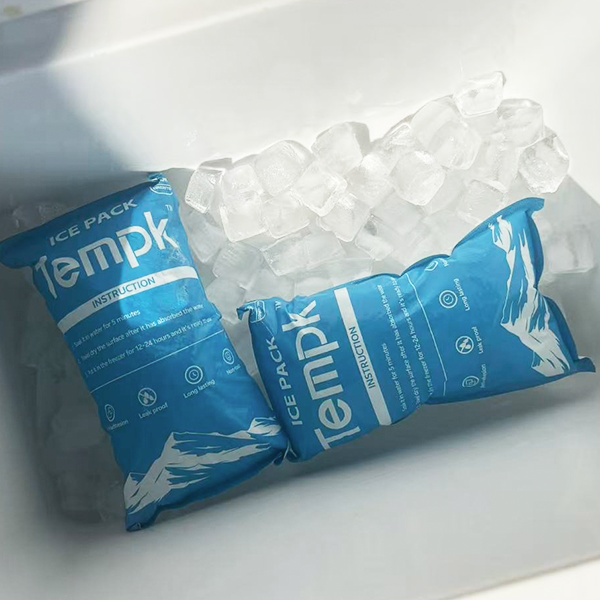
Und Tempk, we offer rigid ice-brick formats and can discuss project choices such as dimensions, Dicke, Schalenfarbe, Etikett, coolant option, und Kartonverpackung. We start a custom review with the limitation of the current packout: container interface, Nutzlast, Vorbereitungsausrüstung, Route, Handhabung, Wiederverwendungsplan, und Zielmarkt. That helps separate a standard-platform adjustment from tooling or formulation work. Share your drawing, Probenstatus, and acceptance criteria with us to plan a focused feasibility review; qualify the final production-representative package before releasing performance claims or volume orders.