Cool Brick Logistics Works Best When You Design From Receipt Backward
A shipment is not successful when the lid closes. Es ist erfolgreich, wenn der Empfänger die Nutzlast mit dem Nachweis akzeptieren kann, dass der definierte Prozess befolgt wurde. Damit ist der Wareneingang der beste Ausgangspunkt für die Cool-Brick-Logistik. Entscheiden Sie, welche Bedingung, Aufzeichnungen, und Inspektionen, die der Empfänger benötigt; Arbeiten Sie dann rückwärts durch Übergaben, Umgebungseinflüsse, Verpackung, Konditionierung, und Produktauswahl. A reusable rigid Kühlmittelstein can support that chain by adding thermal capacity in a stable shape. Es kann den Versender nicht qualifizieren, Legen Sie den Nutzlastbereich fest, oder beweisen Sie, was während des Transports passiert ist.
Begin With the Acceptance Decision
Ask the receiving team what would cause it to accept, Quarantäne, oder die Sendung ablehnen. Die Antwort könnte eine Temperaturaufzeichnung sein, eine Zeit-Temperatur-Anzeige, ein intaktes Siegel, ein korrektes Etikett, eine Pack-Out-Platte, Kühlmittelzustand, Ankunftszeit, oder visuelle Anzeichen einer Beschädigung. Für einige Lebensmittelrouten, the process may be relatively simple. Für Arzneimittel, Impfungen, Diagnostik, or high-value materials, quality review may be more formal.
This backward view prevents the packaging team from optimizing the wrong outcome. A pack-out can look tidy at dispatch but leave the receiver unable to retrieve data. A logger may record the route but sit in a location that does not support the intended decision. A brick can remain partly frozen at delivery while the payload experienced an unacceptable local exposure. None of those observations can be reduced to “the coolant was still cold.”
Define the acceptance logic in plain language:
The product-specific temperature condition that must be maintained.
The time window covered, including staging and post-delivery handling.
The evidence and inspection available at receipt.
The person authorized to interpret an alarm or deviation.
The disposition process when evidence is incomplete.
Only then should you convert the journey into a thermal and operational design brief.
Build a Chain of Evidence, Not a List of Products
Every stage should preserve an assumption made by the stage before it. The following table links decisions to proof.
| Bühne | Decision that must be controlled | Useful evidence or operating control | Fehlersignal |
|---|---|---|---|
| Produktdefinition | Required range and sensitivity are correct | Approved product information and quality review | Staff use a generic chilled category |
| Routendefinition | Duration and ambient risks are realistic | Lane map including dwell, Verzögerungen, und Übergaben | Transit estimate excludes staging or weekends |
| Thermisches Design | Isolierung, Kühlmittel, Nutzlast, and dividers work together | Defined configuration and development data | A component claim substitutes for system evidence |
| Konditionierung | Bricks start in the approved state | Equipment instruction, stock separation, Freigabeprüfung | Frost or elapsed freezer time is the only check |
| Auspacken | Menge, Platzierung, Trennung, and closure are repeatable | Visual work instruction and completion record | Packers improvise when payload changes |
| Transport | Shipment follows the controlled route and handling plan | Carrier instruction, Siegel, Verfolgung, monitoring as justified | Unowned dwell or unexpected rehandling |
| Receipt and return | Acceptance and asset recovery are completed | Inspektion, Datenüberprüfung, quarantine path, return scan | Payload is accepted before evidence is reviewed |
The table is useful because it exposes unsupported leaps. If route time is undefined, a hold-time claim has no operational meaning. If brick conditioning is uncontrolled, thermal test results may not represent daily work. If the consignee cannot act on logger data, monitoring becomes a record without a decision.
Convert the Route Into a Thermal Envelope
The thermal envelope describes the heat challenge the pack-out must manage. It includes the required product range, Ausgangstemperaturen, Gesamtzeit, Umgebungsbedingungen, heat-transfer paths, and margin for credible variation. It should capture more than the scheduled transport leg.
Separate the clocks
At least four clocks may run during one shipment:
Payload time outside controlled storage during picking and packing.
Coolant staging time after conditioning.
Closed-shipper transport and dwell time.
Arrival-to-storage time at the destination.
Combining these into a single optimistic “delivery time” hides risk. A local route may have little driving but long dock waits. A parcel may arrive on schedule and still sit in receiving. The design should use a justified total exposure period and clearly assigned limits.
Treat hot and cold risk separately
Die Isolierung verlangsamt die Wärmebewegung; it does not decide which direction is safe. Frozen coolant near a sensitive product can create cold spots even while external heat enters through the walls. A pack-out needs appropriate coolant conditioning, Abstand, Trenner, and payload placement. WHO vaccine guidance, Zum Beispiel, warns that freeze-sensitive vaccines can be damaged by contact with frozen packs. The general lesson is to follow product-specific instructions rather than treating colder as safer.
Use physics without pretending the model is the route
Coolant absorbs sensible heat as its temperature rises. If it changes phase, it can absorb latent heat during that transition. Masse, Wärmekapazität, Phasenverhalten, and starting state all contribute to the energy budget. Geometry controls how quickly heat reaches the coolant and where local gradients form.
These concepts help screen designs. They do not prove duration. Nähte, Luftkanäle, Nutzlastdichte, Eröffnungsveranstaltungen, manufacturing variation, and real handling complicate the model. Use calculation to ask better questions, testing to evaluate the assembly, and monitoring to learn whether operations match the design.
Specify the Brick as an Engineered Part
A purchasing description such as “blue wiederverwendbarer Eisstein” is not enough for a controlled pack-out. The specification should identify the features that matter to fit, thermisches Verhalten, Eindämmung, Handhabung, and version control.
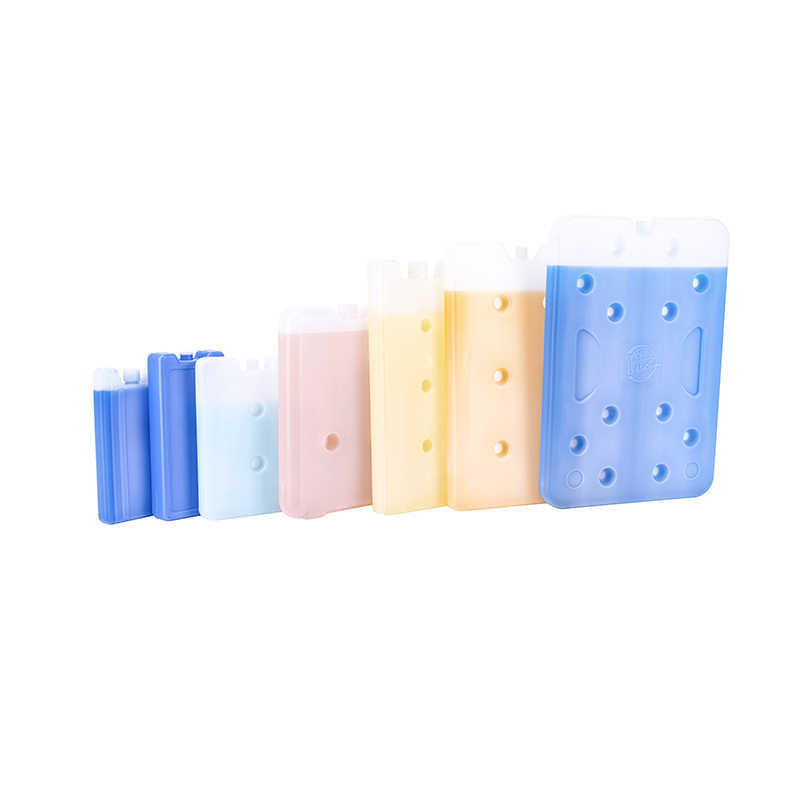
Confirm external dimensions rather than nominal volume alone. Include filled mass or an agreed tolerance where it matters. Identify shell material, cap or closure design, Füll- oder PCM-Formel, Etikett, Farbe, und Kartonverpackung. Zustandskonditionierung, Lagerung, Reinigung, and inspection expectations. If the brick locates in a molded recess, define the geometry tightly enough to preserve fit.
Nominal volume can be ambiguous. It may describe internal fill, advertised capacity, or a product family. Usable payload loss depends on the brick's outer displacement and required spacing. Measure it in the intended container.
Formula control matters because two identical shells can contain coolants with different behavior. Use labeling or shell color to reduce mix-ups, but support the visual cue with purchasing and lot controls. Ask how the supplier manages a formula, Kappe, Harz, Schimmel, Etikett, or packing change. A change that appears minor commercially can affect conditioning, fit, Leckagerisiko, oder thermische Leistung.
Rigid cool bricks are often selected for their repeatable geometry. Protect that advantage by controlling substitutions. Ein flexibler Gelpackung of similar mass is not automatically equivalent. A thicker brick with the same nominal volume can change surface area and airflow. A different PCM phase specification can change the temperature region where latent heat is absorbed.
Hilfreiche Entscheidungshilfen
Überprüfen Sie die Details, bevor Sie sich für die Verpackung entscheiden
Mit diesen schnellen Tools können Sie das Routenrisiko vergleichen, Größenanforderungen, Kühlmittelauswahl, und Verpackungsdetails, bevor Sie ein Angebot anfordern.
Kühlmittel & PCM-Referenz
Vergleichen Sie Kühlmittel- und PCM-Optionen, wenn eine Route zusätzliche Temperaturunterstützung benötigt.
Vergleichen Sie OptionenVerpackungsauswahl
Vergleichen Sie isolierte Verpackungsoptionen nach Produkt, Route, und Temperaturbedarf.
Verpackung findenFallfestigkeit des Isolationsmaterials
Überprüfen Sie die Fallfestigkeit und die Handhabungsfaktoren, bevor Sie Isoliermaterialien auswählen.
Widerstand prüfenMake Conditioning and Pack-Out Observable
An operator should be able to tell what state a brick is in, where it belongs, and what to do when something is wrong. If those decisions live only in a technical report, the warehouse process will drift.
Conditioning instructions should cover equipment, Ladeanordnung, Zubereitungsmethode, Freigabekriterium, Inszenierung, and stock segregation. Do not assume the freezer display equals brick core temperature. Luftstrom, Erholung, brick stacking, and incoming state all influence readiness. When multiple PCM formulas are present, give them separate storage locations and unambiguous identification.
The pack-out instruction should show the complete three-dimensional assembly. Identify bottom, Seite, and top bricks; Orientierung; Nutzlast; Trenner; Logger; fill material; Deckel; Siegel; und Etiketten. Include an approved response for undersized or oversized payloads. Ansonsten, packers will solve fit problems by removing a component or compressing the container.
Use controls that match the failure mode. A count sheet catches missing bricks but not wrong placement. A photograph can confirm placement but may not prove formula. A scan can confirm identity but not conditioning. Combining a few simple controls is often stronger than adding one complicated technology.
The first five shipments are a training test
Early production shipments reveal whether the design is practical. Observe how long packing takes, which instructions cause hesitation, whether bricks become mixed, wie der Deckel schließt, where condensation appears, and how receipt and return work. These observations do not replace qualification, but they can expose human and material issues before volume increases.
Match Qualification and Monitoring to the Risk
Qualification is a documented demonstration that a defined system performs as intended under specified conditions. The scope can differ by organization, Produkt, und Markt. Für einen passiver Versender, the controlled system may include container, Kühlmittelmodell und -menge, Konditionierung, Nutzlast, Abstandshalter, Schließung, Umgebungsprofil, Sensorpositionen, und Akzeptanzkriterien.
ISTA 7E is relevant to thermal exposure testing of individual packaged products in parcel delivery networks and can support Isolierter Versender Testen. It should be applied within its intended scope. A test profile does not guarantee every route, and an ISTA reference should not be attached casually to a single cool brick.
Good distribution practice expectations for medicinal products direct attention to maintaining required storage conditions in transportation and using risk-based controls. WHO technical guidance similarly addresses conditioning, Laden, Handhabung, Überwachung, und Versandcontainerqualifikation. The responsible statement is therefore specific: a named pack-out was evaluated for a defined application. “Globally compliant coolant” is not a useful technical conclusion.
Monitoring strategy should answer a decision. Define whether data is needed for qualification, route characterization, routine release, exception investigation, or continuous improvement. Confirm logger accuracy, Kalibrierung, Aufzeichnungsintervall, Alarmschwellen, Startverzögerung, Platzierung, Batterieeignung, Zeitsynchronisation, und Datenabruf. Do not invent or copy a logger specification from another application.
Bei Erhalt, a written decision tree should address alarms, fehlende Daten, damaged sensors, late arrival, gebrochene Siegel, and pack-out deviations. Temperature data needs product and quality context; an alarm is a signal for review, not always an automatic conclusion about product disposition.
Engineer the Reuse Loop With the Outbound Loop
A reusable brick has environmental and economic potential only when it returns and remains serviceable. Vor der Skalierung, determine the number of units needed across five states: bereit, unterwegs, awaiting return, warten auf die Reinigung, und Konditionierung. Add a justified buffer for demand variation and retirement rather than assuming every purchased brick is dispatch-ready.
Inspection criteria should be objective enough for different staff to apply consistently. Risse, prall, Leckage, Verschlussschäden, unleserlicher Ausweis, abnormal residue, or unexplained mass change may require segregation. Cleaning must be compatible with the shell, Kappe, Etikett, und Eindämmung füllen. Define drying and storage so clean units do not become mixed with returns.
For sustainability decisions, compare services rather than objects. The service is a successful temperature-controlled delivery, not ownership of a reusable item. Consider material production, inbound packing, konditionierende Energie, Ausgehender Transport, Rückbewegung, Waschen, Verlust, Schaden, und Lebensende. Reuse often aligns with source-reduction priorities when loops work well, but the route-specific result depends on actual circulation.
Track data that can improve both cost and environmental performance: Rücklaufquote, Bearbeitungszeit, damage source, Reinigungsausnahmen, emergency replacement purchases, and completed uses before retirement. Avoid promising a fixed reuse count unless it is supported for the product and use conditions.
A Pilot Designed From Receipt Backward
Imagine a healthcare distributor sending a temperaturempfindliches Produkt to several clinics. The clinics need a clear acceptance process, and the distributor wants a reusable rigid-brick pack-out. No route performance number is assumed.
The project begins at the clinic. The receiver must inspect the seal, retrieve the temperature record, confirm shipment identity, and move the product into appropriate storage. An exception path identifies who to contact and where to hold the product while data is reviewed.
Working backward, the team maps a direct route and a transfer route. It includes pharmacy staging, Kurierabholung, Depot wohnen, clinic arrival, and after-hours delivery. The thermal group selects candidate brick shapes based on actual container geometry and payload patterns. Quality reviews product limits and cold-exposure risk.
Development trials compare configurations with representative payloads. The team evaluates both warm and cold locations, Schließung, conditioning feasibility, and operator handling. A protocol then defines the chosen assembly, Profil, Sensoren, Akzeptanzkriterien, and approved operating method. Route trials use monitoring to examine execution at handovers.
The return pilot runs simultaneously. Clinics scan or record empty-box return, the depot inspects and cleans bricks, and conditioned stock is segregated from returns. Data shows where assets wait and why units are rejected. Only after both outbound and reverse processes are workable does procurement scale the program.
The pilot succeeds because “fit” includes the receiving decision, thermischer Beweis, daily work, and asset recovery. Selecting the brick is one important step inside that design.
Questions That Settle Difficult Decisions
Should a buyer ask for the coldest PCM formula?
NEIN. Ask for a formula and conditioning approach suited to the payload's permitted range and the pack-out design. A colder surface can increase freeze or overcooling risk. The useful evidence concerns the actual formula, Masse, Platzierung, Isolierung, Nutzlast, Umgebungsprofil, und Akzeptanzkriterien, not a claim that lower is always stronger.
How should a supplier's hold-time statement be assessed?
Request the complete context: Container, brick type and count, Konditionierung, Nutzlast, Startbedingungen, Umgebungsprofil, Sensorpositionen, Testmethode, und Bestehenskriterien. Compare those conditions with your lane. If important details differ, treat the statement as background information and evaluate the intended configuration rather than transferring the duration.
What makes a pack-out repeatable?
Repeatability comes from controlled components and observable work. Use identified brick models, klare Konditionierung, fixed positions, defined payload patterns, necessary dividers, visual instructions, Inspektion, und Ausnahmeregeln. Training and periodic observation matter. A rigid brick supports repeatability through stable geometry, but process control creates it.
When does a change need review?
Review changes that could affect thermal behavior, fit, Eindämmung, Identifikation, Handhabung, or evidence. Examples include a new fill formula, Muschelharz, Kappe, Schimmel, Ziegelzahl, Konditionierungsprozess, Isolierung, Teiler, Nutzlast, Route, oder Umgebungsprofil. The depth of assessment should be risk-based and governed by your quality process.
Can monitoring replace package qualification?
NEIN. Qualification evaluates whether a defined system is capable under specified conditions. Routine monitoring records a shipment at selected locations. Monitoring can verify execution and reveal exceptions, but it does not redesign an inadequate pack-out. The two activities answer complementary questions.
Endgültige Entscheidung: Control the Whole Journey
The strongest cool brick logistics program begins with the receiver's acceptance decision and works backward. It defines the product limits, Route, thermal envelope, brick specification, Konditionierung, Auspacken, Qualifikation, Überwachung, Ausnahmeantwort, and return loop as one connected process.
That approach also creates a clearer buying standard. Choose a brick whose geometry, Material, füllen, Identifikation, and packing can be controlled inside the intended system. Require evidence with stated conditions. Then observe daily work and manage change. The result is not a magical coolant; it is a shipment process that can be explained, wiederholt, und verbessert.
Über Tempk
Tempk-Lieferungen wiederverwendbare Eissteine und PCM-Eisplatten für Kühltaschen, medizinische Boxen, Isolierkartons, and repeated pack-out layouts. Its public product range includes HDPE ice bricks. Projects may be customized by volume, Formform, Kappendesign, Schalenfarbe, PCM-Formel, Beschriftung, und Kartonverpackung. Those choices can support physical fit, formula identification, and warehouse standardization. Tempk can help frame a suitable component discussion, while the buyer retains responsibility for matching the complete system to payload limits, Streckenbedingungen, Qualifikation, Überwachung, und geltenden Anforderungen.
Ready to specify the component inside a controlled system? Teilen Sie Ihre Nutzlast, Isolierung, Temperaturbereich, Route, Konditionierungsprozess, pack-out drawing, and return plan with Tempk for a focused sample discussion.