


Hitzeeinwirkung
Ein warmer Aufenthalt kann das Vertrauen der Kunden untergraben, wenn das Produkt live verkauft wird, Ferment, oder Wirkstoffpositionierung.
Sendungen probiotischer Hautpflege benötigen Verpackung, die die Lageraussage der Marke respektiert und die Positionierung aktiver Inhaltsstoffe schützt. Der Verpackungsaufbau sollte Wärmeexposition reduzieren, Kondensation kontrollieren und Tiegel, Die Röhre, Etiketten und Kartons präsentabel halten.
Für kosmetische Kühlkettenlieferungen, Die beste Verpackung ist diejenige, die sowohl den Zustand der Formel als auch die Präsentation beim Kunden schützt. Der folgende Verpackungsaufbau bietet einen praktischen Ausgangspunkt vor dem Testen auf der Fahrspur.
Ein warmer Aufenthalt kann das Vertrauen der Kunden untergraben, wenn das Produkt live verkauft wird, Ferment, oder Wirkstoffpositionierung.
Kühlakkus in kleinen Kosmetikpaketen können Kondenswasser bilden und den Einzelhandelskarton durchnässen, wenn keine Feuchtigkeitsbarriere vorhanden ist.
Eine gekühlte Route kann dennoch die Präsentationsprüfungen nicht bestehen, wenn Gelpacks Tiegel berühren, Die Röhre, Etiketten, oder Kartons direkt.
| Streckenzustand | Temperaturziel | Verpackungsaufbau | Vorläufiger Kühlmittelbereich | Empfangsprüfung |
|---|---|---|---|---|
| Lieferung vor Ort, 4-8 H | Benutzen Sie die Markenaufbewahrungsanleitung; Viele Routen erfordern einen Hitzeschutz und einige erfordern eine gekühlte Handhabung. | Isolierter Versandkarton oder kleiner Karton, Feuchtigkeitshülse, ein oder zwei konditionierte Gelpacks oder PCM mit Abstandshalter. | Um 0.4-0.9 kg für a 0.5-2 kg Nutzlast. | Produktsiegel, Kartontrockenheit, und schnelle Übergabe. |
| Warmer E-Commerce-Weg, 8-24 H | Coole oder gekühlte Route je nach Label und Markenversprechen; Vermeiden Sie das Einfrieren, sofern dies nicht ausdrücklich validiert wird. | Isolierter Karton oder kompakte EPP-Box, mittlerer Produkthohlraum, gepuffertes Kühlmittel seitlich/oben, feuchtigkeitsregulierende Schicht. | Um 0.9-2.0 kg für a 0,5-3 kg Nutzlast. | Logger-Datensatz, falls verwendet, Kondensation, Kartonquetschen, und Produkttextur. |
| Heiße Route oder Wochenendrisiko, 24-36 H | Validierte kühle oder gekühlte Route mit zusätzlicher Verweildauer. | Leistungsstärkere Isolierung, konditionierte Gelpacks oder PCM, Produkt isoliert vom Kühlmittel, optional Datenlogger for premium DTC lanes. | Um 2.0-3.2 kg für einen Kompaktverlader; durch Routentest bestätigen. | Minimale und maximale Temperatur, remaining Kühlmittel, Etikettentrockenheit, und Kappendichtung. |
Nutzen Sie diese Bereiche für Verpackungsdiskussionen und Probenahmen. Die endgültige Kühlmittelmasse sollte mit der tatsächlichen Formel bestätigt werden, Anzahl der Einheiten, Flasche or Tiegel size, Kartonabmessungen, Streckendauer, Umgebungsbedingungen, und alle Datenlogger-Anforderungen.
Bestätigen Sie, ob das Produkt gekühlte Handhabung, kühlen Schutz oder nur Reduktion von Wärmespitzen benötigt. So wird Überkühlung einer Formel vermieden, die nur Sommerschutz braucht.
Benutzen Sie Ärmel, Liner, oder absorbierende Trennung, damit die Kondensation des Kühlmittels Kartons und Etiketten nicht beschädigt.
Platzieren Sie konditionierte Gelpacks oder PCM um die Nutzlast, nicht direkt daran. Kleine Hautpflegepakete brauchen oft mehr Trennung als zusätzliche Kühlmittelmasse.
Testen Sie die tatsächliche Tiegel- oder Röhrchenzahl, Einsätze, Isolierung, Kühlmittel mass, und Routendauer vor der Skalierung des DTC-Versands.
Dies sind die Probleme, die der Verpackungsaufbau reduzieren sollte, bevor die Sendung den Kunden erreicht.
Nutzen Sie die Testkurve als Arbeitsvergleich, Anschließend mit dem tatsächlichen Produkt validieren, Kühlmittel mass, Isolierung, Streckendauer, und Jahreszeit. For Hautpflege, Überprüfen Sie auch die Präsentation: Etikettentrockenheit, Kartonzustand, Kappendichtung, und Produkttextur.
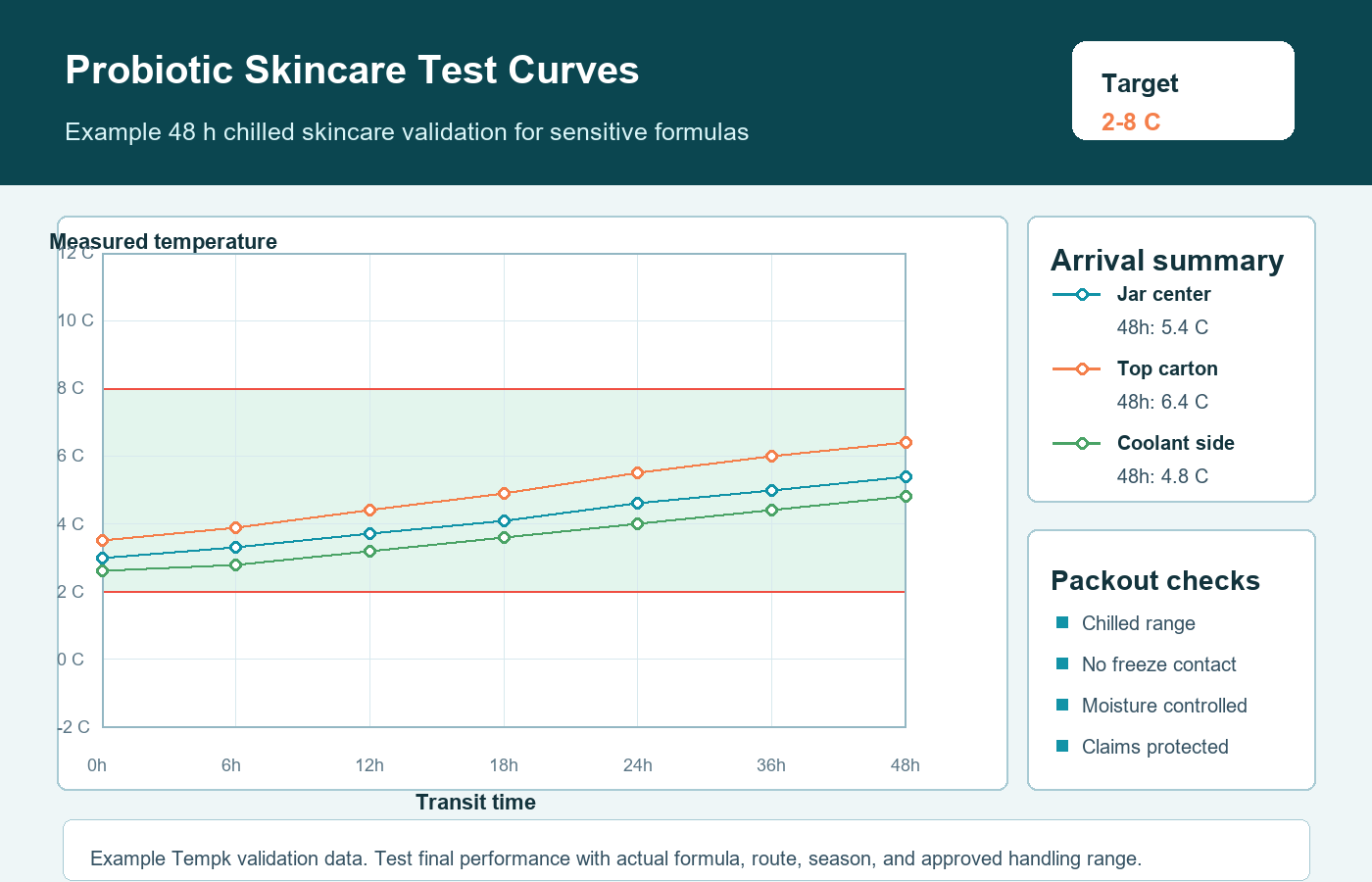
Verwenden Sie diese Seiten, um Produktrouten in der Nähe zu vergleichen, select Kühlmittel, und prüfen Sie das Routenrisiko vor der Probenahme.
Probiotische Hautpflege kann rund um lebende oder aktive Inhaltsstoffe vermarktet werden, Daher sind Temperatursicherheit und saubere Präsentation bei der Lieferung wichtig.
Verlust kann als Formeltrennung auftreten, Geruchsveränderung, Kartonfeuchte, Etikettenlift, und Kundenbedenken hinsichtlich der warmen Lieferung.
Verwenden Sie isolierte Paketverpackungen mit Produkttrenner und feuchtigkeitsbeständiger Innenhülle. Halten Sie das Kühlmittel nahe genug, um die Nutzlast zu stabilisieren, aber getrennt von der Kartonoberfläche.
Verwenden Sie gekühlte Gelpacks oder PCM entsprechend der Formelaufschrift. Für gekühlte Produkte, bestätigen 2 Zu 8 C und vermeiden Sie den direkten Kontakt mit der gefrorenen Packung.
Überprüfen Sie die visuelle Textur, Geruch, Etikettenzustand, und alle erforderlichen Stabilitätsindikatoren. Notieren Sie, ob sich das Produkt beim Öffnen noch hochwertig anfühlt.
Some probiotische Hautpflege products only need heat moderation, während andere eine gekühlte Handhabung erfordern. Der Verpackungsaufbau sollte dem Formeletikett und den Stabilitätsdaten folgen, anstatt für jede SKU eine einzige kosmetische Versandregel anzuwenden.
Verwenden Sie einen geschützten Produktraum, feuchtigkeitsbeständige Innenhülle, und gekühltes Gel oder PCM nach Bedarf. Wenn die Formel es erfordert 2 Zu 8 C, Vermeiden Sie den direkten Kontakt mit der gefrorenen Verpackung und validieren Sie sowohl heiße als auch kalte Spuren.
Beim Tempk-Routentest sollte die Textur der Formel überprüft werden, Geruch, Etikettenzustand, Kartontrockenheit, und ob sich das Produkt beim Öffnen noch hochwertig anfühlt. Für Beauty-Produkte, Präsentation ist Teil der Lösung.
For probiotische Hautpflege, Beginnen Sie mit der Stabilitätsanforderung. Wenn die Formel es erfordert 2 Zu 8 C, Verwenden Sie PCM oder konditionierte Gelpacks in einer separaten Kühlmittelzone und validieren Sie heiße und kalte Spuren. Wenn das Produkt nur einen Hitzeschutz benötigt, Ein milderes gekühltes Gel-Layout kann die Formel schützen, ohne dass der Beauty-Karton nass wird. Die Verpackung sollte Tiegel halten, Die Röhre, oder Airless-Pumpen aufrecht und sauber halten. Beim Empfang sollte der Geruch überprüft werden, Textur, Kartonpräsentation, Etikettenzustand, und ob das Eröffnungserlebnis immer noch eine Premium-Pflegemarke unterstützt.
Custom Verpackungsaufbau support
Für feste Kartongrößen, Nutzlastgrenzen, Branding-Anforderungen, Saisonspuren, oder Validierungsziele, Tempk kann diese Lösung in einen maßgeschneiderten Kühlketten-Verpackungsaufbau umwandeln.
Teilen Sie die Aufbewahrungsanweisung, Anzahl der Einheiten, Kartongröße, Nutzlastgewicht, Streckendauer, Umgebungsbedingungen, Übergabe der Lieferung, und ob Sie einen TemperaturdatenDatenlogger benötigen. Tempk kann beim Vergleich von Gelpacks helfen, PCM, EVP, Isolierkartons, Pufferschichten, und Erhalt von Schecks.
Verpackungsprüfung anfragen