


Calentamiento rápido
Liquid payloads can warm quickly during dock time, delivery-vehicle dwell, or doorstep handoff.
Fresh pasteurized milk needs a chilled packout that keeps bottles upright, limits warm dwell, separates coolant from the liquid, and protects caps, etiquetas, and cartons from leakage or condensation.
A dairy shipment should be judged by both temperature and arrival condition. The packout below gives a practical starting point before lane testing and customer handoff checks.
Liquid payloads can warm quickly during dock time, delivery-vehicle dwell, or doorstep handoff.
Bottles can shift in parcel handling, stressing caps and seams unless the cavity keeps them upright.
Condensation or small leaks can hide receiving information and make the package look unacceptable.
| Condición de la ruta | Intención de temperatura | Packaging setup | Preliminary coolant range | recibir cheque |
|---|---|---|---|---|
| Ruta local refrigerada, 4-8 h | Maintain a chilled route around the product requirement, comúnmente 0-4 C or 2-8 C depending on the operation; evitar la congelación. | cartón aislado, upright bottle divider, forro absorbente, 1-2 conditioned gel packs or PCM with a spacer. | Acerca de 0.6-1.2 kg for a 1-3 L milk payload. | Bottle temperature, cap seal, label dryness, condición del revestimiento, and quick handoff. |
| Warm parcel route, 8-24 h | Chilled delivery with extra protection against vehicle heat and receiving delay. | EPP or insulated carton, bottles in a center cavity, side/top conditioned coolant, capa absorbente, optional logger. | Acerca de 1.2-2.8 kg for a 2-6 carga útil. | Temperatura mínima, no direct freeze contact, fuga, humedad del cartón, and remaining coolant. |
| Hot route or delay risk, 24-36 h | Validated chilled route with enough dwell allowance and no local freezing near coolant. | Higher-performance EPP or thick insulated carton, larger coolant mass, bottle dividers, forro absorbente, logger near center and cold side. | Acerca de 2.8-5.0 kg for a compact milk shipper; confirm by route test. | Curva del registrador, cap leakage, bottle movement, legibilidad de la etiqueta, and remaining coolant state. |
Use these ranges for sampling and quotation. Final coolant mass should be confirmed with the actual product temperature, recuento de unidades, tamaño del paquete, volumen de carcasa, duración de la ruta, perfil ambiental, y requisito de recepción.
Do not rely on the shipper to pull down warm product. Pack from stable chilled storage so the coolant is used to hold the route.
Usa divisores, bandejas, or molded support so bottles cannot roll into a gel pack or press against each other.
Conditioned gel packs or PCM usually work best on side and top positions with a separator, not directly against caps or bottle walls.
Receiving checks should cover product temperature, cap condition, etiquetas mojadas, forro absorbente, and remaining coolant.
These are the visible and operational issues the packout should reduce before the shipment reaches the receiver.
Use the test curve as a working comparison, then validate with the actual product, masa refrigerante, aislamiento, duración de la ruta, y temporada. para lácteos, also check leakage, condensación, presión del paquete, textura, olor, and remaining coolant.
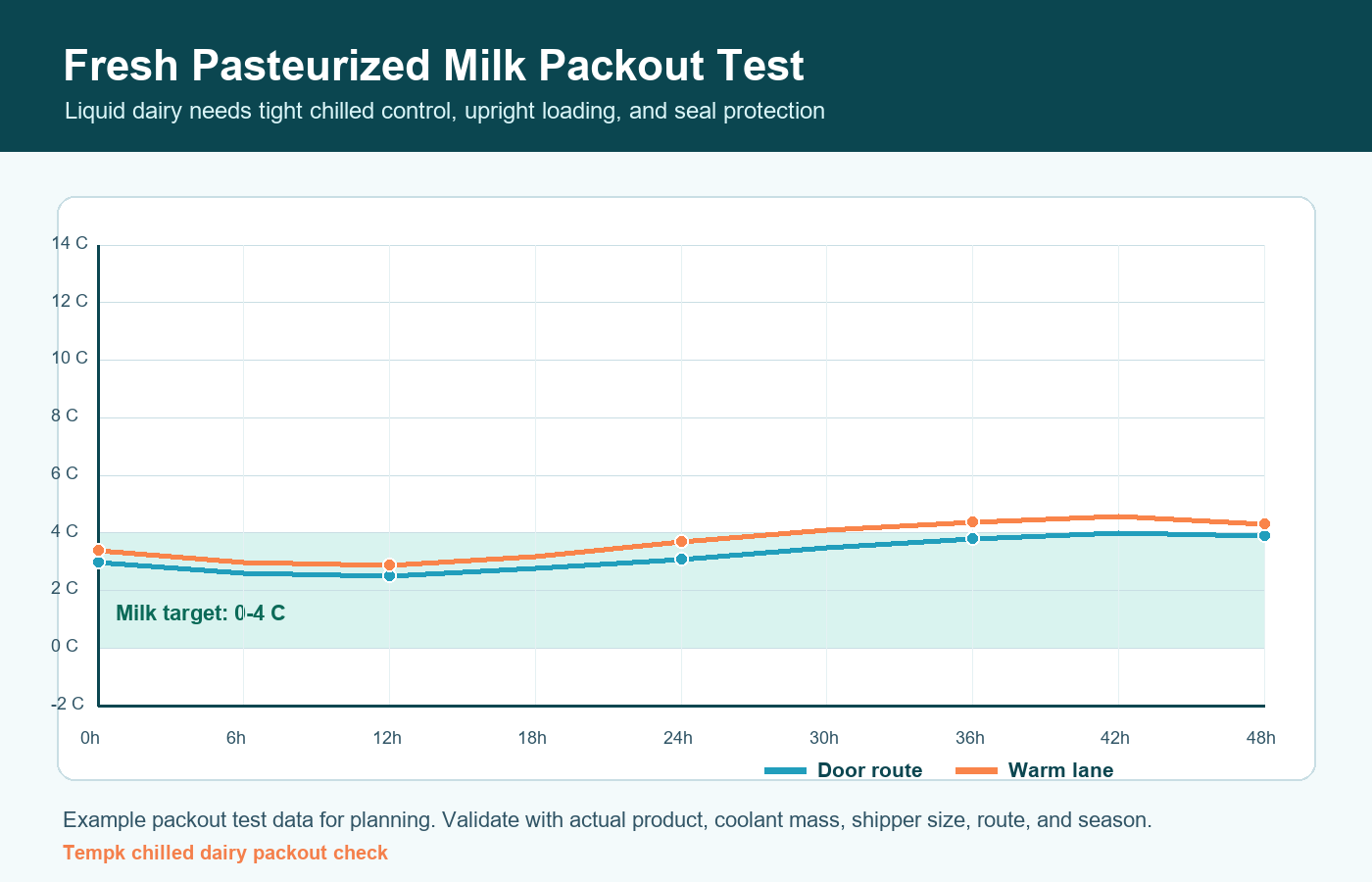
Use these pages to compare nearby dairy routes, select coolant, and check route risk before sampling.
Share the product form, temperatura objetivo, recuento de carga útil, tamaño del cartón, duración de la ruta, condición ambiental, entrega de mensajería, y recibir cheques. Tempk can help compare gel packs, PCM, PPE, cajas aisladas, revestimiento, inserciones, y colocación del registrador.