Cómo especificar un proveedor de una bolsa de hielo seco para la entrega de mariscos
Escriba la decisión de recepción antes de escribir la especificación del refrigerante.. Ese único paso mantiene a un proveedor hielo seco paquete para la entrega de productos del mar relacionados con el producto del mar en lugar de una declaración de duración genérica. El comprador debe saber qué condiciones son aceptables a su llegada., cómo se comprobará, y que pasa despues de una desviacion. Sólo entonces el equipo podrá elegir entre una sábana congelada hidratada., paquete de gel, PCM, hielo mojado, refrigeración activa, o dióxido de carbono sólido real. Estas fuentes de frío no son intercambiables., y ninguno reemplaza el sistema completo de embalaje y seguridad alimentaria..
Diseñar al revés desde la recepción
Un receptor no puede evaluar "lo suficientemente frío". El acuerdo de entrega debe definir el producto., estado requerido, inspección, archivos, y autoridad para disponer.
Empezar con especies, forma del producto, estado de procesamiento, y paquete primario. State whether the seafood is chilled, congelado, cocido, ready to eat, reduced-oxygen packaged, or live. The HACCP plan and applicable requirements determine relevant hazards and controls. FDA seafood guidance, Por ejemplo, addresses time-temperature abuse in relation to pathogen growth and histamine formation for susceptible products. Codex guidance distinguishes chilled seafood near melting-ice conditions from frozen products.
Define the product temperature and condition at dispatch. Passive packaging designed to maintain an established state should not be asked to remove uncontrolled field or process heat. Record how long product may spend at the packing bench and staging area.
Al recibir, checks may include shipment identity, seguridad, integridad del paquete, fuga, hora de llegada, temperature according to the approved method, logger status where used, and evidence of freezing or thawing. Quality attributes such as texture, goteo, vidriado, olor, and package appearance may also matter. The exact criteria should be product-specific.
Disposition must follow a documented process. A single sensor reading, remaining frozen pack, or driver observation is not a universal safety decision. Authorized food-safety or quality personnel should evaluate the time-temperature history, producto, embalaje, HACCP plan, y otras pruebas.
Once the receiver’s needs are clear, map backward through doorstep dwell, last-mile van, depósito, traslado aéreo o terrestre, aduanas, recorrido de línea, levantar, y puesta en escena. This reveals where the passive packout needs margin and where an operational fix may be better.
Make the Coolant Decision Explicit
The phrase “dry ice pack” must be replaced by a technical identity in the specification.
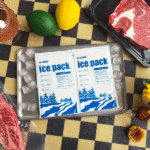
Una lámina de hidrato se activa con agua y se congela.. It can conform around a payload and may reduce inbound storage mass before hydration. Its finished mass, dimensiones, and cooling behavior depend on the activation and conditioning process.
A prefilled gel pack arrives ready for conditioning and offers a controlled fill, but it occupies inbound storage and adds transport mass. Its phase behavior depends on formulation.
An engineered PCM pack uses a formulated phase-change medium. It can be selected to support a defined thermal design, but its transition point does not equal payload temperature and it must be conditioned as specified.
Solid carbon dioxide is actual dry ice. At atmospheric pressure it sublimes at about −78.5°C and releases gas. It may suit some frozen systems, but it can freeze chilled seafood, damage materials, injure workers, and create hazardous carbon dioxide accumulation. Packages must vent, and air cargo may be regulated under UN 1845.
Wet ice or active refrigeration may remain appropriate in some seafood chains. Procurement should not force every route into a frozen-pack solution merely because that is the category being sourced.
| Pregunta de decisión | Si la respuesta no es clara | Required next action |
|---|---|---|
| Is the seafood chilled, congelado, vivir, or otherwise controlled? | Coolant cannot be selected responsibly | Return to product specification and HACCP owner |
| Is “dry ice pack” solid carbon dioxide? | Safety and transport scope is unknown | Obtain composition and classification information |
| Can the pack contact the primary food package? | Frío, abrasión, and material risk is unknown | Define a barrier and review contact documentation |
| Can operations reproduce conditioning? | Test results may not transfer to production | Develop and verify the freezer and pack-station process |
| Does the route include open-loop parcel delivery? | Reuse and delay assumptions may be unrealistic | Model failed receipt and end-of-life handling |
| Does evidence match the proposed box and payload? | Hold-time claim is not applicable | Run representative system testing |
This decision table turns uncertainty into work rather than allowing it to become an unsupported claim in the purchase order.
Lock the Package Architecture and Prove It
The complete package needs structural, humedad, térmico, and communication functions. Assign each one deliberately.
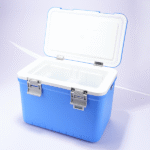
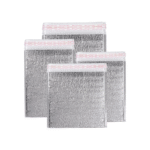
Primary seafood packaging should contain the product and expected liquid under handling. Secondary containment and absorbents can protect insulation and outer cartons from drip, condensación, hielo derretido, or a coolant leak. El aislamiento ralentiza el flujo de calor. El refrigerante absorbe el calor.. Spacers control cold contact and abrasion. Void treatment limits movement and unintended air circulation. The outer package provides strength, cierre, etiquetas, and handling information.
Cada capa cambia el comportamiento térmico.. Un separador grueso reduce el frío directo pero también ralentiza el movimiento del calor hacia el refrigerante.. Un revestimiento impermeable puede contener líquido pero puede atrapar aire u obstruir el drenaje previsto.. Una almohadilla absorbente puede moverse durante el transporte.. Estos detalles pertenecen al dibujo del paquete y a la prueba..
Las pruebas de desarrollo deberían utilizar múltiples sensores para encontrar extremos cálidos y fríos.. Prueba cerca de la tapa, paredes, esquinas, interfaces de refrigerante, y centro de carga útil basado en la geometría. Observar la condensación, fuerza del cartón, fuga, movimiento, condición de la etiqueta, y calidad del marisco junto con la temperatura.
Las pruebas formales deben identificar exactamente contenedor aislado, modelo y recuento de refrigerante, acondicionamiento, carga útil o simulante justificado, estado inicial del producto, llenado mínimo y máximo, secuencia del paquete, cierre, perfil ambiental, duración, mapa de sensores, y criterios de aceptación. Un perfil de paquete estándar como ISTA 7E puede admitir una evaluación estructurada, pero el riesgo de ruta puede justificar desafíos estacionales o de carril adicionales.
Para hielo seco real, qualification should establish quantity and placement without relying on a universal sublimation rate. Forma, aislamiento, exposición ambiental, fuga del paquete, vacíos, and opening all affect consumption. The package must release gas and remain structurally stable as refrigerant disappears.
Bracketing deserves careful reasoning. A minimum order may warm faster because it has less thermal mass. A maximum order may restrict coolant placement. Different seafood packages can have different contact area even at the same mass. Document why selected test loads represent the operating range.
Approve the Supplier for Production, Not Just Samples
An excellent hand-made sample does not prove bulk consistency. Supplier approval should connect the evaluated item to controlled production.
Herramientas útiles para tomar decisiones
Comprueba los detalles antes de elegir el embalaje.
Estas herramientas rápidas pueden ayudarle a comparar el riesgo de la ruta, necesidades de dimensionamiento, opciones de refrigerante, y detalles del embalaje antes de solicitar una cotización.
Calculadora de hielo seco
Calcule las necesidades de hielo seco para envíos congelados o ultrafríos antes de empacar.
Estimar hielo secoResistencia a la caída del material aislante
Revise la resistencia a caídas y los factores de manipulación antes de elegir materiales aislantes..
Comprobar resistenciaSelector de embalaje
Compare las opciones de embalaje aislado por producto, ruta, y necesidad de temperatura.
encontrar embalajeRequest a specification or drawing with product code, categoría de refrigerante, dimensiones, mass and tolerances, cell pattern where relevant, construcción de película o carcasa, diseño de sello, acondicionamiento, almacenamiento, y manejo. Obtain material and food-contact information appropriate to the intended market and contact scenario. Broad “food-safe” wording should not substitute for a document review.
For hydrate sheets, the file should explain activation, drenaje, finished condition, and whether cutting is allowed. Para paquetes reutilizables, it should address inspection, compatibilidad de limpieza, almacenamiento, y jubilación. Para hielo seco sólido, it should provide safety and classification information while leaving shipment preparation to competent parties.
Assess manufacturing controls relevant to risk: identidad material, fill or absorbent dosing, caza de focas, in-process inspection, criterios de fuga, codificación de lotes, liberar, no conformidad, y trazabilidad. The buyer may not need every proprietary process detail, but it needs confidence that production units remain comparable to tested units.
Create a sample-to-production check. Retain a reference, dibujo, fotografías, dimensiones clave, and conditioned mass or other critical measurements. Compare initial bulk lots and set incoming inspection. Complaints should be traceable to both supplier and shipment lots.
The supply agreement should address change notification. Película, formulación, absorbente, patrón de sello, dimensiones, estampación, proceso, método de prueba, or manufacturing location can affect the qualified design. The buyer’s own changes to box, transatlántico, carga útil, ruta, or pack placement need the same discipline.
Commercial topics—MOQ, plazo de entrega, pronóstico, paletización, impresión personalizada, continuidad del suministro, and alternate sources—should be resolved after technical identity. An alternate must enter documented equivalence review rather than automatic substitution.
Operate the System and Improve It with Evidence
The packout must survive a busy shift. Convert the qualified design into a visual work instruction showing exact pack count, orientación, separadores, seafood placement, control de vacío, cierre, y etiquetas. Use separate instructions for materially different box sizes or payloads.
Conditioning is a controlled step. Define hydration where applicable, freezer rack arrangement, batch load, orientación, preparación, exposure time during assembly, y rechazo. A freezer air display does not prove a dense stack of packs is uniformly frozen. Monitor or verify the process at a level justified by risk.
Train staff to recognize the few errors that matter most: using the wrong pack, folding cells, omitting a separator, placing a leaking pack, loading warm seafood, and substituting an unapproved carton. Give them a clear quarantine path so rejected material does not return to stock.
For reusable loops, separate returned and released assets. Clean or sanitize as appropriate, seco, inspeccionar, recondition, and record retirement. comprobar el olor, manchas, puntas, daño en la costura, distorted bricks, and container closure. Measure actual return and loss.
Routine data should improve the route. Link shipment outcomes to packout version, producto, carga útil, component lot where useful, transportador, y temporada. Investigate recurring warm locations, condensación, daño por frío, and packing errors before increasing coolant. A stronger closure, estancia en muelle más corta, or better freezer load may solve the problem with less material.
Sustainability should be assessed on complete delivery performance. Hydrate sheets trade inbound mass for local water, congelación, y mano de obra. Reusable packs trade single-use supply for returns, limpieza, y perdida. Dry ice avoids meltwater but requires production, Susilimaciones, and adds safety controls. Compare systems that meet the same product requirement and report actual, no teórico, reuse and waste.
Applicable compliance remains broader than packaging. En los Estados Unidos, seafood HACCP and sanitary transportation requirements may govern parts of the operation depending on role and product. Other markets have their own food, transporte, worker-safety, material, and waste rules. The supplier provides a component; the food business controls the system.
Preguntas frecuentes
What should be included in the first supplier inquiry?
Include seafood species or category, estado del producto, paquete primario, condición de envío, rango de carga útil, caja aislada, ruta y entregas, retraso creíble, criterios de recepción, equipo de acondicionamiento, acuerdo de contacto, and intended single-use or returnable model. Ask for an exact product code and document list. Also identify expected order volume, plazo de entrega, and change-notification needs.
Can a hydrated sheet replace wet ice in a chilled fish box?
Probablemente, but the systems behave differently in contact, humedad, transferencia de calor, y manejo. The HACCP and product requirements, drenaje, materiales del paquete, colocación de refrigerante, and route must be assessed. Test the intended replacement rather than assuming equal mass provides equal protection. The comparison should also consider receiver handling and disposal procedures.
How can cold damage be detected during qualification?
Place sensors near likely coolant interfaces as well as warm points, then inspect representative seafood for freezing, cambio de textura, goteo, descoloramiento, or package damage under an approved method. Some quality effects may become clearer after a defined recovery period. Document the assessment criteria before testing so results are interpreted consistently.
When is actual dry ice the wrong choice?
It is inappropriate when the product or packaging cannot tolerate its cold, when gas cannot vent safely, when workers or receivers cannot manage it, when carrier rules cannot be met, or when a less demanding system can satisfy the verified requirement. The decision should be documented.
Does supplier test data eliminate the need for a buyer trial?
Not unless it covers the buyer’s exact approved configuration and is accepted under the buyer’s quality process. Supplier data are valuable for screening and design. Differences in box, carga útil, acondicionamiento, ruta, colocación del sensor, or criteria usually require representative confirmation. The buyer should record the rationale for any accepted equivalence claim.
Conclusión
The best seafood packout begins at receipt and works backward. Define the acceptable product condition, identify the coolant without ambiguous names, design for heat and moisture, and prove the complete architecture. Then preserve it through supplier controls, acondicionamiento, instrucciones de trabajo, escucha, y gestión del cambio.
This method avoids two common errors: treating every seafood product as frozen cargo and treating every frozen sheet as dry ice. It also creates a practical basis for cost and sustainability decisions because all candidates must perform the same defined delivery job.
Acerca de Tempk
Tempk publicly supplies hidratar bolsas de hielo seco, paquetes de gel, ladrillos de hielo, y embalaje aislado formats used in seafood logistics. That range gives buyers several geometries and operating models to assess while maintaining a clear distinction between reusable or hydrated coolants and solid carbon dioxide. Tempk puede soportar la identificación de productos, muestras, and bulk-format discussion; packout approval remains tied to the seafood business’s HACCP, ruta, and test program.
Send Tempk the receiving-led specification, including seafood state, carga útil, caja, ruta, acondicionamiento, moisture controls, and acceptance method. Request the exact product documents and a traceable sample lot before setting the production purchase order.