Meilleur sac de glace sèche pour une glacière: Que devriez-vous utiliser?
Si vous emballez des vaccins, Repas surgelés, ou un week-end, choisir le bon sac de glace carbonique pour une glacière determines safety, tenir le temps, et la qualité des produits. La neige carbonique se situe à −78,5°C et devient du gaz CO₂, donc ton sac doit isoler, résister aux crevaisons, et allow safe venting. Ce guide compare les types de sacs, vous montre comment emballer étape par étape, et partage un sélecteur de 2 minutes pour faire rapidement le bon choix.
-
Lequel bag type keeps dry ice longest while staying safe (doublure isolée, PEHD/PEBD, Options EPS/VIP)
-
How to pack a dry ice bag for a cooler in five steps to avoid pressure build‑up
-
De quelle quantité de neige carbonique vous avez besoin for 24–72 hours with simple rules of thumb
-
Quoi pas to do (joints hermétiques, refroidisseurs souples sans chemins de ventilation, contact alimentaire direct)
-
2025 cold‑chain tendances that improve sustainability and monitoring
Which dry ice bag for a cooler keeps cold the longest?
Réponse courte: An insulated, vent‑enabled liner inside a rigid hard cooler delivers the best mix of hold time, durabilité, et la sécurité. Use a heavy‑duty HDPE/LDPE liner only as an inner sleeve—not as your primary insulator—so CO₂ can escape while the cooler provides structure.
Pourquoi ça marche: Dry ice sublimates faster when exposed to warm air. A closed‑cell insulated liner slows heat gain, while a rigid cooler protects against puncture. Add a controlled vent path (cracked drain, gasket gap) so CO₂ can exit. This combination is reliable for food and pharma, and it’s simple to repeat for consistent results.
HDPE/LDPE liners vs. insulated dry ice bags—how should you choose?
Go insulated when you need long hold times or frequent lid openings; use HDPE/LDPE liners for clean handling inside a hard cooler when trips are short and budget matters. If you’re shipping multiple days, add a foam board or EPS lid layer above the dry ice to trim sublimation and shield contents from direct contact.
| Option de refroidissement (2025) | Isolation | Chemin de ventilation | Ce que cela signifie pour vous |
|---|---|---|---|
| Insulated dry ice liner (closed‑cell) | Haut | Use cooler drain/cracked lid | Best hold time; réutilisable; safer for multi‑day trips |
| Heavy‑duty HDPE/LDPE bag (doublure épaisse) | Low‑Medium | Faire pas sceller hermétiquement | Manipulation plus propre; fine for short hauls inside a hard cooler |
| PSE (mousse de polystyrène) insert or lid board | Haut (fragile) | Vent via outer cooler | Forte isolation, budget‑friendly; add as a topper |
| Reusable soft insulated tote (ventilé) | Moyen | Must provide vent gap | Pratique; use for short‑to‑mid trips if manufacturer approves dry ice |
Conseils pratiques que vous pouvez appliquer aujourd'hui
-
Pré-Chill la glacière for 30–60 minutes with sacrificial ice packs.
-
Layer up: dry ice at the bottom → thin cardboard/foam sheet → product → insulation topper.
-
Fill dead air: empty space accelerates sublimation—add towels or frozen gel packs to reduce voids.
Cas réel: A regional meal‑kit shipper cut spoilage by shifting to insulated liners plus a vented drain plug. The same routes kept meals frozen through 48 hours with fewer re‑ice interventions.
How do you pack a dry ice bag for a cooler safely?
Étapes de base (follow in order):
-
Portez des gants isolés et une protection des yeux. Treat dry ice like a power tool.
-
Pre‑line the cooler avec un sac de glace carbonique isolé or heavy‑duty HDPE/LDPE liner (faire pas joint).
-
Placez de la glace carbonique au fond. Use blocks/pellets wrapped in kraft paper to limit direct contact.
-
Add a separator layer (cardboard or foam sheet), then load product. Finish with an insulation topper.
-
Create a vent path. Crack the drain plug or lid latch slightly so CO₂ can escape. Never use airtight seals.
What about a soft cooler?
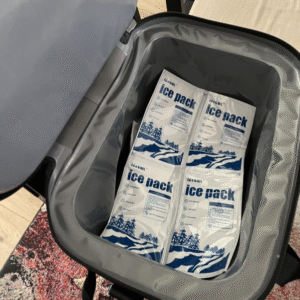
If the soft cooler is hermétique, don’t pair it with dry ice. Pressure can build. If the soft cooler is manufacturer‑approved for dry ice and you can create a controlled vent gap, it’s fine for short runs. En cas de doute, use a rigid hard cooler with a known vent path.
Combien sac de glace carbonique pour une glacière as-tu vraiment besoin?
Quick‑start rule of thumb (conservative):
-
24 heures: ~10 à 20 livres (4.5–9 kg) for a ~40‑qt hard cooler at room temperature
-
48–72 heures: Scale linearly, then add 20–30% if you’ll open the lid often or run in hot weather
-
Short local runs: A few pounds in an insulated liner may suffice if the load is already frozen
These numbers vary by cooler build, température ambiante, masse du produit, and lid‑open frequency. Commencez par être conservateur, then optimize after one test run with a probe logger.
2‑minute selector (mini-outil copier-coller)
What should you pas do with a dry ice bag for a cooler?
-
Ne pas sceller dry ice in an airtight bag, jar, or cooler. Gas needs a way out.
-
Do not use direct contact between dry ice and delicate foods—add a separator sheet.
-
Do not pack in glass or thin brittle plastics.
-
Do not use unapproved soft coolers with airtight zippers.
-
Do not transport in unventilated spaces. Casser les fenêtres; avoid confined trunks.
2025 developments and trends for your dry ice bag for a cooler
Quoi de neuf cette année: Reusable insulated shippers are growing fast as brands tackle waste and cost. ISO 23412 keeps shaping last‑mile processes for temperature‑controlled parcels. More operators add capteurs intelligents for temperature/CO₂ monitoring. Expect broader adoption of doublures recyclables and EPS‑light designs that still deliver multi‑day performance.
What’s changing at a glance
-
Reusable systems rise: Lower total cost over repeated lanes; fewer disposables.
-
Sensor‑enabled trips: Low‑cost loggers and CO₂ monitors reduce surprises in transit.
-
Design for recycling: Mono‑material liners and simpler separates boost recovery rates.
Perspicacité du marché: Analysts project the cold‑chain packaging market to expand through the decade, avec reusable solutions and smart packaging leading growth as e‑grocery and biologics volumes climb.
FAQ
Can I use a zip‑seal plastic bag as my primary dry ice bag for a cooler?
Non. Zip‑seal bags can trap gas and burst. Use an unsealed HDPE/LDPE liner à l'intérieur a rigid cooler and maintain a vent path.
Can I put dry ice in a soft cooler?
Only if the manufacturer explicitly allows dry ice et you can vent it. Airtight soft coolers can build dangerous pressure.
Where should the dry ice sit in the cooler?
At the bottom, then a thin separator sheet, alors votre produit. Add an insulation topper to slow warm air.
Comment disposer des restes de glace sèche en toute sécurité?
Let it sublimate in a well‑ventilated outdoor area away from kids and pets. Never down a sink or toilet.
What gloves should I use?
Insulated or cryogenic‑rated gloves. Avoid cotton alone; it can freeze and stick to skin.
Résumé & étapes suivantes
Principaux à retenir: Utilisez un isolé, vent‑enabled liner inside a hard cooler as your primary sac de glace carbonique pour une glacière. Gardez un chemin de ventilation, ajouter separator sheets, et fill dead air Pour ralentir la sublimation. Start with conservative dry ice amounts, log one trial, then tune.
Fais ceci ensuite:
-
Choose an insulated liner + rigid cooler combo.
-
Pack using the 5‑step method and crack the drain for venting.
-
Test once with a probe logger, then apply the estimator above to right‑size your dry ice for future runs.
À propos du tempk
We build practical cold‑chain content and tools for teams shipping temperature‑sensitive goods. Our recommendations focus on répétabilité et sécurité—from insulated liners to pack‑outs you can train in minutes. We prioritize reusable, vent‑safe solutions that balance cost with product protection.
Besoin d'aide? Book a 15‑minute pack‑out review with our team.