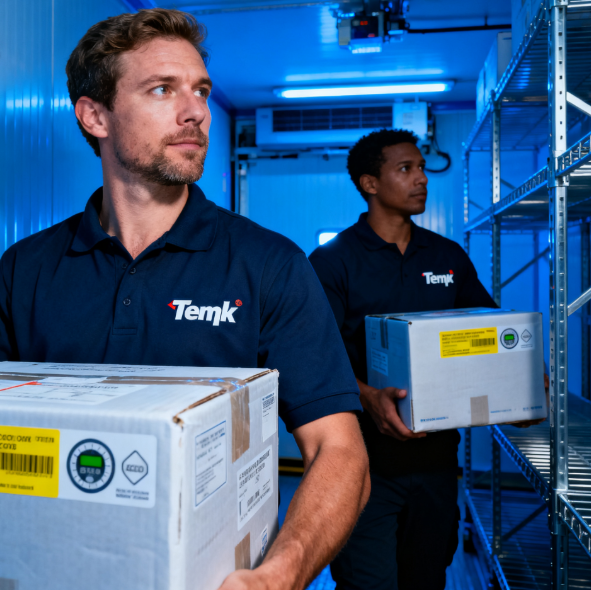
Transport sous chaîne du froid packaging is not simply a box with a compresse froide. It is a defined shipping configuration that must protect a specific payload through packing, collection, transport, transferts, delivery and receiving. The useful starting point is the product requirement and the actual route, not a generic hold-time claim or an matériau isolant En isolement.
For a temperature-sensitive shipment, document the permitted temperature conditions, sensibilité au gel, état de la charge utile, expected journey, likely delay exposure and the evidence needed before routine use. Those inputs determine whether a simple starting configuration is worth sampling, or whether the shipment needs a route-specific technical review.
Définir ce que le colis doit protéger
A temperature range by itself is not a complete packaging brief. The responsible product owner or quality team should confirm what the range means for the product and what happens if it is approached or exceeded. A useful requirement set includes:
- The approved product temperature limits and any freeze-sensitive condition.
- The initial product temperature, masse de charge utile, dimensions, orientation and allowable stacking.
- The shipment timeline from pack-out through delivery and receiving, including credible delay time.
- The expected ambient exposure at loading, tri, airport or cross-dock, linehaul and final handoff.
- The acceptance criteria, monitoring requirement and the person who will review an excursion or test result.
For regulated life-science shipments, the product requirement should come from the approved product information and the relevant quality process. A packaging supplier can help define a configuration, but it should not replace the product owner’s temperature and acceptance criteria.
Map the actual transport exposure
Carrier transit time is only one part of a thermal exposure. The packaging brief should include time before collection, mise en scène, transfer dwell, customs or weekend risk where applicable, final-mile delivery and the time until the receiver opens the shipper. A route profile can turn an assumed journey into a defined ambient and duration scenario for design and testing.
Pour le transport pharmaceutique, WHO route-profiling guidance explains why representative temperature data helps reveal route risks and supports package design. This is a technical reference for temperature-sensitive pharmaceuticals; other products still need a route review appropriate to their own quality and safety requirements.
Build the complete packout rather than selecting components separately
The useful unit of evaluation is the loaded, closed package. Isolation, liquide de refroidissement, payload layout and packing instructions interact. A material property or empty-box test cannot establish the performance of the assembled shipment.
Outils de décision utiles
Vérifiez les détails avant de choisir l'emballage
Ces outils rapides peuvent vous aider à comparer le risque d'itinéraire, besoins de dimensionnement, choix de liquide de refroidissement, et les détails de l'emballage avant de demander un devis.
Sélecteur d’emballage
Comparez les options d'emballage isotherme par produit, itinéraire, et besoin de température.
Trouver un emballageRésistance aux chutes du matériau isolant
Examinez la résistance aux chutes et les facteurs de manipulation avant de choisir des matériaux d'isolation..
Vérifier la résistanceDoublure de boîte & Dimensionnement des couvertures de palettes
Vérifiez la logique de dimensionnement du revêtement de boîte et du couvercle de palette pour les projets d'emballage isotherme.
Dimensionnement estimé| Élément d'emballage | Decision to define | Why it changes the result |
|---|---|---|
| Conteneur d'expédition extérieur | Handling strength, dimensions, closure and moisture protection. | It protects the insulated system and affects usable space and packability. |
| Isolation | Format, wall layout, seams and protection from damage. | It slows heat transfer but does not set the shipment temperature on its own. |
| Fluide de refroidissement | Taper, quantité, conditioning state and placement. | A coolant must be matched to the target conditions and kept from creating unintended local cold or heat exposure. |
| Separators and void control | Barrières, dunnage and loading order. | They help control contact risk, airflow paths and product movement. |
| Charge utile | Masse, température de départ, geometry and product spacing. | The payload affects thermal load and sensor-relevant locations. |
| Instructions and checks | Pack-out sequence, fermeture, labels and verification points. | A sound design can still fail if routine assembly differs from the approved configuration. |
Passive packaging uses insulation and a finite amount of conditioned coolant. An active system uses a powered mechanism to control the environment. Neither label is a performance guarantee. The better choice depends on product limits, voyage, variabilité de l'itinéraire, handling controls and the evidence needed for the intended shipment.
Choose a starting direction based on the shipment risk
The following matrix is a planning aid, not a qualification decision. It helps the buyer identify what must be reviewed before a package is approved for routine use.
| Conditions d'expédition | Direction de départ à revoir | Decision before rollout |
|---|---|---|
| Predictable local or regional delivery with modest exposure | A simple insulated format plus conditioned cooling medium may be a practical starting point. | Confirmez l'ajustement de la charge utile, vitesse d'emballage, receiving conditions and a representative test scope. |
| Parcel or cross-regional shipment with multiple handoffs | Review an insulated shipper, disposition du liquide de refroidissement, closure and delay allowance as one packout. | Define a realistic time-temperature profile and test the loaded configuration. |
| Sensible au gel, high-value or narrow-range product | Escalate to a product- and route-specific thermal review. | Agree acceptance limits, separation strategy, sensor placement and evidence with the responsible quality owner. |
| Long, variable or interruption-prone route | Review the full logistics plan as well as the packaging approach. | Determine whether a passive design, contrôle actif, different service level or changed handoff process is appropriate for the risk. |
Test the question that matters
A sample fit check, a controlled thermal test and a monitored shipment answer different questions. Keep the evidence tied to the decision it supports:
- A sample fit check can confirm usable space, fermeture, handling and the packing sequence. It does not demonstrate thermal duration.
- A thermal test can evaluate a defined configuration against agreed payload, conditionnement, profil ambiant, durée, sensor locations and acceptance limits.
- A monitored shipment can provide operational evidence for a defined lane. It does not automatically qualify every season, transporteur, payload or configuration.
For parcel delivery testing, ISTA Standard 7E describes thermal emballage de transport profils. The selected protocol should still reflect the actual product, packout and intended use rather than being treated as a universal certificate.
Control the approved configuration after the test
Review the packout whenever a material or operating condition changes. Examples include a new carton, épaisseur d'isolation, coolant SKU or quantity, méthode de conditionnement, plage de charge utile, modèle de chargement, itinéraire, transporteur, saison, warehouse process or acceptance limit. A temperature logger records what happened; it does not regulate temperature or extend the tested limits of the package.
Prepare a complete request for quotation
A request that only names a product type usually produces a component quote, not a useful packout recommendation. Include the approved product conditions, dimensions et masse de la charge utile, température de départ, outer-package constraints, chronologie de l'itinéraire, exposition ambiante attendue, indemnité de retard, limites de manipulation, besoin de surveillance, sample or test objective, annual volume and any branding or disposal requirements.
Use the Packaging Selector to create a practical starting shortlist, then move to custom Emballage de la chaîne froide and packout testing guidance when the shipment needs a defined configuration and evidence plan.