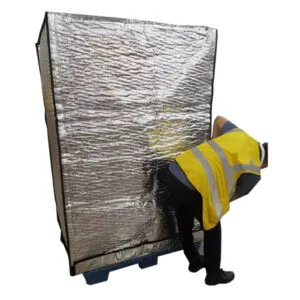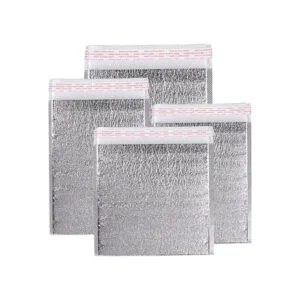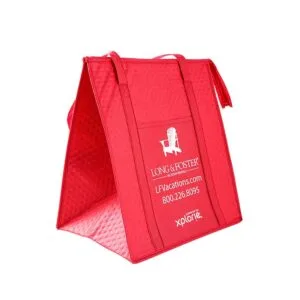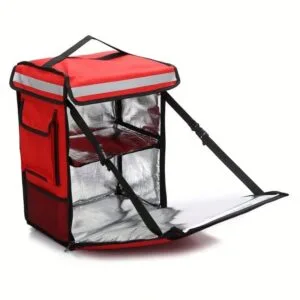
Emballage passif sous chaîne du froid protects a temperature-sensitive payload with an insulated enclosure and a finite amount of conditioned cooling or heating medium. It can be a practical way to manage defined shipment conditions, but it is not a universal substitute for route planning, correct conditioning or product-specific testing.
The WHO definition of a passive system includes an insulated enclosure and preconditioned coolant such as packs de gel, matériaux à changement de phase ou glace carbonique. The key constraint is finite thermal capacity: the package has a defined operating life that depends on the complete configuration and the transport environment.
Passive packaging is a system not a material
Un doublure isolée, a VIP panel, a gel pack or a dry-paquet de glace is a component. A passive shipping system is the closed packout formed by the outer container, isolation, liquide de refroidissement, séparateurs, charge utile, closure and pack-out procedure. The performance question is therefore not “how long does this material last?” but “does this exact loaded configuration meet the agreed conditions for this route?»
The same insulation can perform differently when the payload mass changes, when coolant conditioning changes, when empty space is added or when a product sits too close to a cold surface. Those interactions are especially important for products that can be damaged by unintended freezing.
Passive and active control solve different problems
| Question | Système passif | Système actif |
|---|---|---|
| How temperature control is created | Insulation plus a finite amount of preconditioned coolant or other thermal medium. | A powered heating or cooling mechanism controls the environment during transport. |
| Core planning constraint | The packout must cover the defined route and delay period before its thermal capacity is exhausted. | The logistics plan must account for equipment capability, pouvoir, operating controls and contingency arrangements. |
| What must be evaluated | Coolant state and amount, isolation, charge utile, mise en page, fermeture, route exposure and pack-out consistency. | Equipment performance, setpoint control, power or battery arrangements, operating procedures and route interfaces. |
| What neither system proves alone | A component or container does not prove performance for every payload and route. | Powered control does not remove the need to define product limits, handling and acceptance criteria. |
Dry ice is a finite passive coolant; it does not require external electrical power to provide cooling. Its compatibility, ventilation, carrier requirements and product suitability must still be confirmed for the individual shipment.
Define the shipment before selecting the packout
The selection sequence below prevents the common mistake of selecting a container first and trying to make the route fit it afterward:
- Confirm the product’s permitted transport conditions, freeze sensitivity and initial temperature with the responsible owner.
- Map the complete door-to-door timeline, including packing, mise en scène, transferts, delivery and credible delay time.
- Define payload mass, dimensions, orientation, fill level and whether multiple SKUs share the shipper.
- Choose an insulation format that fits the required usable volume, handling conditions and physical protection needs.
- Choose the coolant type, méthode de conditionnement, mass and placement as part of the complete design.
- Define separators, fardage, closure and pack-out instructions before testing or routine use.
WHO transport guidance describes passive systems as a combination of insulation and temperature-stabilizing media, and emphasizes qualification of the route and container before use for the intended pharmaceutical operation. Read the transport operations supplement for that life-science context. Pour la nourriture, consumer goods or other applications, apply the product-specific requirements and a proportionate evidence plan.
Outils de décision utiles
Vérifiez les détails avant de choisir l'emballage
Ces outils rapides peuvent vous aider à comparer le risque d'itinéraire, besoins de dimensionnement, choix de liquide de refroidissement, et les détails de l'emballage avant de demander un devis.
Outil d’évaluation du risque d’itinéraire
Examinez les conditions des pistes avant de sélectionner l'emballage en fonction des exigences opérationnelles réelles..
Vérifier le risque d’itinéraireDoublure de boîte & Dimensionnement des couvertures de palettes
Vérifiez la logique de dimensionnement du revêtement de boîte et du couvercle de palette pour les projets d'emballage isotherme.
Dimensionnement estiméCalculateur d’accumulateurs de froid
Estimation de la quantité de pain de glace pour les expéditions réfrigérées et planification pratique des itinéraires.
Estimer les packs de glaceSet the coolant and separation strategy deliberately
Coolant selection is not a choice between “more cold” and “less cold.” It determines how the package absorbs heat and how the payload may be exposed to cold surfaces. Condition the coolant according to the approved pack-out instruction, use separators where direct contact creates a risk, and define placement so packers can repeat it. A change in coolant temperature, quantity or location is a configuration change, not a cosmetic change.
When a packout uses phase change materials, select them for the intended product conditions and use them in the tested configuration. Do not infer route performance from the nominal phase-change point or an insulation claim alone.
Construire des preuves en couches
| Evidence activity | Ce qu'il peut soutenir | Ce qu'il ne peut pas prouver |
|---|---|---|
| Component and assembly review | Volume utilisable, fermeture, ordre d'emballage, panel protection and handling practicality. | Thermal duration or performance under an ambient profile. |
| Controlled thermal test | A defined packout against stated payload, conditionnement, profil, emplacements des capteurs, duration and pass-fail limits. | Every possible season, voie, payload or operating error. |
| Monitored shipment | Operational evidence for a specified lane and process. | Automatic transferability to a changed route or configuration. |
If a parcel-delivery test profile is part of the validation plan, ISTA thermal standards describe the role of Standard 7E and related qualification processes. The test standard should be selected by the responsible team and linked to the intended shipment, rather than used as a blanket claim for an empty shipper.
Escalate the review when route risk changes
A passive system may need a stricter technical review when the product has a narrow permitted range, ne peut pas geler, has a high replacement cost, travels through several handoffs, faces variable seasons or must tolerate a credible interruption. The response may be a changed passive design, un niveau de service différent, stronger operating controls, active temperature control or a different logistics model. The right answer comes from the product and route evidence, not from the name of the matériau isolant.
Prepare a useful passive-packaging RFQ
Provide the product condition, approved temperature limits, sensibilité au gel, dimensions et masse de la charge utile, température initiale du produit, outer-carton constraints, chronologie, exposition ambiante, indemnité de retard, route and carrier, préférence pour le liquide de refroidissement, besoin de surveillance, reuse or disposal expectation, sample objective and expected volume. That information allows a supplier to discuss a configuration and evidence plan instead of quoting an isolated component.
To compare packaging families before an RFQ, use the Packaging Selector. Pour les dimensions personnalisées, coolant layouts or a complete packout discussion, continue to custom cold chain packaging.
A passive package is successful only when the approved product, itinéraire, configuration and operating instruction stay aligned. Treat it as a controlled shipping system, not as a standalone box or coolant claim.