Comment spécifier des couvertures de chargement isolées pour l'agriculture
La question utile n’est pas de savoir si une housse de palette « fonctionne ». La question utile est de savoir s'il contrôle une exposition nommée sans créer un autre problème.. Couvre-bagages isolés pour l'agriculture, peut ralentir le gain ou la perte de chaleur autour d'une charge unifiée pendant la mise en scène, transfert, inspection, ou recevoir. Ils ne peuvent pas éliminer la chaleur du champ, alimenter une chaîne du froid, ou prouver qu'un produit est resté acceptable. Une spécification solide commence donc par une lacune dans le processus, pas un matériau. Il relie les besoins de la culture, état de la palette, environnement, conception de la couverture, règle de fonctionnement, et des preuves en une seule décision que les travailleurs peuvent répéter et que les équipes de qualité peuvent examiner.
Définissez un écart thermique avant de définir le produit
Commencez par une phrase qui décrit l'utilisation prévue. Par exemple: « Protégez les produits palettisés pré-refroidis pendant qu'ils passent d'un stockage contrôlé à travers une zone de chargement exposée jusqu'à transport réfrigéré.» Ceci est plus précieux que « Fournir une couverture isolée pour les palettes d'exportation » car il indique la condition de départ, format, emplacement, et contrôle de destination.
Testez maintenant la phrase par rapport à l'itinéraire. La palette attend-elle également l'inspection? Le chargement peut-il s'arrêter? Le soleil direct est-il possible? Le vent soulève-t-il les rabats lâches? La housse restera-t-elle dans le véhicule frigorifique? Qui le supprime? Si la couverture doit combler plusieurs lacunes, documenter chacun séparément. Un design peut convenir à plusieurs usages, mais l'approbation ne doit pas s'étendre silencieusement.
L'approche des écarts de processus expose également des situations dans lesquelles une couverture constitue un mauvais premier investissement.. Si le produit n’est pas suffisamment prérefroidi, améliorer l'évacuation de la chaleur. Si le flux d’air du réfrigérateur frigorifique est bloqué par un mauvais empilement, configuration de charge correcte. Si les palettes attendent parce que la prise de rendez-vous échoue, réduire le séjour. Si une base exposée est le chemin thermique dominant, l'isolation latérale à elle seule ne résoudra pas le problème. L'emballage doit suivre le mode de défaillance diagnostiqué.
Il y a trois premières portes:
Porte produit: Quelle condition le produit nécessite-t-il, et quelles variations de température, humidité, ou la ventilation peut-elle tolérer?
Porte d'itinéraire: Quelle exposition incontrôlée est importante en fonctionnement normal et dans un délai crédible?
Porte de contrôle: Une couverture passive est-elle capable de supporter cet intervalle, ou la réfrigération est-elle active, mouvement plus rapide, ombre, une salle tampon contrôlée, ou un autre package nécessaire?
Ne procédez pas à la comparaison des fournisseurs tant que les trois portes n'ont pas reçu suffisamment de réponses pour un exemple de brief..
Préserver l’état du produit sans bloquer la chaîne du froid
La gestion de la température agricole commence avant le recouvrement d'une palette. Moment de la récolte, ombre, pré-refroidissement, emballage, rangement froid, et le transport réfrigéré établir et maintenir l'état du produit. Les directives de la FAO décrivent la chaîne du froid comme des activités liées en amont et en aval., tandis que les directives post-récolte mettent l'accent sur la circulation de l'air à travers les emballages de produits et les charges empilées.. Un couvercle doit être inséré sans contredire ces contrôles.
Une erreur récurrente consiste à appliquer l’isolation trop tôt. Le produit chaud peut continuer à respirer et à dégager de la chaleur, tandis que le couvercle ralentit l'évacuation de la chaleur. Un autre consiste à laisser le couvercle autour des cartons ventilés à l'intérieur d'un conteneur frigorifique sans confirmer l'effet de flux d'air.. Dans les deux cas, un produit destiné à réduire l'exposition externe peut interférer avec le processus prévu.
Écrire les points d'application et de suppression dans la spécification:
Le statut de sortie du produit requis avant de couvrir
L'endroit où la couverture est installée
La géométrie maximale des palettes autorisée
Le contrôle de fermeture
Les endroits agréés où la palette couverte peut attendre
L'événement qui déclenche la suppression
L'action entreprise lors d'un retard
La disposition de réception ou de retour
La couverture ne doit pas devenir une autorisation de prolonger un séjour incontrôlé. Une règle de retard peut renvoyer la palette vers une chambre froide, dans un tampon à température contrôlée, ou via une autre réponse approuvée. L'action exacte dépend de l'opération. Ce qui compte c'est que les ouvriers ne l'inventent pas à côté du quai.
Convertissez le transfert de chaleur en choix de conception
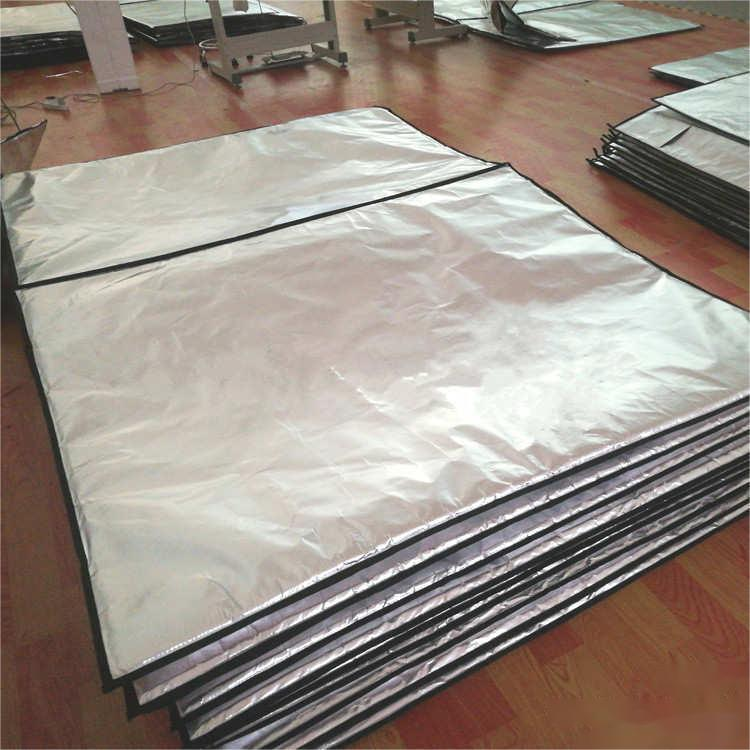
Chaque couverture gère une combinaison de trois chemins de transfert de chaleur externes. Les couches isolantes ralentissent la conduction à travers l’assemblage. Les fermetures et les chevauchements réduisent les échanges d'air chaud indésirables. Un extérieur réfléchissant peut réduire la charge de chaleur radiante lorsqu'il fait face à l'espace aérien et à l'exposition pertinents.. La charge utile, pile de cartons, base de palette, et l'air interne déterminent comment ces charges externes affectent la température du produit.
Aucune couche ne décrit le résultat final. Un noyau épais avec une jupe courte peut laisser les cartons inférieurs exposés. Un visage hautement réfléchissant ne peut pas faire grand-chose contre une exposition prolongée à l'air chaud si les coutures restent ouvertes. Une conception bien ajustée peut améliorer la couverture, mais prendre trop de temps à installer ou obstruer la ventilation nécessaire. La sélection des matériaux et la géométrie doivent être revues ensemble.
La description minimale de la conception doit inclure:
dimensions utilisables finies et tolérances dimensionnelles;
haut, côté, coin, et couverture inférieure;
description fonctionnelle de la face extérieure, isolation, et doublure intérieure;
construction des coutures et des bords;
type de fermeture, chevaucher, et emplacement;
accès à l'étiquette ou à la numérisation si nécessaire;
poids, taille du pli, et fonctionnalités de manipulation;
Outils de décision utiles
Vérifiez les détails avant de choisir l'emballage
Ces outils rapides peuvent vous aider à comparer le risque d'itinéraire, besoins de dimensionnement, choix de liquide de refroidissement, et les détails de l'emballage avant de demander un devis.
Calculateur de banquise
Estimation de la quantité de pain de glace pour les expéditions réfrigérées et planification pratique des itinéraires.
Estimer les packs de glaceGénérateur de liste de contrôle de conformité
Créer une liste de contrôle pratique pour l'examen des emballages, expédition, et documentation.
Construire une liste de contrôleCalculateur de glace carbonique
Estimer les besoins en glace carbonique pour les envois congelés ou ultra-froids avant l'emballage.
Estimation de la neige carboniqueméthode de nettoyage et de séchage compatible pour les produits réutilisables;
identification et marquage des lots de production;
critères de réparation et de mise hors service approuvés, si disponible.
Évitez d'utiliser « étanche » ou « qualité alimentaire » sans une définition précise et une documentation justificative pour l'utilisation prévue. Un visage résistant à l'eau peut toujours avoir des coutures perméables. Un couvercle touchant uniquement des cartons de transport présente une situation de contact différente de celle d'un matériau touchant des aliments non emballés.. Les équipes qualité et réglementaires doivent évaluer l’interface réelle.
Spécifier des couvertures de chargement isolées pour l'agriculture contre les modes de défaillance
Une revue en mode échec est plus productive qu’une longue liste de fonctionnalités. Il demande comment le contrôle prévu pourrait échouer et transforme la réponse en une conception, processus, ou exigence de preuve.
| Mode de défaillance | Conséquence probable | Spécification ou réponse opérationnelle |
|---|---|---|
| Le produit est couvert avant que le conditionnement ne soit terminé | La chaleur est conservée et le refroidissement ultérieur peut être ralenti | Lier l'application à la version documentée du produit ou à l'état de pré-refroidissement |
| La couverture est trop petite pour le renflement ou le surplomb de la palette | Les espaces exposent les cartons et les fermetures ne peuvent pas s'enclencher | Mesurer les palettes de production acceptables dans le pire des cas et définir les dimensions internes utilisables |
| Le dessus ou la base est laissé en dehors de la limite thermique | Une charge thermique inégale contourne la protection latérale | Indiquer quelles surfaces doivent être couvertes et si une solution de base fait partie du système |
| Le couvercle bloque la ventilation prévue | Le flux d'air réfrigéré à travers les cartons ou la pile est réduit | Définir le point de retrait ou démontrer la compatibilité avec le plan de circulation d'air réel |
| L'exposition au soleil n'est représentée que par un test de température de l'air | La charge radiante n’est pas abordée par la preuve | Inclure une exposition radiante pertinente ou limiter clairement l'allégation |
| Les travailleurs soulèvent le couvercle à plusieurs reprises pour numériser les étiquettes | La protection est interrompue et le couvercle est endommagé | Ajoutez une fonctionnalité d'accès correctement placée ou révisez la séquence de numérisation |
| La housse réutilisable revient mouillée ou contaminée | Odeur, détérioration, ou un risque d’hygiène apparaît | Établir la ségrégation, nettoyage, séchage complet, inspection, et étapes de libération |
| Le fournisseur modifie une couche ou une fermeture sans examen | Ajuster, durabilité, nettoyabilité, ou le comportement thermique peut changer | Exiger des spécifications contrôlées, notification, et règles de réévaluation |
La réponse ne doit pas toujours être une couverture plus complexe. Parfois, un changement d'itinéraire ou une instruction de travail constitue le contrôle le plus efficace.. Le tableau évite également un problème d'approvisionnement courant: demander à une propriété matérielle de résoudre les défaillances causées par les opérations.
Construire des preuves en couches
Les preuves devraient devenir plus représentatives à mesure que l'achat passe de l'idée au déploiement. Un programme discipliné peut utiliser quatre couches.
Couche 1: Examen des documents
Examiner la construction proposée, dimensions, utilisation prévue, instructions de manipulation, déclarations importantes, et tout rapport de test existant. Un rapport utile identifie l'élément testé, charge utile ou simulateur, conditions de départ, profil environnemental, durée, configuration de mesure, et critères d'acceptation. Les résumés marketing sans ces détails peuvent soutenir le contrôle mais pas une décision d'itinéraire.
Couche 2: Essai d'ajustement et d'utilisabilité
Appliquer l'échantillon sur une palette représentative et sur la plus grande palette acceptable. Inclure le surplomb du carton, sangles, planches de coin, et étiquettes. Application et suppression du temps, observer les points d'accroc, fermetures d'essai, vérifier l'accès des chariots élévateurs, et stockage de pratique. Exécutez l'essai avec des opérateurs réels pendant une période de travail réaliste.
Couche 3: Comparaison thermique contrôlée
Comparez la configuration couverte proposée avec la référence pertinente dans des conditions documentées. La conception de la comparaison doit refléter la décision. Un transfert direct au soleil nécessite une exposition différente d’une attente chaude à l’intérieur. L'emplacement des capteurs et l'équipement de mesure doivent être planifiés, mais l’interprétation des données doit utiliser les critères de produit du propriétaire du produit..
Couche 4: Confirmation de l'itinéraire et examen des exceptions
Quand le risque le justifie, revoir la voie complète ou un pilote représentatif. Inclure les transferts et le processus de retard, pas seulement un timing normal. Un pilote réussi sur une seule voie n’approuve pas tous les climats, cultures, formats de palettes, ou des saisons. Enregistrez les limites afin que les équipes ultérieures sachent ce qui a été établi.
ISTA 7E peut apparaître dans la documentation des fournisseurs, mais il est conçu pour le thermique emballage de transport dans les systèmes de livraison de colis. Il ne s'agit pas d'une qualification universelle pour couvertures de palettes ou voies agricoles. Utiliser des normes dont la portée correspond à la décision, et complétez-les par des travaux spécifiques à l'itinéraire, le cas échéant.
Rendre le contrôle visible à chaque transfert
Un programme de couverture efficace a un contrôle physique et informationnel. Le contrôle physique est le couvercle correctement installé. Le contrôle informationnel indique à la personne suivante quelle est la palette, quel statut a-t-il, quand il était couvert, où ça devrait aller, et que faire si le plan change.
Pour une housse jetable, les informations peuvent faire partie d'une étiquette d'expédition et d'instructions de travail. Pour une housse réutilisable, l'article lui-même peut porter un identifiant d'actif unique ainsi qu'une marque de taille et d'état visible. Gardez la traçabilité des produits et le suivi des actifs de couverture distincts: l'identifiant de la palette suit la marchandise, tandis que l'identifiant de l'actif suit la couverture.
A la réception, le destinataire ne doit pas utiliser l'état de couverture comme seul signal d'acceptation. Une couverture déplacée ou endommagée est une preuve pertinente, mais une couverture intacte ne prouve pas l'état du produit. Examiner les enregistrements de température, historique des expéditions, état de l'emballage, et inspection du produit selon la procédure établie.
Si l'envoi répond aux exigences en matière de transport de produits alimentaires, les rôles et les enregistrements applicables doivent être considérés séparément. Aux États-Unis, Les exigences sanitaires de la FDA en matière de transport concernent les véhicules, opérations, entraînement, enregistrements, et protection contre les risques liés à la sécurité alimentaire dans leur champ d’application. Une couverture peut soutenir la procédure, ne le remplace pas.
Décidez si la réutilisation convient au réseau
La réutilisation est attractive lorsque les flux agricoles sont prévisibles, mais la saison des récoltes rend le déséquilibre des actifs particulièrement probable. Les arguments économiques et environnementaux dépendent des rendements réels, pas de durabilité théorique.
Tracer l'itinéraire inverse. Les couvertures peuvent revenir sur le même camion, consolider dans un centre de distribution, ou passer par un pool tiers. Chaque option nécessite une appropriation, événements d'analyse, responsabilité de nettoyage, espace de séchage, tampons d'inventaire, et gestion des pertes. Si aucune partie n'accepte la responsabilité à destination, la boucle de retour prévue peut ne jamais commencer.
La réflexion sur le cycle de vie est plus crédible qu’une simple déclaration « réutilisable est durable ». Le cadre de gestion durable des matériaux de l'EPA met l'accent sur l'utilisation productive des matériaux tout au long de leur cycle de vie.. Appliquez cette idée à la couverture en tenant compte de la quantité de matériaux, fabrication, transport aller et retour, nettoyage, réparation, perte, utilisation, et fin de vie.
Les règles de destination comptent également. Le règlement de l’Union européenne sur les emballages et les déchets d’emballages commence généralement à s’appliquer à partir du 12 Août 2026 et introduit des exigences tout au long du cycle de vie de l'emballage, avec application en fonction de l'opérateur et du format de conditionnement. Les exportateurs agricoles desservant les marchés de l'UE devraient obtenir, conseils spécifiques à la situation. Ne présumez pas qu’une étiquette réutilisable ou une déclaration de matériau établit la conformité.
Un produit à sens unique peut rester le meilleur choix opérationnel pour une voie d'exportation ouverte. Une conception durable et réutilisable peut être plus solide sur un itinéraire intérieur fermé. La bonne conclusion vient du réseau, pas d'une hiérarchie universelle.
Passer de l'échantillon à la production contrôlée
Avant la mise à l'échelle, convertir l'échantillon approuvé en une spécification contrôlée. Conserver des photos, dessins, descriptions des couches, détails de fermeture, étiquettes, et tolérances. Convenir des points d'inspection et de la notification des modifications. Décidez si le premier lot de production nécessite une inspection approfondie ou un nouvel essai d'ajustement..
La formation doit être courte et visuelle. Afficher la bonne orientation, séquence de fermeture, traitement du fond, accès aux étiquettes, et méthode de suppression. Inclure les défauts qui nécessitent une ségrégation. Les superviseurs doivent être en mesure d'observer une utilisation correcte sans démonter la palette.
Utiliser les données de déploiement précoce pour améliorer le système. Suivre les couvertures manquantes, temps d'application, emplacements des dommages, retours humides, erreurs de taille, et exceptions. Ces données révèlent si la conception ou le processus nécessite une attention particulière. Elles ne doivent pas être transformées en allégations de performance sans une étude appropriée.
Le contrôle des modifications se poursuit après le lancement. Revoir la décision lorsqu’il y a un nouveau produit, carton, modèle de palette, itinéraire, climat, véhicule, méthode de nettoyage, matériel du fournisseur, ou exigence du client. L'isolation fait partie d'un processus de distribution vivant.
Questions fréquemment posées
Combien de temps une couverture de chargement agricole isolée protégera-t-elle une palette?
Il n’y a pas de durée universelle responsable. Le résultat dépend de l’état de départ du produit, masse thermique, configuration de palette, exposition ambiante, soleil et vent, construction de la couverture, ajuster, base, et critère d'acceptation. Demandez les conditions complètes derrière toute réclamation de durée, décidez ensuite si des tests supplémentaires sont nécessaires pour votre itinéraire.
Une couverture complète du bas est-elle toujours nécessaire?
Pas toujours, mais la base doit être considérée. La chaleur peut pénétrer par contact avec une surface chaude ou de l'air autour d'une jupe ouverte. Certains systèmes utilisent une base isolée, feuille de palette, ou surface de scène contrôlée. Définir l'état de base et l'inclure dans l'évaluation au lieu de supposer que la couverture latérale et supérieure représente la palette entière.
La housse peut-elle rester en place pendant le transport réfrigéré?
Seulement si le produit, ventilation des cartons, flux d'air de véhicule, et évalué le support de configuration qui utilise. De nombreux chargements de produits frais dépendent de la circulation de l'air à travers les évents d'emballage et les canaux de palettes alignés.. Une couverture utilisée lors du transfert à l'extérieur devra peut-être être retirée avant le chargement final. Mettre le point de retrait dans la notice de travail.
Quel est le document fournisseur le plus important?
Aucun document ne répond à toutes les questions. La spécification du produit contrôlé établit ce qui sera fourni, tandis qu'un rapport de test détaillé explique toute preuve thermique. Instructions de nettoyage, documentation matérielle, termes de contrôle des changements, et les dossiers d'inspection de la production peuvent également être importants. Ensemble, ils connectent l'échantillon, réclamer, et lot de production.
Quand faut-il retirer une couverture réutilisable?
Utilisez des critères observables supportés par le fournisseur et votre processus d'hygiène et de qualité. Les exemples peuvent inclure des fermetures endommagées, coutures ouvertes, isolation perforée ou humide, délaminage, contamination qui ne peut pas être éliminée, perte d'ajustement, ou une réparation non approuvée. Évitez de supposer un nombre fixe de déplacements à moins qu'il ne soit pris en charge par les conditions réelles..
Conclusion
Une spécification de couverture agricole défendable commence par une lacune dans le processus et la suit jusqu'à l'état du produit., flux d'air, transfert de chaleur, géométrie, manutention, preuve, et la propriété. La couverture doit conserver un état établi par la chaîne du froid, ne pas cacher un contrôle manquant. Test en couches, garder les réclamations liées à leur configuration, et définir le délai de réponse avant le déploiement. Pour des conceptions réutilisables, prouver la boucle de retour aussi soigneusement que le produit physique. Cette méthode basée sur l'itinéraire produit un plus petit, une revendication plus claire et un fonctionnement plus fiable.
À propos du tempk
Tempk est un B2B emballage chaîne du froid fournisseur dont les offres pertinentes incluent des palettes isolées et des couvertures thermiques et connexes emballage à température contrôlée. Nous pouvons aider les acheteurs à transformer une description d'itinéraire en une discussion de couverture qui aborde les dimensions utilisables., couverture, fermetures, gestion de l'accès, et réutilisation prévue. L’exigence relative aux produits agricoles, stratégie de qualification, et l'agrément d'exploitation restent de la responsabilité du chargeur et de son équipe qualité. Le point de départ le plus utile de Tempk n’est donc pas une durée générique demandée, mais une palette représentative et une description claire de l'exposition que la couverture est censée gérer.
Partagez votre marchandise, géométrie des palettes, séquence de transfert, exposition environnementale, et plan de retour avec Tempk. Utilisez ces informations pour demander un échantillon ciblé et un examen des preuves avant la mise à l'échelle.