Couvertures de palettes isolées pour la gestion de la chaîne d'approvisionnement: A Stage-Gate Playbook
An insulated pallet cover is easy to buy and surprisingly easy to mismanage. Ce n'est peut-être pas la bonne taille, appliqué après que la charge soit déjà chaude, ouvert pour chaque scan, laissé là où le flux d'air est nécessaire, ou abandonné chez le destinataire bien qu'il soit qualifié de réutilisable. Couvertures de palettes isolées for supply chain management need a governance model as much as a material specification. Le modèle le plus efficace rend cinq décisions explicites: l'exposition étant contrôlée, la limite thermique, les preuves requises, le propriétaire à chaque remise, et la règle du changement. Cet article présente une méthode par étapes qui relie ces décisions depuis la définition initiale du problème jusqu'au déploiement à grande échelle..
Porte 1: Prove That the Problem Is a Cover Problem
Begin with evidence from the operation. Examiner les étapes d'expédition, séjour au quai, enregistrements de température si disponibles, enquêtes sur les écarts, commentaires du transporteur, et observations des équipes de l'entrepôt. L’objectif est d’identifier quand la protection des produits s’affaiblit, not to prove that a requested product is necessary.
A cover is a plausible control when a correctly conditioned unitized load faces a temporary external exposure and the cover can be applied without disrupting another control. Typical candidates include transfer between controlled areas, short outdoor movement, accès pour inspection, mixed-environment cross-docking, and receiving queues.
Other problems demand different action. If the product begins outside its required condition, insulation preserves the wrong condition. If an active container fails, a blanket cannot replace its cooling capacity. If pallets spend hours at a dock because schedules are uncontrolled, process redesign may offer more protection. If the load needs continuous refrigerated airflow, leaving it wrapped can be counterproductive.
Write a problem statement that can be challenged:
“A released pallet at the required starting condition experiences a defined uncontrolled exposure between two named temperature controls. We are evaluating whether a fitted passive cover can reduce that exposure without interfering with handling, flux d'air, accéder, or quality review.”
The statement prevents scope drift. It also gives finance and procurement a clear reason for the project.
Porte deux: Design the Boundary and the Workflow Together
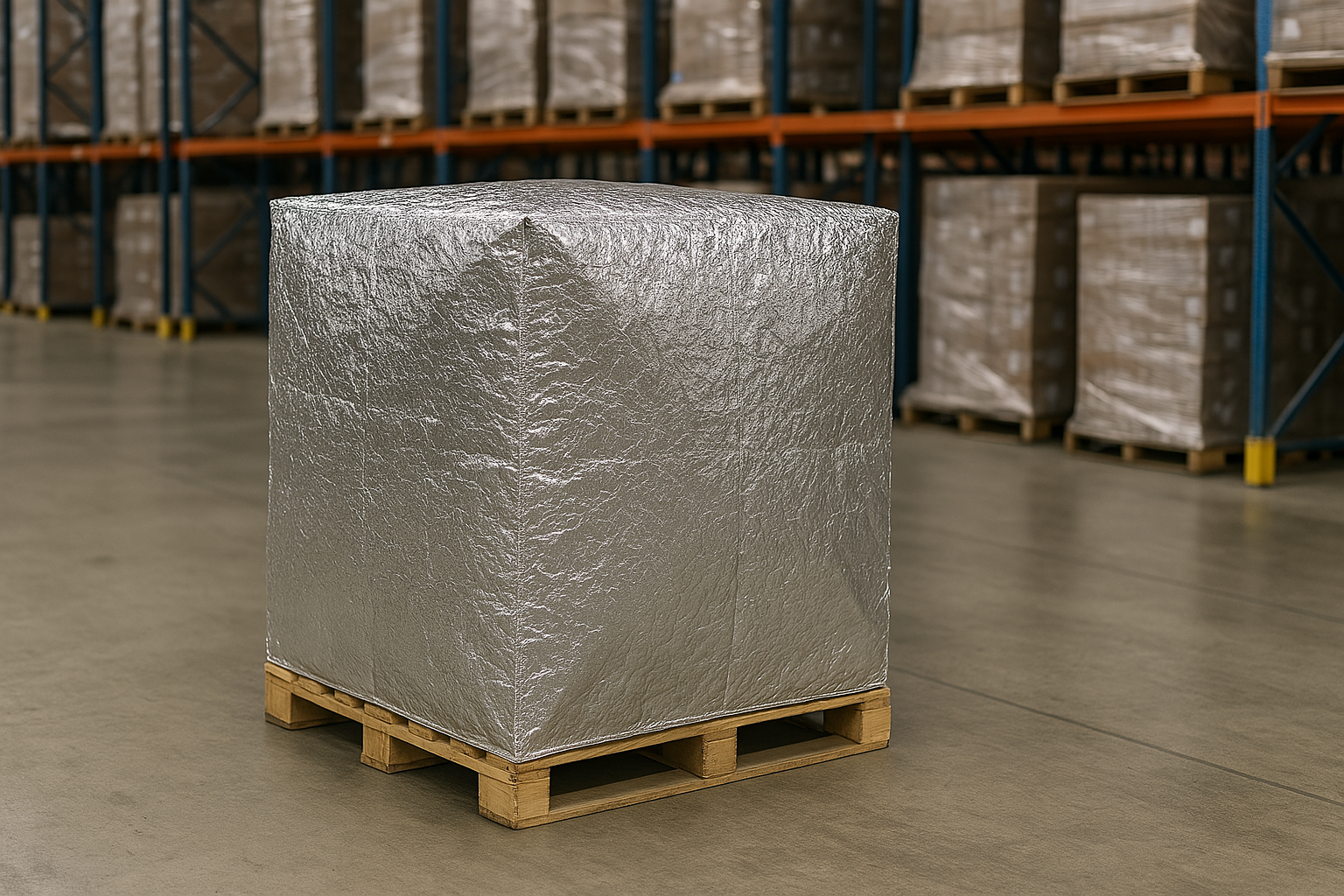
The thermal boundary includes panels, coutures, fermetures, haut, côtés, and possibly the base. The workflow includes the person who installs the cover, the time available, the label that must be scanned, the equipment that moves the pallet, and the event that triggers removal. Designing one without the other creates failure.
Boundary choices
Specify usable internal length, largeur, and height based on actual production loads. Inclure le surplomb, sangles, planches de coin, renflements, et variation acceptable. State whether the top is integrated, séparé, or overlapped. Decide how the lower edge meets the pallet and whether a base component is required.
Describe functional layers rather than accepting a generic material name. The outer face may provide abrasion or moisture resistance and may manage radiant heat. The insulation slows conductive heat flow. The liner protects the core and affects friction and cleaning. Seams and closures join the system but can become thermal or moisture paths.
A reflective face is not active cooling. NOUS. Department of Energy guidance on radiant barriers explains that reflective surfaces reduce radiant transfer when facing an air space. On a pallet, that principle is relevant to sun and hot surroundings but does not eliminate warm-air leakage or conductive contact.
Workflow choices
Observe how a pallet moves before choosing doors, rabats, fenêtres, ou fermetures. A document pocket may prevent a full opening. A scan flap may help at a hub but become a snag point during forklift handling. A heavier cover may add thermal resistance but require two operators and more storage space.
Define the sequence: libérer, identify correct size, appliquer, fermer, balayage, start exposure, remettre, retirer, inspecter, et disposition. Add an exception sequence for delay, dommage, missing cover, wet cover, and route change. The sequence becomes a design input and later a training tool.
Porte trois: Create an Evidence Ladder
Not every shipment needs the same depth of study. Match evidence to product risk, exposition, business impact, and the novelty of the use. An evidence ladder prevents both under-testing and unnecessary complexity.
Step A: Supplier document assessment. Review the controlled product description, dimensions, matériels, utilisation prévue, existing test data, conseils de nettoyage, et les limites. Separate raw-material properties from finished-cover performance.
Step B: Operational fit assessment. Trial representative and worst-case acceptable pallets. Observe application time, fermeture, accéder, ergonomie, interaction avec un chariot élévateur, identification, suppression, pliant, et stockage.
Step C: Controlled thermal assessment. Use a representative payload or justified simulator, documented starting condition, relevant environmental exposure, suitable measurement equipment, and predefined analysis. Compare against a meaningful baseline if the decision requires it.
Step D: Process pilot. Run the cover through named origin, transporteur, moyeu, and destination events. Include the return path for reusable products. Review normal execution and at least the exception handling that can be practiced safely.
Step E: Qualification within the owner’s quality system. Where product risk or regulation calls for formal qualification, the product owner determines the protocol, critères d'acceptation, approbations, et changer de contrôle. The cover supplier’s report can support but does not replace that responsibility.
Evidence must keep its boundaries. ISTA 7E is a standardized thermal test for insulated emballage de transport dans les systèmes de livraison de colis. It should not be presented as automatic validation for a pallet cover in every air, océan, truckload, or warehouse lane. Standard methods are valuable when their scope matches the use; lane-specific information addresses different uncertainty.
Monitoring is also separate. A data logger records temperature where its sensor is located. It does not insulate the pallet, and an insulated cover does not create a temperature record. Decide monitoring based on product and quality requirements.
Porte quatre: Assign Ownership at Every Interface
The cover crosses organizational lines, while accountability often stops at the warehouse door. A responsibility map prevents the physical control from becoming ownerless.
| Process point | Primary decision | Evidence or record | Escalation trigger |
|---|---|---|---|
| Product release | Is the pallet at its approved starting status? | Release record under the applicable process | Load is not ready or status is unclear |
| Cover issue | Is the correct design and condition available? | Asset or stock issue and visual inspection | Mauvaise taille, mouillé, endommagé, or unapproved cover |
| Application | Is coverage complete and access correct? | Operator check or scan event | Closure cannot engage or pallet exceeds limits |
| Carrier handover | Does the next party accept the use instruction? | Shipment instruction or agreed handover record | Carrier cannot maintain the planned handling |
| Delay or inspection | Can the covered exposure continue? | Time and exception record | Reviewed dwell or condition is exceeded |
| Réception | Is shipment information sufficient for disposition? | Température, condition, and receipt review as required | Dommage, données manquantes, or other acceptance concern |
| Cover return | Is the asset accounted for and segregated by status? | Return scan and inspection status | Manquant, contaminé, mouillé, or irreparable item |
The table does not impose one regulatory model. It makes decisions visible so each organization can place them in its own contracts, instructions de travail, accords de qualité, or service levels. Responsibility should be confirmed with third-party logistics providers before launch, especially where they will open, retirer, magasin, or return covers.
Food and medicinal supply chains may have additional obligations. Within its scope, the FDA Sanitary Transportation rule addresses vehicles, opérations de transport, entraînement, enregistrements, and risks such as inadequate refrigeration and contamination. European good distribution practices address medicinal-product distribution controls in their jurisdiction. A cover can support an approved process, but “compliant cover” is too broad unless a precise claim and applicable requirement are defined.
Outils de décision utiles
Vérifiez les détails avant de choisir l'emballage
Ces outils rapides peuvent vous aider à comparer le risque d'itinéraire, besoins de dimensionnement, choix de liquide de refroidissement, et les détails de l'emballage avant de demander un devis.
Liquide de refroidissement & Référence PCM
Comparez les options de liquide de refroidissement et de PCM lorsqu'un itinéraire nécessite une prise en charge supplémentaire de la température.
Comparez les optionsGénérateur de liste de contrôle de conformité
Créer une liste de contrôle pratique pour l'examen des emballages, expédition, et documentation.
Construire une liste de contrôleDoublure de boîte & Dimensionnement des couvertures de palettes
Vérifiez la logique de dimensionnement du revêtement de boîte et du couvercle de palette pour les projets d'emballage isotherme.
Dimensionnement estiméPorte cinq: Turn the Approved Sample Into a Controlled Supply
Sample approval should create a production baseline. Keep a drawing or specification that covers functional layer construction, usable dimensions and tolerances, coutures, fermetures, chevaucher, accéder aux fonctionnalités, étiquetage, weight if relevant, et emballage pour la livraison. Retain an approved sample when practical.
Define incoming checks according to risk. Visuel, dimensionnel, and functional inspection may confirm identity, taille, fermeture, état des coutures, défauts de surface, étiquette, et en forme. More extensive testing can be triggered by changes or periodic review. Inspection should detect meaningful differences rather than generate paperwork without a decision.
Supplier change control needs a defined threshold. Substituting an outer film, isolation, fil, obligatoire, adhésif, fermeture, or manufacturing method may affect thermal behavior, rigidité, nettoyage, ajuster, ou durabilité. Require notification for potentially meaningful changes and decide whether the response is document review, approbation de l'échantillon, essai d'ajustement, or thermal re-evaluation.
Production consistency also includes labeling. A reusable cover needs a durable identifier and design revision that remain readable through the intended cleaning and handling. A one-way cover needs clear size and orientation so it is applied correctly. Avoid printing unsupported performance or compliance claims on the product.
Operating a Reusable Cover Pool
A reusable cover pool is a small returnable-asset system. It needs inventory rules, contrôle d'état, logistique inversée, capacité de nettoyage, repair boundaries, and loss accountability.
Create distinct physical areas for clean available stock, returned uninspected stock, wet items, repair candidates, and retired covers. The digital status should mirror those areas. A cover should not become available merely because it was scanned at the warehouse; it becomes available after the required inspection, nettoyage, et séchage.
Permanent cover identification should be separate from the pallet’s shipment identity. GS1 standards support identifying logistics units such as pallets; the reusable cover can have its own asset code that associates temporarily with a shipment. This lets one cover serve many pallets without corrupting product traceability.
Plan inventory using observed cycle time, not just trip duration. A cover may spend time waiting at origin, en transit, at destination, en transport retour, en nettoyage, et en stockage. Add realistic buffers for seasonal volume and imbalance. If the route cannot recover assets reliably, reconsider the format before buying a large reusable fleet.
Repair and retirement criteria should be visible. Coutures ouvertes, failed closures, isolation humide, délaminage, contamination qui ne peut pas être éliminée, distorted fit, and unapproved patches may create risk. The supplier may be able to recommend compatible repair methods for limited damage. Do not assume a fixed reuse count unless evidence covers the real cleaning and handling conditions.
Measuring Cost and Sustainability Without Shortcuts
The unit price answers only one part of the business case. For a one-way cover, consider procurement, stockage, travail d'application, gestion des destinations, and material disposition. Pour un système réutilisable, add identification, transport de retour, tri, nettoyage, séchage, réparation, perte d'actifs, working inventory, and management.
Use scenarios rather than a single optimistic forecast. A closed route with reliable backhaul may support high asset utilization. A fragmented international network may not. Pilot data should replace assumptions about loss, temps de cycle, and labor as soon as it becomes available.
Environmental evaluation needs the same discipline. EPA’s sustainable materials management approach considers productive material use across the life cycle. Reuse may reduce repeated manufacturing, but it also creates return and cleaning activity. A credible comparison defines the functional unit, system boundary, expected turns, perte, et traitement de fin de vie. Specialized life-cycle expertise may be appropriate for public claims.
Le règlement de l’Union européenne sur les emballages et les déchets d’emballages commence généralement à s’appliquer à partir du 12 Août 2026 and addresses packaging design, composition, Recyclabalité, réutilisation, and waste prevention through provisions with different scopes and schedules. Businesses operating in the EU should review current official guidance and obtain legal or regulatory advice for their specific role and cover format. Procurement specifications should be capable of evolving as implementation details develop.
Operating Insulated Pallet Covers for Supply Chain Management at Scale
Après le déploiement, measure what the program can responsibly observe. Useful operational indicators may include correct application, missing assets, type de dommage, cleaning turnaround, wrong-size selection, unplanned openings, transferts retardés, et réponse d'exception. Temperature-event review may contribute, but it should respect measurement and product-disposition procedures.
Rechercher des modèles. Repeated corner tears can indicate a design or pallet-overhang problem. High loss at one consignee can indicate unclear ownership. Long cleaning queues can indicate insufficient drying capacity. Frequent label access can justify redesigning a flap. These findings improve the system without requiring exaggerated thermal claims.
Hold a change review when the product, palette, itinéraire, site, transporteur, véhicule, exposition, règlement, matériau de couverture, or cleaning process changes materially. Decide whether the original evidence still applies. A small administrative change may require no test; a new payload or climate may require more.
Document retirement of the old design when revisions occur. Mixed versions can confuse workers and make evidence hard to interpret. Large visible revision marks and controlled rollout dates can help.
Questions fréquemment posées
Who should own an insulated pallet cover program?
Ownership is usually shared, but one function should coordinate. Logistics may own workflow, packaging engineering the design, quality the product requirements and evidence, procurement the supplier, and warehouse operations execution. Finance and sustainability teams may review cost and life-cycle claims. Define decision rights rather than assuming collaboration will happen automatically.
What is the difference between a thermal cover pilot and qualification?
A pilot tests practical use on a limited route or volume. It can reveal fit, remettre, suivi, et problèmes de retour. Qualification is a planned, documented demonstration against predetermined requirements under the relevant quality system. A pilot may provide qualification evidence, but the terms are not interchangeable and scope depends on product and organization.
Can a pallet cover correct a temperature excursion?
Non. A passive cover slows heat transfer; it does not actively cool or heat the product back into condition. Si une excursion est suspectée, follow the established product-disposition and quality process. Do not cover the pallet and assume the event has been reversed.
How should a third-party logistics provider be trained?
Provide the intended use, correct size and orientation, application and closure steps, scan access, removal point, delay escalation, gestion des dommages, et processus de retour. Use images and a practical demonstration. Confirm responsibility in operating documents or agreements appropriate to the relationship, then observe early execution.
When should the cover design be requalified or retested?
Consider review after meaningful changes to layers, coutures, fermetures, dimensions, charge utile, modèle de palette, itinéraire, exposition ambiante, véhicule, durée d'utilisation, nettoyage, ou critères d'acceptation. The quality team should decide the level of re-evaluation based on risk. Not every change needs a full study, but no meaningful change should be ignored.
Conclusion
Managing pallet covers is a sequence of gates: confirm the problem, design the thermal boundary with the workflow, build proportionate evidence, assign interface ownership, and control production. Reusable programs add asset status, logistique inversée, nettoyage, et la retraite. Cost and sustainability need system boundaries rather than labels. When these elements are connected, a passive cover can become a dependable control for a specific exposure without being mistaken for refrigeration, surveillance, or universal compliance.
À propos du tempk
Tempk est un B2B emballage chaîne du froid provider offering insulated pallet and thermal covers and related emballage à température contrôlée options. We can help turn a process problem into a focused product brief by reviewing pallet geometry, intended coverage, fermetures, accès aux étiquettes, manutention, and reuse intent. Tempk does not define the customer’s product acceptance criteria or regulatory obligations. Those remain within the route owner’s quality and logistics system, supported by suitable evidence and documented use.
Send Tempk the problem statement, dessin de palette, exposition, and handover map for your intended lane. Those inputs support a more relevant sample and supplier discussion before full deployment.