Temperature Control Pallet Covers for Temperature-Controlled Warehousing: Close the Right Control Gap
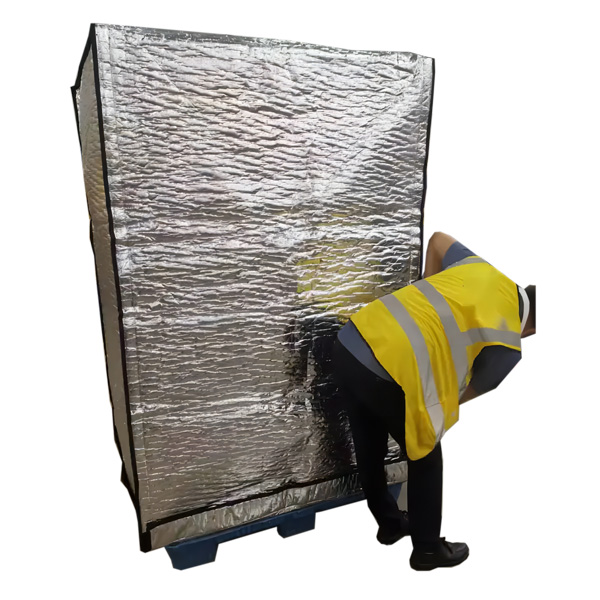
A pallet cover should earn its place in the control strategy. Couvertures de palettes de contrôle de température for temperature-controlled warehousing are most credible when they address a named, time-bounded exposure that the facility and workflow cannot reasonably eliminate. They are passive barriers, so they change the rate of heat transfer rather than commanding a temperature. That distinction turns a vague purchase into an engineering and operations decision: define the gap, compare control options, specify the complete cover, verify it in context, and govern its use.
This method is useful whether the pallet contains pharmaceutical goods, nourriture, matériel de laboratoire, or another produit sensible à la température. The required condition always comes from the product and applicable quality system, not from the cover catalog.
Name the Control Gap Before Naming the Product
Write the problem as an event. "Warm dock" is only a location. "Released pallets may wait between the monitored dispatch room and a confirmed vehicle while exterior air enters during door cycles" describes an event that can be observed. It identifies the load state, étape du processus, boundary, and delay that a control must address.
Suivant, identify why the event exists. It may result from trailer scheduling, calendrier d'inspection, insufficient protected staging, a long transfer between buildings, intermittent door operation, or an emergency contingency. Causes matter because a process or facility correction may outperform an accessory. If pallets are called too early, a release rule could prevent the wait. If solar exposure reaches a marked bay, shielding or relocation could protect every load. If control is lost because refrigeration capacity is inadequate, a cover should not legitimize continued storage.
Define the consequence without assuming it. Environmental temperature outside the required range does not automatically prove that product temperature exceeded its limit; product thermal mass and packaging influence response. The reverse is also important: a room reading within range may not represent a pallet near a door or radiant source. Use mapping, routine monitoring, informations sur le produit, and risk assessment to decide what measurement and response are relevant.
Then set the boundary. State the normal event duration, retard crédible, product and pallet configurations, condition de départ, season or weather concerns, and the action triggered when the boundary is exceeded. Do not turn a trial result into a universal allowable exposure time. The quality team must retain authority over product impact and deviations.
Choose the Control Layer With the Fewest Fragile Steps
Controls differ in dependence on human action. A protected, temperature-controlled staging room acts on every correctly placed pallet. A scheduling rule can prevent unnecessary dwell but depends on coordination. A fitted cover can travel with an individual load but must be available, intact, correctly oriented, fermé, removed, and recovered. The most suitable answer may combine layers, yet each layer should have a reason.
Evaluate options in a practical order. Can the exposure be eliminated by changing timing or route? Can engineering reduce it through an enclosure, door management, airflow change, or added controlled space? Can administrative controls limit dwell and improve escalation? If residual exposure remains, could a passive cover add a meaningful buffer? This is not a rigid regulatory hierarchy for every facility; it is a way to avoid using a portable item to compensate for a preventable system problem.
Consider failure visibility. A warehouse alarm is designed to signal a facility condition. A torn or partly open cover may fail silently unless an operator notices. A reusable cover may appear present while its seams or closure are no longer fit. Inspection, entraînement, and supervision must match that failure mode.
Also consider whether covering conflicts with the primary storage design. Cold rooms may rely on airflow around loads and defined pallet spacing. Covers can obstruct visual inspection, barcode scanning, pest observation, sprinkler patterns, or stock status. Long-term stationary covering should therefore be reviewed separately from short transfer use. It should never be adopted simply because the cover is already purchased.
Write a Requirement That Suppliers Can Answer Honestly
A user requirement should describe function and context before asking for a construction. Avoid prescribing a fashionable layer stack without understanding the heat path. Give suppliers enough information to propose a fit, while protecting confidential product details through an appropriate data-sharing process.
| Requirement field | What the buyer should define | What a useful response should show |
|---|---|---|
| Intended event | Warehouse route, staging activity, normal use, cas de retard, and exposure direction | A clear statement of suitable and unsuitable use |
| Load envelope | Empreinte de palette, plage de hauteur, surplomb, capuchon supérieur, envelopper, étiquettes, et les besoins d'accès | Ajustement interne, closure arrangement, and a sample on a representative load |
| Thermal purpose | Radiant shielding, reduced convective exchange, added resistance, ou une combinaison | Construction rationale and relevant complete-cover evidence |
| Manutention | Application area, dotation en personnel, équipement, balayage, mouvement, et retrait | Safe work sequence with no loose material in travel paths |
| Contrôles de qualité | Identification, inspection, documentation, nettoyage, stockage, et notification de changement | Defined material and construction controls plus buyer-review points |
| Vérification | Défi, charge utile, capteurs, répétitions, règle d'acceptation, and report expectations | Transparent test conditions and limits, not an unconditional performance promise |
| End of use | One-way disposal or reusable recovery, nettoyage, réparation, et la retraite | Practical instructions and material information for the destination market |
The table creates a comparable request without forcing every supplier into one unsupported claim. If a field cannot yet be completed, that gap belongs in the project plan. It should not be replaced with a guessed dimension, assumed hold time, or generic request for "GDP certification."
Material details still matter. Ask what controls radiant properties, what supplies insulation, how seams and corners are formed, and how the skirt closes around an irregular load. Request production tolerances and change-notification practices appropriate to the risk. If the cover includes a window or flap, assess the edge construction and the behavior after repeated access. If it is reusable, confirm cleaning compatibility, séchage, identification, inspection, and repair boundaries.
Performance evidence must describe a complete configuration. Panel coupons do not capture seams, ajuster, compression, or air leakage. A supplier test with a different pallet, charge utile, état initial, or ambient challenge may be useful background but not direct proof. ISTA thermal profiles and processes can inform certain transport-packaging work, yet a warehouse transfer should be represented by conditions relevant to that transfer. Applicability is part of verification.
Pilot the Process, Not Just the Cover
An effective pilot begins before the first sensor is placed. Opérations, qualité, ingénierie, sécurité, and procurement should agree on the decision to be made. The protocol identifies production-representative covers and loads, reference condition, sensor rationale, instrument calibration status, environmental measurements, handling sequence, écarts, répétitions, et critères d'acceptation. Record photographs or diagrams of fit when permitted, because a graph alone cannot show an open skirt or compressed corner.
Use operators from the intended shifts after initial instruction. Timed application can inform staffing, but speed is not the only measure. Observe awkward reaches, blocked labels, loose hems, larmes, closure mistakes, load movement, and removal at destination. Check that workers understand the stop point: a cover does not authorize an extension when the vehicle is delayed, an alarm sounds, or the pallet is misrouted.
Outils de décision utiles
Vérifiez les détails avant de choisir l'emballage
Ces outils rapides peuvent vous aider à comparer le risque d'itinéraire, besoins de dimensionnement, choix de liquide de refroidissement, et les détails de l'emballage avant de demander un devis.
Générateur de liste de contrôle de conformité
Créer une liste de contrôle pratique pour l'examen des emballages, expédition, et documentation.
Construire une liste de contrôleCalculateur de glace carbonique
Estimer les besoins en glace carbonique pour les envois congelés ou ultra-froids avant l'emballage.
Estimation de la neige carboniqueVérificateur de risque d'itinéraire
Examinez les conditions des pistes avant de sélectionner l'emballage en fonction des exigences opérationnelles réelles..
Vérifier le risque d'itinéraireConsider a hypothetical campus transfer. A mapped and monitored storage room dispatches mixed-height pallets to another controlled building through a covered but unconditioned passage. The project team expects the cover to buffer variable air exposure. Pendant le pilote, thermal traces are acceptable for the tested loads, but short covers ride above the pallet deck on taller configurations and leave a gap. The correct response is not to average all runs and approve the product. The team may narrow the approved height range, add a size, redesign the closure, or change the transfer process, then test the controlled configuration again.
Read the data by location and event. Edge and top sensors can respond faster than core locations. Ambient readings help explain the challenge but do not equal product temperature. Averages can hide the worst position. Investigate outliers, notes de manipulation, starting differences, and sensor movement before concluding that the material succeeded or failed. Predetermine how protocol deviations will be evaluated.
Approval should state exactly what was established: cover identifier, construction, plage de charge, étape du processus, application method, relevant conditions, et les limites. It should also name what was not established. This concise boundary is more useful to future operators and auditors than a broad claim that the cover "passed."
Keep the Approved State Intact
Routine control begins with availability. Store covers where the procedure can be followed without a search, while keeping clean and used items separated when needed. Identify size and status plainly. Inspecter les fermetures, coutures, panneaux, fenêtres, étiquettes, and contamination before use. Define quarantine and retirement so damaged units do not return because replacement stock is inconvenient.
For reusable covers, build the return loop at launch. Decide who scans or counts returns, where covers are cleaned, which method is allowed, how drying is confirmed, whether repairs are permitted, and how an unreturned item is investigated. Reuse claims should be based on actual recovery and condition data, not on a theoretical maximum. Single-use designs need destination-aware disposal instructions and material information; theoretical recyclability does not guarantee local acceptance.
Monitor the process as well as the environment. Useful review questions include whether covers were applied when required, whether closures remained shut, whether labels were accessible, why units were rejected, and whether unplanned delays occurred. These findings can trigger retraining, inventory changes, refonte, or a more fundamental workflow fix.
Change control protects the evidence. A different material, couture, fermeture, fenêtre, site fournisseur, hauteur de palette, modèle de cas, stretch-wrap method, transfer route, door schedule, or cleaning chemistry may affect the approved state. Assess significance through risk and testing rather than assuming all changes are equal. World Health Organization guidance and EU Good Distribution Practice principles reinforce the broader need for qualified storage, suitable monitoring, mapped areas, maintained equipment, procédures, and risk-based control. The cover remains one documented part of that system.
Set a review trigger for major facility or workflow changes and a sensible periodic review under the site's quality system. The team should confirm that approved loads, cover inventory, operator practice, and challenge conditions remain current. Re-verification should be driven by risk; routine repetition with no decision attached is not a substitute for watching the variables that can actually change performance.
Decision FAQs
What is the strongest sign that a cover project is poorly defined?
A request for a guaranteed duration without a product, charge utile, état de départ, défi ambiant, or acceptance rule is a warning sign. Duration is an outcome of a complete configuration and test condition, not an inherent promise of the fabric. Convert the request into a defined event and ask what evidence represents it.
Can a cover compensate for a monitoring hot spot?
It should not be the automatic response. A mapped hot spot may influence monitoring placement, storage restrictions, airflow investigation, entretien, or layout. A cover might be evaluated for a specific transfer or residual exposure, but it cannot make the underlying space uniformly controlled or replace corrective action approved by the facility and quality teams.
When should procurement reject a sample despite good thermal data?
Reject or redesign it if safe and consistent use is unrealistic. Examples include a skirt that enters equipment paths, blocked release labels, excessive fitting strain, poor closure access, nettoyage incompatible, or uncontrolled construction changes. Thermal response is necessary only when thermal protection is the purpose; it is not sufficient for warehouse suitability.
Does using a data logger make the covered pallet temperature controlled?
Non. A logger records conditions at its sensing location; it does not protect the load or regulate temperature. Monitoring can verify and investigate, while the facility and qualified process provide control. Sensor selection, placement, étalonnage, intervalle, examen des données, and alarm use should match the decision and product requirements.
Conclusion: A Narrow Claim Can Support a Strong Control
The most defensible pallet-cover program makes a modest claim and supports it well. Name the exposure, compare stronger control layers, specify fit and function, pilot the full process, approve a bounded configuration, and maintain it through inspection, entraînement, enregistrements, et changer de contrôle.
Temperature control pallet covers for temperature-controlled warehousing are passive, supplemental controls. They are not a substitute for a controlled building, representative mapping, ongoing monitoring, HVAC or refrigeration, product-specific storage requirements, qualification, planification d'urgence, or quality assessment. Use them to close the right gap, not to hide a larger one.
À propos du tempk
Tempk is a name associated with emballage à température contrôlée for cold-chain applications. We can help buyers turn a warehouse exposure into a more precise discussion of cover fit, construction, manutention, réutilisation, and verification needs. We do not infer universal performance or compliance from a product category. The selected approach should be reviewed against the buyer's pallet configuration, facilité, surveillance, contrôles de processus, et attentes en matière de qualité.
Send Tempk the event you need to manage, along with the load envelope and operating constraints, to compare a practical path forward. Plan independent or site-specific verification as required before deployment.