“Which is better, a gel pack or a PCM pack?” is the wrong first question. Gel packs and PCM (material de mudança de fase) packs do the same job — they carry cold into an insulated shipper — but they behave differently because a PCM is engineered around a phase-change point and a gel pack is not. The right question is which behaviour your shipment needs: a general cold reservoir, or a coolant that holds a stable plateau near a defined temperature band. This comparison sets out what each option is good at, where each one tends to fit, and what you should confirm with sample testing before you commit to either.
What a gel pack actually is
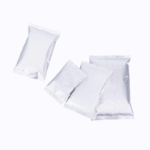
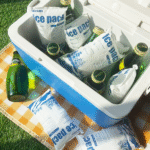
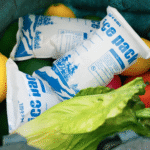
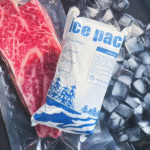
A gel pack is a sealed pack filled with a water-based gel. Listas temporárias bolsas de gelo em gel, hydrate packs and water-Pacotes de gelo de injeção among its gel ice packs and ice bricks product families. In practice a gel pack is a general cold reservoir: it is frozen or chilled, encenado, and placed around the payload to absorb heat over the shipment window.
Its strengths are simplicity and flexibility. It suits a wide range of remetentes isolados, it is easy to condition and handle, and it is widely used in food, kit refeição, seafood and general refrigerated lanes. Its limitation is precision: without an engineered phase-change point, a gel pack does not hold a fixed target band as steadily as a coolant designed to change phase there.
What a PCM pack actually is
A PCM pack is filled with a phase change material chosen so that it changes phase at a defined temperature. That phase-change point is the whole design idea: while the material is changing phase it releases or absorbs energy at a relatively stable temperature, which is what makes a PCM useful for holding a target band instead of simply being cold.
Because the phase-change point can be selected, PCM bricks can be matched to a temperature band rather than used generically. That is why the site pairs “gel packs, PCM bricks and separator layers” in its 2–8°C packout direction, and why the coolant and PCM reference is organised the way it is.
The phase-change point is the real difference
Tempk’s coolant and PCM reference tool compares coolants on six parameters: ponto de mudança de fase (°C), calor latente (kJ/kg reference range), calor específico, expansão de congelamento (%), necessidade de pré-condicionamento, and typical cold-chain use case. Read those parameters as the vocabulary of the choice:
- Ponto de mudança de fase is what you match to the lane — a coolant whose phase point sits outside your target band cannot hold that band as stably.
- Preconditioning need is the operational cost of the choice: a coolant that must be brought to a documented state and staged takes time and discipline in the warehouse.
- Freezing expansion is the planning factor for pack space and for how the coolant behaves as it freezes or thaws.
- Latent heat and specific heat are the reference properties behind how much coolant mass a lane needs.
The tool presents these as reference ranges and states plainly that the final packout still needs product testing, route conditions and supplier data. Use it to narrow candidates; do not read a table value as a guaranteed hold time.
Gel pack vs PCM pack: a practical comparison matrix
| Fator | Pacote de gel | Pacote pcm |
|---|---|---|
| Alvo de temperatura | General cold reservoir; no fixed phase point | Phase-change point selected for a target band |
| Condicionamento | Frozen or chilled, then staged before loading | Conditioned to its phase state; preconditioning need is a listed parameter |
| Risco de congelamento | Higher when used in direct contact with the payload | Lower when the phase point sits at or above the target band and separation is used |
| Sensibilidade da carga útil | Fine for payloads that tolerate a colder buffer | Better suited to freeze-sensitive medicines and biological samples |
| Duração da rota | Shorter lanes with adequate coolant mass | Longer lanes where a stable plateau is wanted |
| Validation need | Sample test per configuration | Sample test per configuration |
Notice the last row: it is identical on purpose. Neither option is self-validating, which is why the answer to “which is better” is a packout test rather than a product label.
How to choose by shipment profile
Work through the same six questions in both directions and let the shipment decide:
Ferramentas úteis de decisão
Verifique os detalhes antes de escolher a embalagem
Essas ferramentas rápidas podem ajudá-lo a comparar o risco da rota, necessidades de dimensionamento, escolhas de refrigerante, e detalhes da embalagem antes de solicitar um orçamento.
Calculadora de bolsa de gelo
Estime a quantidade de bolsas de gelo em gel para remessas refrigeradas e planejamento prático de rotas.
Estimar bolsas de geloGerador de lista de verificação de conformidade
Crie uma lista de verificação prática para revisão de embalagens, envio, e documentação.
Lista de verificação de construçãoResistência à queda de material de isolamento
Revise a resistência à queda e os fatores de manuseio antes de escolher materiais de isolamento.
Verifique a resistência- Alvo de temperatura. If the lane has a tight, product-defined band — 2–8°C refrigerated, for example — a coolant with a phase point in that band is the natural candidate. If the requirement is simply “keep it cold”, a gel pack may be sufficient.
- Conditioning capability. A PCM program depends on reliable conditioning and staging. If the warehouse cannot hold a documented conditioning step, a simpler gel pack process may be the realistic choice.
- Risco de congelamento. Where freezing injury is the main danger — refrigerated medicines and samples — separation layers and a phase point above freezing matter more than raw cold capacity.
- Sensibilidade da carga útil. Denso, thermally stable payloads tolerate a colder buffer; pequeno, freeze-sensitive payloads do not.
- Duração da rota. Longer lanes and warm seasons push toward more coolant mass, melhor isolamento, or a coolant that holds a plateau.
- Validation need. Every configuration, whichever coolant it uses, still needs its own sample test.
Where each option tends to fit
In practice the split usually follows the payload, not the coolant. Food and meal kit lanes — including the meal kit and food delivery packaging e frozen food and seafood shipping paths — often work well with gel packs and ice bricks, where the goal is to keep product cold without a tight band. Refrigerated pharmaceutical and clinical lanes often point toward PCM bricks with separator layers, which is how the pharmaceutical cold chain packaging page describes its 2–8°C direction.
That is a tendency, not a rule. Um breve, high-value pharmaceutical lane may still be best served by a simple gel pack configuration, and a long food lane may need a phase-change coolant.
What to confirm before you commit
Before either coolant goes into a specification, confirm the shipment profile, the shipper family, the coolant quantity and conditioning, the separation layout, the logger position and the route assumptions — then reproduce the configuration in a sample test. O validation and packout testing guide covers the testing side, o 2Guia de design de embalagem farmacêutica –8°C covers the design side, e o seletor de embalagens helps narrow the family before you request samples.
Gel pack vs PCM pack: perguntas frequentes
Is a PCM pack always better than a gel pack?
Não. A PCM is better when you need to hold a defined temperature band, especially for freeze-sensitive payloads. A gel pack is often better when you simply need a reliable, easy-to-condition cold reservoir for a shorter or less temperature-critical lane.
Can I replace gel packs with PCM bricks without re-testing?
Não. Changing the coolant type changes the thermal behaviour of the packout, so the configuration should be re-tested with the same payload, shipper and ambient profile before it is used in routine shipments.
Do PCM packs remove the need for separator layers?
Não. Separation between coolant and payload still matters. A PCM reduces freeze risk when its phase point is appropriate, but the payload chamber and separation layers remain part of the design.
Which coolant should I use for 2–8°C pharmaceutical shipments?
Use the coolant whose phase-change point matches the 2–8°C band, condition it to a documented state, separate it from the payload, and confirm the arrangement with sample testing. The pharmaceutical pages describe the general packout direction rather than a single mandatory coolant.
Where can I compare coolants objectively?
Use o coolant and PCM reference to compare phase-change point, calor latente, calor específico, expansão de congelamento, preconditioning need and typical use case, then confirm the final configuration with supplier data and a packout test.