


Bifes
Escolha um pacote de gel resfriado ou uma lógica de gelo seco congelado com base no fato de o bife deve chegar fresco, profundamente gelado, ou sólido congelado.
Os embarques de carne e aves não são um problema de embalagem. Bifes premium podem ser resfriados ou congelados, frango cru precisa de contenção de vazamento mais forte, e frios precisam de uma apresentação de varejo limpa. A embalagem deve corresponder à forma do produto, temperatura alvo, comportamento do refrigerante, duração da rota, e recebendo verificações de qualidade.
A temperatura é importante, mas os programas de carne também falham devido ao vazamento de purga, bandejas esmagadas, etiquetas molhadas, contato de refrigerante, e intenção de rota refrigerada versus congelada pouco clara.
Escolha um pacote de gel resfriado ou uma lógica de gelo seco congelado com base no fato de o bife deve chegar fresco, profundamente gelado, ou sólido congelado.
Controle o vazamento de aves cruas, capacidade absorvente, integridade do revestimento, e risco de contato cruzado enquanto detém um 0-4 Rota refrigerada C.
Proteger 0-4 Temperatura C, legibilidade do rótulo, aparência do pacote de varejo, condensação, e separação de odores sem congelar a superfície do produto.
Use esses intervalos de planejamento para escolher o primeiro pacote Tempk para teste. A massa final do refrigerante deve ser validada com a carga útil exata, tamanho do isolamento, rota, e estação.
| Rota do produto | Alvo comum | Estrutura da embalagem | Ponto de partida do refrigerante | Assista primeiro |
|---|---|---|---|---|
| Bifes refrigerados premium, 8-36 h | 0-2 C para apresentação refrigerada de alta qualidade, ou 0-4 C onde o programa de segurança alimentar permite. | Embalagem a vácuo ou bandeja, camada absorvente, forro de vazamento, EPP ou caixa isolada, pacotes de gel separados ou 0 PCM. | Sobre 0.8-2.8 kg de pacotes de gel ou PCM para 1-4 kg de carga útil. | Marcas de congelamento, purga, amassados na bandeja, mudança de cor. |
| Peito de frango cru, 8-36 h | 0-4 Rota refrigerada C com controle rigoroso de vazamentos. | Pacote primário selado, forro secundário, base absorvente, refrigerante separado das embalagens de aves. | Sobre 0.8-2.6 kg de pacotes de gel condicionado ou PCM para 1-4 kg de carga útil. | Vazamentos, molhamento da caixa, risco de contato cruzado, camada superior quente. |
| Salsichas e frios, 8-36 h | 0-4 Rota refrigerada C para embalagens processadas ou prontas para consumo. | Bolsa ou bandeja de varejo, barreira de condensação, proteção de rótulo, refrigerante lateral e superior com divisor. | Sobre 0.6-2.2 kg de pacotes de gel ou PCM para 1-4 kg de carga útil. | Condensação, dano na etiqueta, transferência de odor, congelamento de superfície. |
| Remessas de carne congelada | -18 C ou inferior quando a rota é especificada como congelada. | Remetente Congelado, plano de gelo seco ou refrigerante congelado, lacuna de vapor, verificações de etiqueta e transportadora. | Use o planejamento de gelo seco por tamanho de caixa, peso da carne, tempo de rota, e limite da operadora. | Sublimação com gelo seco, descongelar na última milha, marcação regulamentar. |
Para paletes congelados ou programas a granel, ver Paletes de Carne Congelada. Para programas de assinatura, ver Caixas de carne DTC.
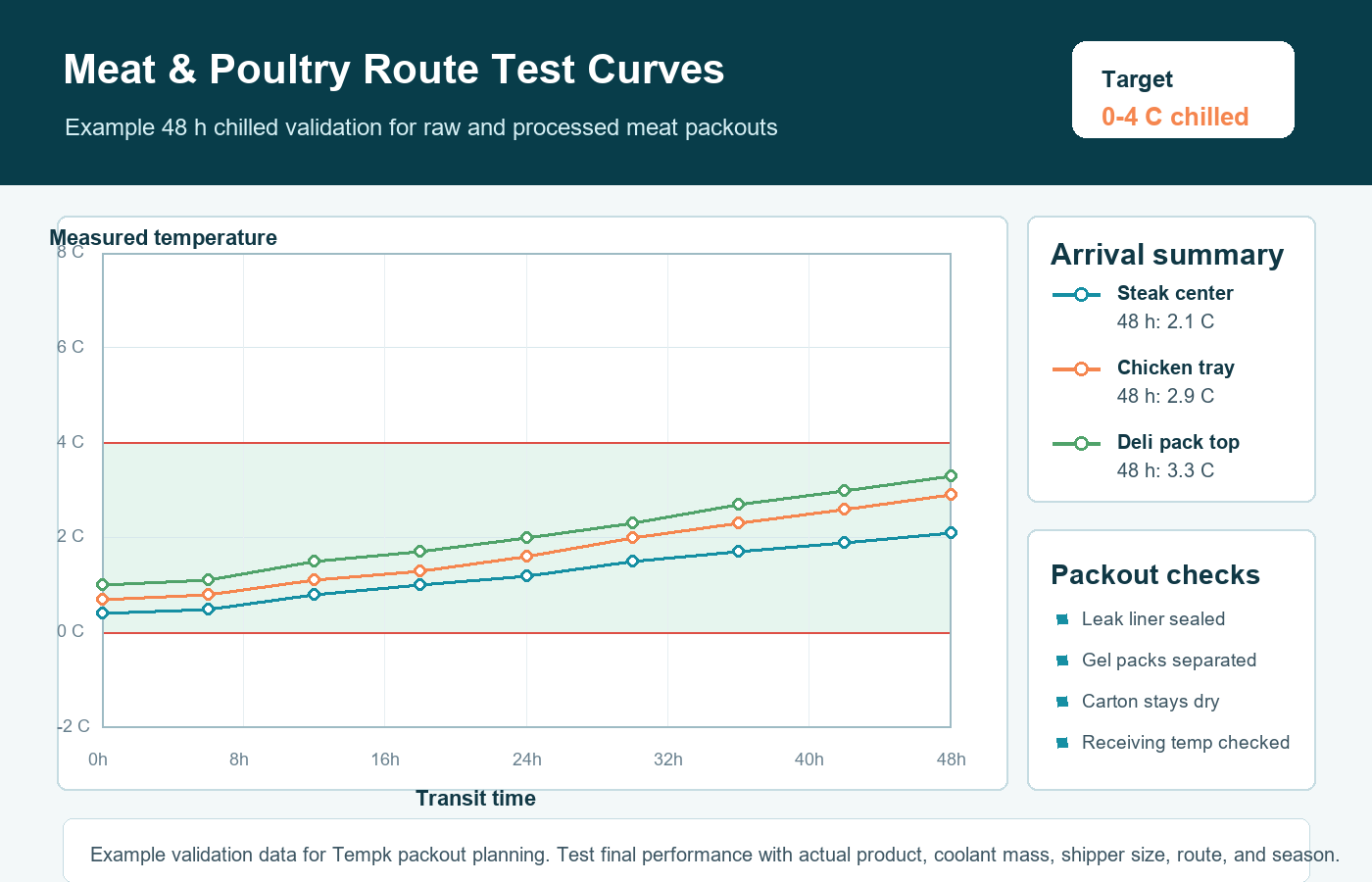
As curvas de temperatura só são úteis quando combinadas com o recebimento de cheques: purga, vazamento, condição do rótulo, secura da caixa, posição do refrigerante, e qualidade da superfície do produto.
Esses guias de produtos oferecem suporte à página de categoria sem forçar cada produto em uma página de solução separada.
Use este guia quando o produto não estiver em uma das três páginas prioritárias, mas ainda precisar de uma decisão de embalagem de carne específica para o produto.
Use este guia quando o produto não estiver em uma das três páginas prioritárias, mas ainda precisar de uma decisão de embalagem de carne específica para o produto.
Use este guia quando o produto não estiver em uma das três páginas prioritárias, mas ainda precisar de uma decisão de embalagem de carne específica para o produto.
Use este guia quando o produto não estiver em uma das três páginas prioritárias, mas ainda precisar de uma decisão de embalagem de carne específica para o produto.
Use as ferramentas para dimensionar o primeiro teste, em seguida, valide com a carga útil de carne real e receba cheques.
Compartilhe o formulário do produto, alvo resfriado ou congelado, peso da carga útil, Tamanho da caixa, duração da rota, temporada, e recebimento de cheques. Tempk pode ajudar a escolher o isolamento, massa de refrigerante, estrutura do forro, e etapas de validação.
Carne & Os embarques de aves não devem usar uma receita de caixa fixa para cada produto. Comece com 0-4 C controle resfriado para cortes frescos ou -18 C para programas de carne congelada, em seguida, separe os produtos por carga de calor, força da embalagem, e como eles são recebidos. Para programas mistos, Tempk geralmente compara uma rota local curta, uma rota noturna de encomendas, e a estação mais quente esperada antes de confirmar o remetente.
Use suporte para embalagem a vácuo, almofadas absorventes, forro de vazamento, caixa isolada, e proteção de canto. O plano de refrigeração deve começar com pacotes de gel para pacotes resfriados e gelo seco ou PCM congelado para pistas congeladas que exigem tempo de espera prolongado. Quando a carga contém caixas de varejo delicadas, textura macia, material ao vivo, ou documentação médica, proteja a carga útil primeiro e depois adicione capacidade de resfriamento. Se a remessa atrasar na embalagem, não interferir, alfândega, ou transferência de doca, o perfil da rota deve ser verificado novamente em vez de apenas aumentar o peso do líquido refrigerante.
A validação deve incluir controle de purga de verificação, temperatura da superfície, compressão de caixa, e tempo de descarga no destino. Um teste útil registra o ponto de carga útil mais quente, o ponto mais frio perto do refrigerante, e a condição de recebimento após o manuseio. Isso dá à equipe de operações uma instrução prática de embalagem, não apenas um gráfico de temperatura.
Suporte a pacotes personalizados
Para tamanhos de caixa fixos, limites de carga útil, requisitos de marca, pistas sazonais, ou alvos de validação, A Tempk pode adaptar esta solução em um pacote personalizado de cadeia de frio.