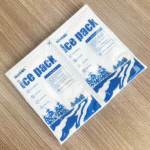
Dairy pallets need a different Kühlkette plan from parcel dairy shipments. A single case of milk or yogurt can be protected with an Isolierter Versender, but a pallet depends on Kühlspeicher Disziplin, trailer airflow, Palettengeometrie, wrap pattern, Dock-Exposition, und Loggerplatzierung. The main failure is often not the pallet core. It is the top edge, the corner facing the door, the bottom layer exposed to a warm dock, or a mixed-load position beside products with stronger odor or different temperature requirements.
Dairy pallet cold storage planning data
| Typischer Zielbereich | 0-4 C for chilled dairy pallet distribution; apply the dairy producer's specification when it is stricter. |
|---|---|
| Feuchtigkeitskontrolle | Protect cartons, corrugated trays, Etiketten, and outer cases from condensation during dock transfer and trailer unloading. |
| Vorkühlung | Produkt vorkühlen, Palettenbasis, and staging area before wrapping. A warm pallet core is difficult to pull down after loading. |
| Verpackungsdruck | Use column stacking, Eckbretter, and case strength checks so lower layers do not crush under stretch wrap and pallet height. |
| Coolant or thermal protection | Use refrigerated transport first. Thermopalettenabdeckungen, trockene Liner, or gel assist can support short dock dwell, not replace a cold trailer. |
| Transportdauer | Best managed with validated cold storage, dock-to-trailer transfer control, and continuous trailer temperature monitoring for each lane. |
| Häufige Verluste | Warm pallet edges, wet cases, collapsed lower tiers, Flecken auf dem Etikett, off-odor, and mixed-load contamination from adjacent seafood or meat. |
| Tempk-Verpackung passt | Thermo-Palettenabdeckung, pallet liner, Eckenschutz, insulated divider, product-zone logger, and a route validation report. |
Why dairy pallets need their own validation
Dairy pallets are dense, feuchtigkeitsempfindlich, and often shipped in retail cartons or corrugated trays. If the product leaves cold storage too warm, the pallet core may remain above target after loading. If the pallet is overwrapped too tightly, trailer airflow can bypass the product zone and leave the center slow to recover. If the stretch wrap traps condensation, paperboard can soften and labels can stain before receiving.
The pallet should be built from cold product in a cold staging area. Cases should be aligned in stable columns, with corner boards or edge support when the load is tall. Stretch wrap should stabilize the pallet without blocking every airflow path. For mixed dairy pallets, keep leak-prone liquids away from dry cartons and separate strong-smelling foods. When dock transfer is unavoidable, use a planned dwell limit and treat Thermopalettenabdeckungen as a short-exposure aid, not a replacement for refrigerated handling.
Hilfreiche Entscheidungshilfen
Überprüfen Sie die Details, bevor Sie sich für die Verpackung entscheiden
Mit diesen schnellen Tools können Sie das Routenrisiko vergleichen, Größenanforderungen, Kühlmittelauswahl, und Verpackungsdetails, bevor Sie ein Angebot anfordern.
Eisbeutel-Rechner
Schätzen Sie die Menge an Gel-Eisbeuteln für gekühlte Sendungen und nutzen Sie die praktische Routenplanung.
Schätzen Sie EisbeutelReferenz zu Isoliermaterialien
Vergleichen Sie die Auswahl an Isoliermaterialien für unterschiedliche Kühlkettenverpackungsanforderungen.
Vergleichen Sie MaterialienKühlmittel & PCM-Referenz
Vergleichen Sie Kühlmittel- und PCM-Optionen, wenn eine Route zusätzliche Temperaturunterstützung benötigt.
Vergleichen Sie OptionenEmpfohlener Tempk-Ansatz
Tempk would normally define logger positions before the test: pallet core, top edge, lower edge, and the side facing the trailer door. The validation should record product starting temperature, cold room staging time, Dock wohnen, trailer set point, trailer return-air trend, und Ankunftszustand. Receiving checks should include internal product temperature, case dryness, pallet lean, wrap integrity, Kondensation, Geruch, Leckage, and signs of case compression.
FoodSafety.gov listet die Lagerung von Kühlschränken unter auf 40 F (4 C) or below and freezer storage at 0 F (-18 C) oder unten. FDA Food Code guidance is also used as a retail food protection model for time and temperature control. For commercial dairy pallet logistics, Diese Referenzen sind Ausgangspunkte. Final release should follow the product owner’s specification, örtlichen Vorschriften, and the actual lane validation data.