VIP-Kühlkettenbehälter für den Versand von Blutplasma: Approve the Shipment System, Not Just the Insulation
A VIP cold chain container for blood plasma shipping must be approved around the exact plasma product, its required state and the complete dispatch-to-receipt process. Confirm the applicable temperature conditions, protect the actual bag geometry, test a representative loaded configuration and preserve usable evidence through handover. Kühlmittelaufbereitung, carrier acceptance and receiving authority are as important as insulation. Reuse or connected monitoring should be added only within a controlled operating model. The purchasing decision should establish a traceable shipment system, not a generic medical-box claim or an unsupported assumption that all plasma can travel under one temperature program.
Resolve product identity before selecting a thermal program
The requirement begins with the full product designation. Fresh Frozen Plasma, Liquid Plasma, Source Plasma and thawed products are not interchangeable labels. Obtain the approved handling conditions from the responsible establishment and product information before asking a packaging supplier to select materials or refrigerant.
US regulations illustrate the importance of naming the activity as well as the product. In 21 CFR 600.15, Fresh Frozen Plasma is listed for shipment at minus 18°C or colder and Liquid Plasma at 1°C to 10°C. The separate Liquid Plasma storage provision in 21 CFR 640.34 uses 1°C to 6°C. These distinctions should remain visible rather than being simplified into one generic cold-chain range.
The regulatory entry is not the entire operating specification. Confirm the approved product labeling, establishment procedures, relevant destination conditions and any additional limits. A permitted shipping boundary does not automatically become the design setpoint, storage setting or acceptance rule for another plasma category.
Assign authority at the outset. Logistics and packaging teams need to know who can approve the configuration and who assesses individual shipment deviations. A supplier can contribute technical information without becoming the authority for plasma use. Keeping these roles explicit prevents urgency or commercial wording from filling an unresolved responsibility gap.
| Genehmigungsfrage | Beweise oder Entscheidung erforderlich | Reason to stop and resolve the issue |
|---|---|---|
| What plasma product is moving? | Exact designation and approved handling conditions | The request says only blood plasma or frozen product |
| Does the complete load fit? | Tasche, Hafen, containment and support arrangement | Units require compression or unapproved fillers |
| Is thermal protection demonstrated? | Configuration-specific evidence and acceptance basis | Only an empty-box duration or material value is supplied |
| Can dispatch reproduce the start state? | Available preparation process and controlled assembly | Coolant readiness is based on appearance or guesswork |
| Can the route and receiver handle it? | Transport acceptance and authorized receiving plan | The proposed delivery has no agreed handover |
| How are exceptions decided? | Defined review and disposition authority | Staff are expected to improvise product acceptance |
Use these questions as gates in the project, not as a new substitute for the establishment's procedures. A strong answer in one row does not eliminate a critical gap elsewhere. The package should enter routine use only when the relevant decisions have been made by the appropriate functions.
Engineer the load and refrigerant as a protected arrangement
Specify payload capacity using the actual primary containers and all required protective materials. Bag dimensions alone may omit ports, overwraps, sekundäre Eindämmung, supports and monitoring components. A useful loaded drawing shows these items together with the thermal components and the closure.
Consult the relevant primary-container handling information for the intended product state. The outer design should prevent uncontrolled movement and inappropriate loading on vulnerable features. Do not assume a chamber developed around rigid pharmaceutical cartons provides suitable restraint for plasma units. The supports must be evaluated for this load.
Minimum and maximum shipments need defined arrangements. A smaller load can change thermal response and mechanical restraint; a larger one can reduce clearance or interfere with closure. Establish permitted placement and any approved filler or support rather than leaving the operator to create a new configuration for each order.
Select the thermal storage method from the confirmed product requirement. VIP panels reduce heat transfer, while a PCM or other approved refrigerant manages thermal energy. The phase point or apparent coldness of a component does not demonstrate the temperature of the plasma load. Seine Formulierung, Menge, placement and preparation belong to the assessed system.
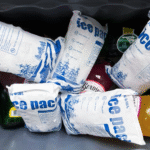
Distinguish actual Trockeneis from products marketed with similar names. Solid carbon dioxide has specific handling and transport considerations and must be able to vent. A water-based hydrated Kühlakku is not automatically the same substance or a substitute. Confirm refrigerant identity, compatibility and applicable carrier requirements before adopting the proposed arrangement.
Protect the insulating assembly during integration. Never cut or puncture a sealed VIP to fit a bag port or monitor cable. Resolve required geometry and access through the design. A forced lid, displaced panel or improvised opening can create a package different from the one described by the supplier's evidence.
A hypothetical change from a full replenishment load to a small urgent shipment illustrates the combined risk. Removing units may leave space for movement and alter the relationship between the remaining units, coolant and sensor. The smaller shipment should use an arrangement covered by the approved system, not merely the same box with fewer bags inside.
Demand evidence for the product-related temperature history
Qualification should connect the exact packout to the permitted product conditions. Request the component baseline, load or justified surrogate, Ausgangszustand, preparation records, Montagereihenfolge, sensor arrangement, external challenge and acceptance criteria. A report that omits these details may be difficult to apply to the shipment you intend to operate.
A surrogate must be appropriate to the conclusion being drawn. A convenient water load may help early design work, but it should not be assumed equivalent to the final plasma configuration without a rationale. Relevant representation can include geometry, packaging and thermal behavior as well as total mass. Let the responsible technical and quality functions approve that rationale.
Include the real exposure interval. Product removal from storage, Montage, waiting before collection and the receiving sequence can all affect the thermal history. The test boundary should not omit an important routine stage simply because it occurs outside the carrier's nominal transit. Make the evaluated start and end points explicit.
Review local behavior and load variation. A sensor beside refrigerant is not automatically representative of the most exposed unit, and an average trace can conceal a relevant event. Establish the measurement objective and locations through the qualification design. Routine monitoring should then reproduce the approved arrangement without compromising primary containment.
Use test frameworks for their intended purpose. Standardized thermal profiles can support a structured challenge, while route studies and relevant mechanical assessments address other parts of the operating risk. A recognized test name does not itself establish plasma-specific approval. Review what was performed and how it supports the proposed application.
Inspect the complete record, including the beginning of the exposure and any transitions. Do not infer acceptability solely from remaining refrigerant, a frozen appearance or an on-time delivery. Those observations can contribute information, but the required product-related evidence and inspection process govern the decision.
Keep qualification and individual product disposition separate. A well-supported package can still experience an unexpected deviation. The authorized establishment must assess that event under its procedure. Re-cooling does not reconstruct missing history, and a packaging supplier's general reassurance cannot replace the appropriate product decision.
Hilfreiche Entscheidungshilfen
Überprüfen Sie die Details, bevor Sie sich für die Verpackung entscheiden
Mit diesen schnellen Tools können Sie das Routenrisiko vergleichen, Größenanforderungen, Kühlmittelauswahl, und Verpackungsdetails, bevor Sie ein Angebot anfordern.
Referenz zu Isoliermaterialien
Vergleichen Sie die Auswahl an Isoliermaterialien für unterschiedliche Kühlkettenverpackungsanforderungen.
Vergleichen Sie MaterialienCompliance-Checklisten-Generator
Erstellen Sie eine praktische Checkliste für die Verpackungsüberprüfung, Versand, und Dokumentation.
Checkliste erstellenKühlmittel & PCM-Referenz
Vergleichen Sie Kühlmittel- und PCM-Optionen, wenn eine Route zusätzliche Temperaturunterstützung benötigt.
Vergleichen Sie OptionenMake dispatch and receipt one accountable process
Confirm a suitable receiving arrangement before assembling the shipment. Identify who will accept custody, inspect the relevant condition, retrieve records and transfer units into the prescribed environment. An ordinary delivery address is not enough when the product requires an authorized receiving process.
Beim Versand, readiness includes more than availability of an empty container. The correct thermal components must be prepared, the product must be in its approved state and the required protective materials must be available. Maintain clear status distinctions so returned, unprepared or rejected components cannot be selected accidentally.
The assembly instruction should be usable by the actual operating team. It needs clear part identity, permitted load arrangements, monitor position and closure checks. A rehearsal can expose where staff guess or need verbal coaching. Resolve these ambiguities before routine use, while recognizing that usability testing does not replace thermal qualification.
Agree the evidence required at the transition from development to routine purchasing. A prototype photograph, a sample component list and a preliminary test observation may help the project, but the production order needs an identifiable accepted configuration. Ask the supplier to confirm which components and instructions will accompany routine supply and which items remain proposals. Have the responsible establishment review that baseline before treating a successful pilot as permission for unrestricted ordering.
Where several plasma programs share an outer enclosure, make their configuration identities distinguishable at the point of use. The same external appearance should not require an operator to remember different coolant or loading rules from experience alone. Use the approved identification method and keep the selection decision connected to the exact product requirement.
Link the shipment record to the physical configuration. The information required by the establishment may include product identity, Packout-Version, component readiness, relevant times and monitor association. The purpose is to preserve a reviewable chain from the accepted design to the parcel that leaves, not to create a parallel paperwork exercise.
Transport acceptance remains separate from thermal capability. The consignor must resolve the applicable classification, Verpackung, refrigerant and documentation requirements for the actual contents and route. A medical-looking enclosure or an accepted monitoring device does not automatically resolve those obligations.
Bei Erhalt, distinguish transport status from product acceptance. A carrier scan does not prove that the authorized team completed inspection and storage transfer. The receiving procedure should define the event that closes the operational handover and the information sent back to the sender when an exception remains open.
Plan for delays and unavailable recipients. Name the escalation owner and permitted alternatives. Staff should not improvise by opening the package, replacing refrigerant or deciding that units are usable because they still feel cold. An urgent request increases the value of an established contingency process; it does not reduce the need for one.
Preserve the system when devices, components or routes change
A monitoring device can support the program when its measurement and record use are defined. Verify sensor placement, environmental suitability, configuration and shipment association. For connected devices, distinguish missing transmission from missing acquisition and confirm how original measurements are recovered. A communication status alone is not a conclusion about plasma temperature.
Where air transport is involved, check the exact device against the relevant carrier process. IATA's device assessment does not replace airline approval for on-board use. The contents and refrigerant require their own acceptance review. Maintain those distinctions when a forwarder proposes an alternate routing during a disruption.
Reuse should be evaluated by component and process. The outer case, VIP-Versammlung, PCM -Packungen, supports and electronic device can have different inspection and replacement needs. Define what recipients retain, how empties return and where acceptance checks occur. Returned hardware is not automatically ready for another plasma shipment.
Cleaning must suit the actual construction and product program. Do not apply one method indiscriminately to corrugated parts, protected panels and coolant containers. Keep uncertain components outside accepted stock until their status is resolved. A theoretical reuse count cannot replace condition assessment or the approved maintenance process.
Supplier changes need timely notification. A new panel source, Kühlmittelformulierung, support geometry or primary-container format can affect different portions of the evidence. Use the configuration baseline to assess the effect and decide what additional information or testing is necessary. Physical similarity alone does not demonstrate equivalence.
Expansion to a new site or route also warrants review. Preparation equipment, Personalbesetzung, receiving availability and carrier options can differ even when the product and outer box remain the same. Scale the operating model only where its assumptions remain valid or where the required additional work has been completed.
The strongest purchasing outcome is a defined program with transparent limits: this product, this load arrangement, this preparation process, these routes and this receiving authority. VIP insulation can be a valuable part of that program. Its value comes from controlled integration, not from being called a universal plasma container.
Questions for the final approval meeting
What must be clarified when the request only says frozen plasma?
Obtain the exact product designation, approved state and handling conditions from the responsible establishment. Similar names can have different regulatory and operational contexts. Confirm the relevant labeling, route and acceptance procedure before choosing a thermal program. A supplier should not resolve an ambiguous product identity by selecting whichever frozen-shipping configuration is already available.
Can remaining refrigerant replace a temperature record?
Nicht automatisch. Its presence is an observation about the packout, not a complete account of the product-related temperature history. Follow the program's defined evidence and inspection requirements. Where a record is missing or another exception is present, refer the shipment to authorized review rather than treating cold material inside the box as universal proof of acceptability.
What makes a supplier proposal ready for a plasma pilot?
The proposal should identify the complete construction, load arrangement, preparation procedure, monitoring position and available evidence, while stating what development remains. The responsible establishment should agree the pilot's purpose and product controls. A generic medical shipper specification can be a starting point, but it should not be presented as completed plasma-specific qualification.
Über Tempk
Und Tempk, protected VIP structures and configurable PCM packouts provide a starting point for evaluating thermal protection and payload fit together. We can supply specifications, samples and assembly information to support the buyer's technical review. Für Plasma, those inputs must be developed into product-specific evidence under the responsible establishment's process; no universal suitability is implied. Share your exact product designation, bag arrangement and route with Tempk when assessing a VIP cold chain container for blood plasma shipping within a controlled qualification program.