


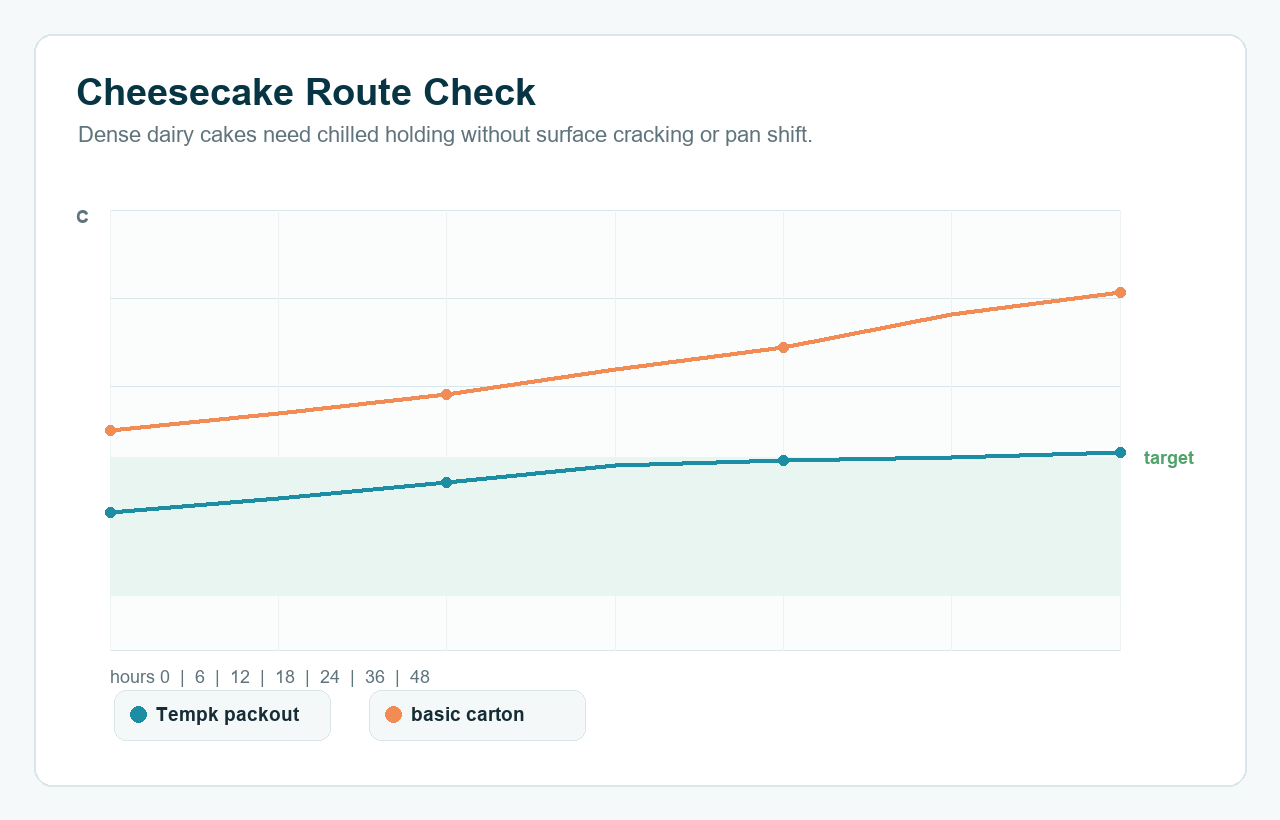
Die Mitte verändert sich langsam
Eine kalte Oberfläche garantiert nicht, dass der Käsekuchenkern innerhalb des vereinbarten Kühlbereichs bleibt.
Kühlkette für Käsekuchen
Käsekuchen haben mehr Masse als viele Backdesserts. Die Verpackung sollte eine stabile Kühlstrecke ermöglichen, Unterstützen Sie die Pfanne oder das Brett, die Kruste schützen, und verhindern Kondensation oder gefrorene Kanten.
Produktrisiko
Die richtige Verpackung muss die Empfangsqualität schützen, Halten Sie einen Temperaturlogger nicht nur kalt. Die folgenden Risikopunkte bestimmen die Wahl der Isolierung, Kühlmittelposition, Produktunterstützung, und Validierungsprüfungen.
Eine kalte Oberfläche garantiert nicht, dass der Käsekuchenkern innerhalb des vereinbarten Kühlbereichs bleibt.
Schnelle Erkältungskrankheiten, Vibration, oder lose Pfannenauflagen können zu Rissen oder Kantenfehlern führen.
Kondenswasser und aufgetautes Kühlwasser können die Krustenstruktur und die Präsentation des Gebäcks beeinträchtigen.
Eine schwache Basis ermöglicht das Biegen, Eckdruck, oder Seitenwandreiben während der Handhabung.
Routenbasierte Empfehlung
Dies sind praktische Ansatzpunkte für die Probenplanung. Das endgültige Kühlmittelgewicht und die Isolationsdicke sollten anhand des tatsächlichen Desserts überprüft werden, Karton, Route, und Empfangsstandard.
| Versandzustand | Empfohlenes Tempk-Paket | Startrichtung des Kühlmittels | Kühlmittelposition | Was zu validieren ist |
|---|---|---|---|---|
| Gekühlte Lieferung noch am selben Tag 8-18h-Route, Umgebungstemperatur unten 22 C, vorgekühlter Kuchen | Isolierte Kartoneinlage oder kompakte EPS-Versandhülle, starre Basis, Pfannen- oder Brettträger, Liner-Tasche, und saugfähiges Blatt | Um 0.4-0.9 kg insgesamt konditionierte Gelpackungen für a 1-3 kg Nutzlast für gekühlte Desserts. Bei dichten Kuchen ist möglicherweise eine weniger herunterziehbare, dafür aber stabilere Isolierung erforderlich. | Seitenwandplatzierung mit Trennwand; Vermeiden Sie direkten Kältekontakt an den Pfannenrändern oder der Krustenseite. | Kern- und Kantentemperatur, Krustentrockenheit, Oberflächenrisse, Grundstabilität, und verbleibender Kühlmittelzustand |
| Paketroute über Nacht 18-36h-Route, Depot- und Van-Belichtung, Ambient 22-30 C | Isolierbox aus EPP oder EPS, starre Basiseinlage, Feuchtigkeitsbarriere, Feste Pfannenpassung, und stärkerer Umkarton | Um 0.9-1.6 kg Gelpackungen insgesamt oder gekühltes PCM für ein kleines Paket. Kerntemperatur validieren, nicht nur die Oberflächentemperatur. | Zwei seitliche Positionen oder seitlich-plus-oben mit dicken Pufferschichten und ohne Oberlastdruck. | Core-Logger-Trace, Gefahr einer kalten Kante, Krustenweichheit, Schwenkbewegung, und Kartonkomprimierung |
| Heißes Wetter oder verzögerungsanfällige Route 30-35 C Umgebungstemperatur, 36-48h Risiko, längere Depothaltezeit | Dickeres EPP/EPS-Versandpapier, höherer Isolationsspielraum, verstärkte Basis, Feuchtigkeitsbarriere, und Routenlogger | Um 1.6-2.8 kg Gesamtkühlmittel oder ein PCM-System für ein kleines Paket. Verwenden Sie Pufferschichten, um eingefrorene Kanten zu verhindern. | Umlaufende Kühlmittelanordnung mit Trennwänden auf allen dem Produkt zugewandten Seiten; Halten Sie das Kühlmittel von Krustenkontaktstellen fern. | Maximale Kerntemperatur, niedrigste Kantentemperatur, Schwitzen, knacken, Krustenzustand, und das Erscheinen empfangen |
Die Kühlmittelmasse ist ein Ausgangspunkt, keine Garantie. Passen Sie die Produkttemperatur beim Verpacken an, Kuchen- oder Kartongewicht, Kastengröße, Isolationsmaterial, Kühlmittelaufbereitung, Streckendauer, Umgebungsprofil, und Erhalt von Schecks. Mehr Eis kann zu nassen Kartons führen, gefrorene Kanten, oder Oberflächenschäden bei falscher Abstützung und Pufferung.
Packout-Struktur
Desserts benötigen Produktunterstützung, bevor Kühlmittel hinzugefügt wird. Beginnen Sie mit der Tafel, Pfanne, Karton, und Oberflächenfreiheit, Anschließend Kühlmittel um das geschützte Produkt verteilen.
Verpackungsprozess
Eine kältere Box kann ein Dessert, das warm anfängt, nicht reparieren, lose, gekippt, oder gegen den Deckel gedrückt werden. Der Verpackungsprozess sollte diese Risiken vor dem Versiegeln beseitigen.
Dichte Käsekuchen benötigen vor dem Verpacken ausreichend Zeit zum Abkühlen; Allein die Oberflächentemperatur kann irreführend sein.
Verwenden Sie eine starre Basis und begrenzen Sie den Hohlraum, damit schwere Desserts beim Pakethandling nicht verrutschen.
Wählen Sie konditionierte Gelpackungen oder PCM und trennen Sie diese mit Trennwänden vom Produkt.
Überprüfen Sie Oberflächenrisse, Krustenweichheit, Feuchtigkeit, Schwenkbewegung, und Loggerdaten nach dem Empfang.
Wann sollte das Design geändert werden?
Vorkühlung verbessern, Erhöhen Sie den Isolationsspielraum, Kühlmittelmasse anpassen, und mit einem kernseitigen Logger validieren.
Reduzieren Sie die direkte Einwirkung des Kühlmittels, Kühlmittelaufbereitung wechseln, oder dickere Trennwände hinzufügen.
Verbessern Sie die Feuchtigkeitsbarriere, absorbierende Schicht, und Kühlmitteltrennung, anstatt nur die Temperatur zu ändern.
Verwandte Ressourcen
Teilen Sie das Gewicht des Käsekuchens, Pfannen- oder Brettformat, Kartongröße, Produkttemperatur, Streckendauer, Umgebungsbereich, und Erhalt von Schecks. Tempk kann bei der Auswahl der Isolierung helfen, Kühlmittelanordnung, Basisunterstützung, und Validierungsschritte.
Fordern Sie eine Packout-Bewertung anUnterstützung für benutzerdefinierte Pakete
Für feste Kartongrößen, Nutzlastgrenzen, Branding-Anforderungen, Saisonspuren, oder Validierungsziele, Tempk kann diese Lösung in eine individuelle Kühlkettenverpackung umwandeln.