


El calor puede colapsar la textura.
Las capas de mousse se ablandan más rápido que los pasteles densos y pueden perder los bordes limpios durante los retrasos..
Tortas Mousse Cadena de Frío
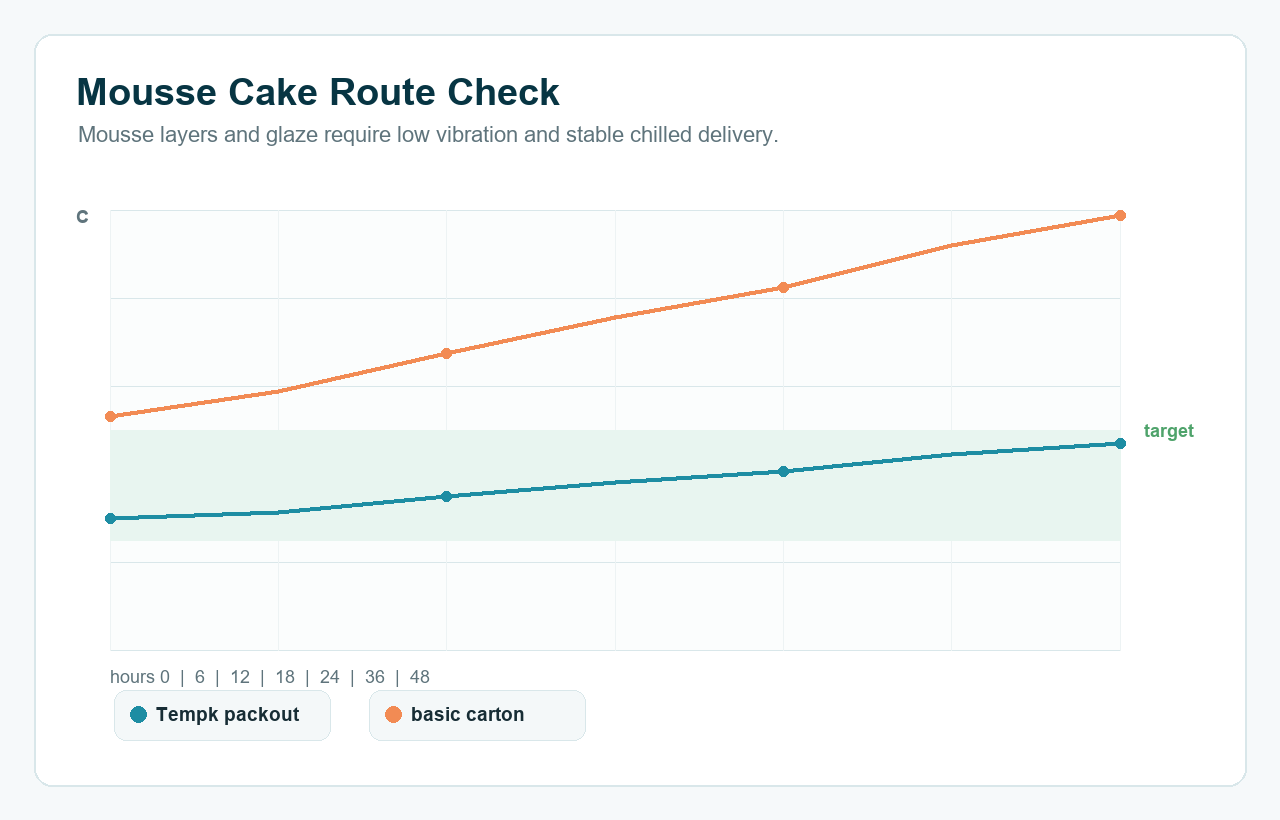
Los pasteles de mousse son muy sensibles al calor., vibración, inclinación, y humedad superficial. El paquete debe mantener una ruta fría mientras protege las capas delicadas., esmalte de espejo, decoraciones, y liquidación de cajas.
Riesgo del producto
El paquete correcto debe proteger la calidad de recepción, no sólo mantiene frío un registrador de temperatura. Los puntos de riesgo siguientes determinan la elección del aislamiento., posición del refrigerante, soporte de producto, y controles de validación.
Las capas de mousse se ablandan más rápido que los pasteles densos y pueden perder los bordes limpios durante los retrasos..
La condensación puede opacar el esmalte del espejo., decoraciones puntuales, o hacer que la superficie parezca mal manejada.
Los envases sueltos pueden cambiar de capa, untar los lados, o dañar las decoraciones.
El refrigerante duro colocado demasiado cerca puede crear puntos congelados y grietas en la superficie..
Recomendación basada en ruta
Estos son puntos de partida prácticos para la planificación de muestras.. El peso final del refrigerante y el espesor del aislamiento deben verificarse con el postre real., caja de cartón, ruta, y recibir estándar.
| Condición de envío | Paquete Tempk recomendado | Dirección inicial del refrigerante | Posición del refrigerante | Que validar |
|---|---|---|---|---|
| Entrega refrigerada el mismo día 8-18h ruta, ambiente debajo 22 do, traspaso controlado | Revestimiento de cartón aislado o cargador compacto de EPS, base rígida para pastel, espaciador de altura, revestimiento seco, y sábana absorbente | Acerca de 0.5-1.0 kg total de paquetes de gel acondicionado para un 1-3 kg de carga útil de postre refrigerado. Utilice más pequeños, paquetes bien amortiguados en lugar de hielo pesado de carga superior. | Colocación en pared lateral o esquina con divisor; Mantenga el refrigerante alejado del glaseado y de los lados del pastel.. | Temperatura del pastel, acabado de esmalte, mancha de pared lateral, sequedad de la caja, y estado restante del refrigerante |
| Ruta de paquetería nocturna 18-36h ruta, ambiente 22-30 do, Manejo de depósitos y furgonetas. | Caja aislada de EPP o EPS, inserto de base rígida, soporte antivuelco, bolsa de revestimiento, y cartón exterior más fuerte | Acerca de 1.0-1.8 kg total de paquetes de gel o PCM refrigerado para un paquete pequeño. Combine una masa más alta con una separación fuerte para evitar bordes congelados. | Dos bolsillos laterales o disposición perimetral con espuma o amortiguador corrugado; sin refrigerante en la tapa del pastel. | Punto de producto más cálido, bordes fríos, condensación de esmalte, evidencia de inclinación, y compresión de cartón |
| Ruta con clima cálido o propensa a retrasos 30-35 ambiente C, 36-48h riesgo, exposición más prolongada en la última milla | Transportador de EPP/EPS más grueso, mayor margen de aislamiento, soporte rígido para pastel, barrera contra la humedad, y registrador de rutas | Acerca de 1.8-3.0 kg de refrigerante total o un sistema PCM para un paquete pequeño. Validar tanto la temperatura como la presentación antes de escalar.. | Disposición perimetral del refrigerante con divisores y base de producto fija.; mantener el nivel del paquete durante la calificación. | Temperatura máxima, temperatura de borde más baja, marcas de esmalte, movimiento de capas, y recibiendo apariencia |
La masa refrigerante es un punto de partida., no es una garantía. Ajustar por temperatura del producto en el embalaje., peso de la torta o del cartón, tamaño de la caja, material aislante, acondicionamiento del refrigerante, duración de la ruta, perfil ambiental, y recibir cheques. Más hielo puede crear cajas mojadas, bordes congelados, o daños en la superficie cuando el soporte y la amortiguación son incorrectos.
Estructura de embalaje
Los postres necesitan soporte del producto antes de agregar refrigerante. empezar con el tablero, cacerola, caja de cartón, y limpieza de la superficie, luego coloque refrigerante alrededor del producto protegido.
Proceso de embalaje
Una caja más fría no puede arreglar un postre que empieza caliente, perder, inclinado, o presionado contra la tapa. El proceso de embalaje debe eliminar esos riesgos antes de sellar..
Deje que la estructura del mousse fragüe antes de envasar para que la ruta no comience con un producto blando..
Fije primero la posición de la base y la caja.; una caja más fría no arreglará un pastel que se resbala.
Coloque refrigerante alrededor del perímetro con divisores y mantenga libre el espacio superior..
comprobar glaseado, decoraciones, paredes laterales, sequedad de la caja, marcas de inclinación, y seguimiento del registrador.
Cuándo cambiar el diseño
Mejorar la separación de la humedad., acondicionamiento del refrigerante, y entrehierro antes de aumentar la masa de refrigerante.
Mejorar el soporte base, reducir el espacio vacío, añadir inserciones antivuelco, y revisar el manejo de la ruta.
Aumentar el margen de aislamiento, ajustar la masa de refrigerante, acortar el tiempo de ruta, o utilizar un cargador de mayor rendimiento.
Recursos relacionados
Compartir altura del pastel, tipo de esmalte, tamaño de la caja, temperatura del producto, peso de carga útil, duración de la ruta, rango ambiental, y controles de llegada. Tempk puede ayudar a elegir el aislamiento, disposición del refrigerante, soporte antivuelco, y pasos de validación.
Solicite una revisión del paqueteSoporte de paquete personalizado
Para tamaños de cartón fijos, límites de carga útil, requisitos de marca, carriles estacionales, o objetivos de validación, Tempk puede adaptar esta solución a un paquete de cadena de frío personalizado.