


Los cambios de temperatura cambian la sensación en boca
El helado puede desarrollar granulosidad después de descongelarlo y volver a congelarlo incluso cuando la taza llega congelada..
Cadena de frío del helado
El helado es denso y sensible a la textura.. Una ruta que permite ablandar y volver a congelar puede crear granulosidad incluso cuando el producto parece congelado nuevamente., por lo tanto, el paquete debe mantener un carril congelado estable y proteger la taza o recipiente contra las heladas y la presión..
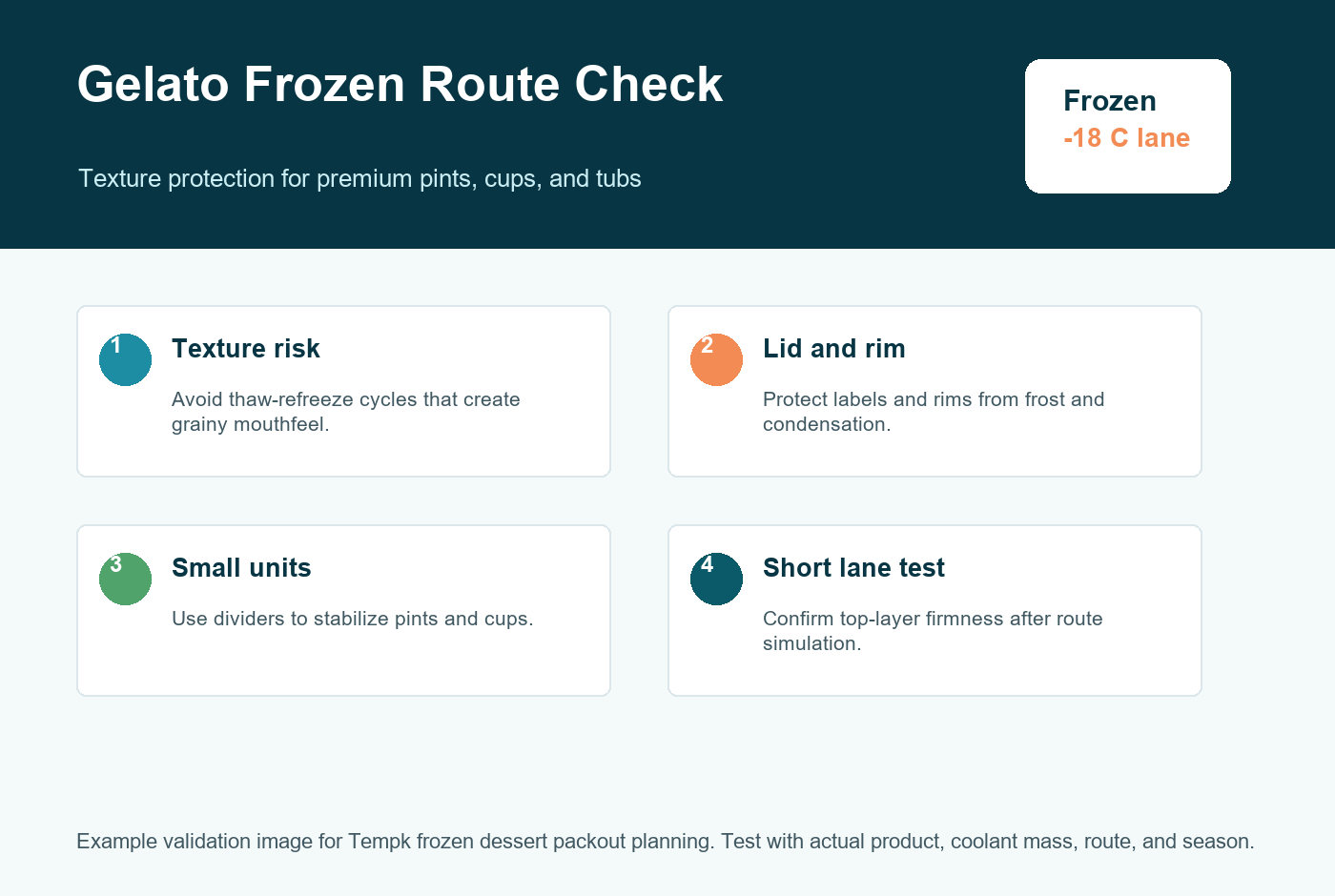
Riesgo del producto
El paquete correcto debe proteger la calidad de llegada., no sólo muestra un rastro de registrador en frío. Los siguientes puntos de riesgo determinan la masa de hielo seco, aislamiento, soporte de producto, desfogue, y recibir cheques.
El helado puede desarrollar granulosidad después de descongelarlo y volver a congelarlo incluso cuando la taza llega congelada..
La masa del producto debe congelarse antes de empacar para que no se le pida al transportista que la baje..
Las tapas sueltas permiten que se escarche., transferencia de olores, o deshidratación de la superficie dentro del cargador.
Los carriles más cortos y el margen de hielo seco validado suelen ser mejores que las rutas largas con traspasos inciertos.
Recomendación basada en ruta
Estos son rangos de partida prácticos para las pruebas de ruta.. La masa final de hielo seco y el espesor del aislamiento deben verificarse con la carga útil real., expedidor, modo portador, ruta, y recibir estándar.
| Condición de envío | Paquete Tempk recomendado | Dirección inicial del hielo seco | Posición del hielo seco | Que validar |
|---|---|---|---|---|
| Entrega congelada el mismo día 8-18h ruta, ambiente debajo 22 do, tazas o sartenes congeladas | Transportista EPS o EPP, divisores de tazas, transatlántico, divisor de hielo seco, y caja exterior ventilada | Acerca de 1.2-2.2 kg de hielo seco para un 1-3 kg de carga útil de helado como rango de prueba inicial. Utilice la calculadora de hielo seco para conocer las condiciones reales de la ruta. | Hielo seco encima o en zonas laterales con divisor; Mantenga la presión alejada de las tapas y los bordes de las tazas.. | Dureza del producto, sello de tapa, nivel de escarcha, textura de la superficie, y el hielo seco restante |
| Ruta de paquetería nocturna 18-36h ruta, manejo de depósito, ambiente 22-30 do | Transportador de EPS/EPP más grueso, filas de copas fijas, divisor de hielo seco, revestimiento de humedad, y registrador | Acerca de 2.5-4.0 kg de hielo seco para una prueba de paquete pequeño. Ajustar por número de tazas, volumen de carcasa, perfil ambiental, y tiempo de ruta. | Zona de hielo seco en el lado superior positivo con divisor y vía de ventilación de gas; Evite aplastar las tapas de las tazas.. | taza más caliente, áreas de contacto frío, escarcha alrededor de los párpados, control de textura, y hielo seco restante |
| Ruta con clima cálido o propensa a retrasos 30-35 ambiente C, 36-48h riesgo, Posibilidad de retención durante el fin de semana | Aislamiento de mayor rendimiento, cámara de hielo seco más grande, soporte de copa más fuerte, ruta de ventilación, y registrador de rutas | Acerca de 4.0-6.5 kg de hielo seco para pruebas prolongadas de paquetes pequeños. Confirmar las reglas del transportista, espacio para la cabeza, y llegada hielo seco antes de escalar. | Hielo seco perimetral con cobertura divisoria completa; mantener las tazas en posición vertical y apoyadas. | Temperatura máxima, hielo seco restante, movimiento de la tapa, acumulación de escarcha, y riesgo de textura al descongelar y volver a congelar |
La masa de hielo seco es un punto de partida, no es una garantía. Ajustar por temperatura del producto en el embalaje., peso de carga útil, tamaño del listón, material aislante, forma de hielo seco, duración de la ruta, perfil ambiental, y reglas del transportista. El hielo seco no debe sellarse en un recipiente hermético., y los envíos aéreos o de paquetes pueden requerir etiquetado y documentación específicos.
Estructura de embalaje
Los paquetes de postres congelados necesitan soporte del producto y separación con hielo seco antes de sellar el envío.. Comience con la condición del producto, fuerza del paquete al por menor, y ventilación, luego dimensione el hielo seco y el aislamiento.
Proceso de embalaje
El transportista debe conservar un producto congelado., No rescatar a uno que ya se ha ablandado.. Una buena manipulación antes del sellado reduce la demanda de hielo seco y previene defectos visibles en el producto..
Cargue helado duro congelado y minimice el tiempo fuera del congelador durante el envasado..
Utilice divisores y un ajuste perfecto para que las tapas no se froten., estallido, o acumular escarcha de manera desigual.
Coloque hielo seco en una zona controlada con material amortiguador y un camino de ventilación..
Inspeccionar la dureza, helada, sello de tapa, condición de la superficie, y cualquier signo de daño por descongelación y recongelación.
Cuándo cambiar el diseño
Comprobar precongelación, punto registrador más cálido, retraso en la ruta, y hielo seco restante antes de cambiar el embalaje.
Mejorar el soporte de la tapa, divisor de hielo seco, control de humedad, y estabilización de copa.
Aumentar el margen de aislamiento, masa de hielo seco, o velocidad de ruta; validar con un registrador dentro de la zona de carga útil.
Recursos relacionados
Compartir tamaño de taza o sartén, temperatura del producto, peso de carga útil, tiempo de ruta, rango ambiental, modo portador, y requisitos de textura. Tempk puede ayudar a elegir masa de hielo seco, soporte de copa, tamaño del listón, y pasos de validación.
Solicitar una revisión de ruta congeladaSoporte de paquete personalizado
Para tamaños de cartón fijos, límites de carga útil, requisitos de marca, carriles estacionales, o objetivos de validación, Tempk puede adaptar esta solución a un paquete de cadena de frío personalizado.