


Ne chargez pas de produits chauds
Les packs de gel supplémentaires ne peuvent pas corriger complètement les fruits chauds. Le produit pré-refroidi réduit la charge thermique et maintient la voie froide stable.
Fruits & Chaîne du froid des légumes
Les expéditions de produits frais ont besoin de plus que de l’air froid. Un emballage pratique doit contrôler le pré-refroidissement, humidité, flux d'air, compression, condensation, et le temps d'acheminement sans geler le produit ni endommager les emballages de vente au détail.
Décisions de catégorie
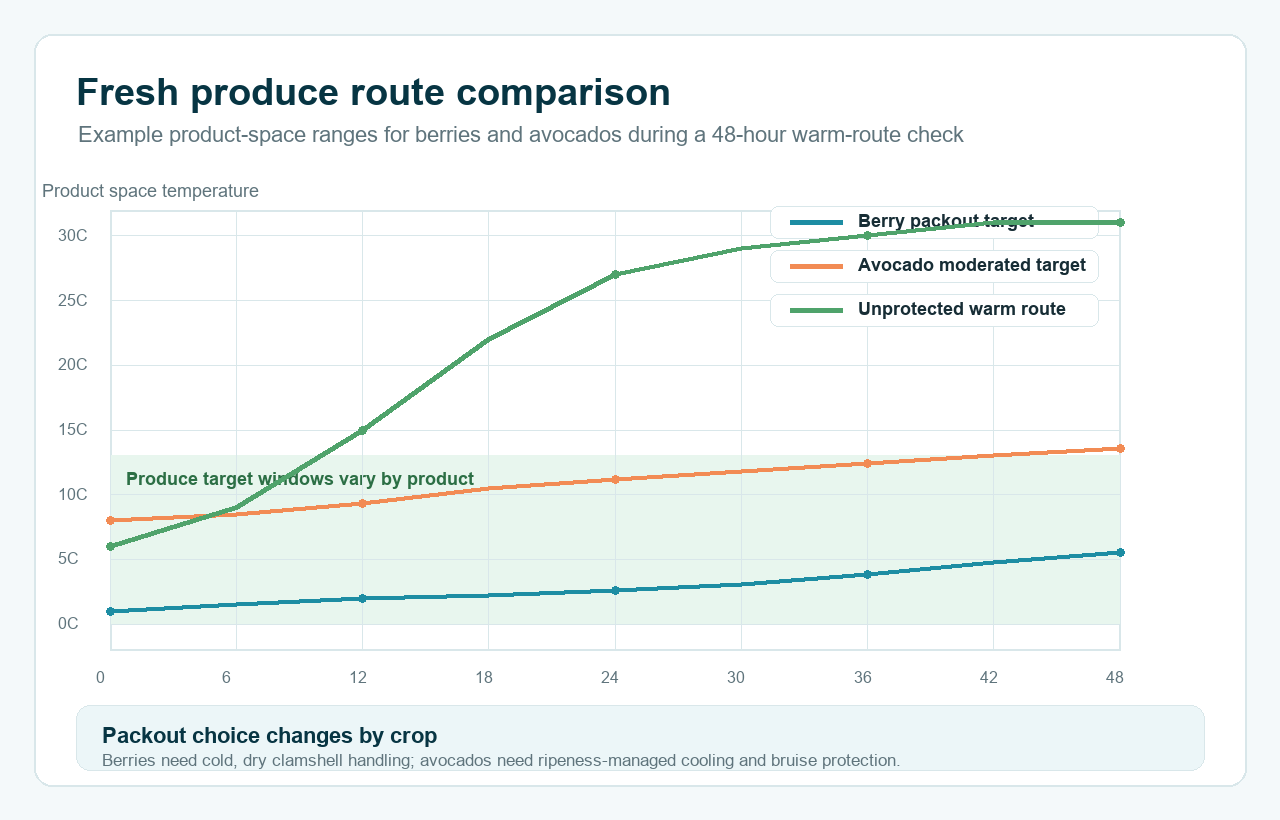
Les emballages de fruits et légumes échouent pour différentes raisons. Baies meurtries et fuites, les myrtilles perdent leur floraison et leur fermeté, les avocats ont besoin d'un contrôle de maturité, et les champignons ou les asperges peuvent être endommagés par des erreurs d'humidité et de circulation d'air. The best package is built around the product’s temperature sensitivity, fréquence respiratoire, format du paquet, et recevoir des chèques.
Les packs de gel supplémentaires ne peuvent pas corriger complètement les fruits chauds. Le produit pré-refroidi réduit la charge thermique et maintient la voie froide stable.
Utiliser des tampons absorbants, sacs de doublure, et des espaces de circulation d'air pour éviter les marques de déshydratation et de condensation.
Les paquets congelés peuvent aplatir les coquilles, marquer les fruits, ou bloquer les évents lorsque la charge utile n'est pas prise en charge.
Les contrôles à l'arrivée doivent inclure la fermeté, sécheresse, ecchymoses, fuir, floraison, état de la tige, et la résistance du carton.
Itinéraires de produits à forte valeur ajoutée
Ces pages donnent des conseils d'emballage au niveau du produit, plages de démarrage du liquide de refroidissement, exigences de pré-refroidissement, et contrôles de validation des trois itinéraires de produits déjà intégrés dans ce groupe de solutions.
Expéditions de coquilles pré-refroidies axées sur les contusions, fuites, condensation, et maintien au froid sans contact gel.
Voir la solution aux fraises Petite baieEmballages à clapet ventilés qui protègent la floraison, fermeté, flux d'air, et présentation au détail sèche.
Voir la solution aux bleuets Sensible à la maturitéDes parcours à température contrôlée et axés sur la maturité, ecchymoses, risque de blessure par refroidissement, et support carton.
Voir la solution d'avocatPlanification de l'itinéraire
Le même expéditeur peut fonctionner différemment lorsque la charge utile est une coquille à baies ventilée, un carton d'avocat mûrissant, ou un plateau de champignons très humide. Utilisez ces choix d'itinéraire comme point de départ avant de tester le produit.
| Conditions d'expédition | Direction typique du colis | Direction du liquide de refroidissement | Que vérifier |
|---|---|---|---|
| Livraison réfrigérée le jour même Produit pré-refroidi, petit itinéraire urbain, temps de quai limité | Doublure en carton isolé ou expéditeur compact en EPS avec séparateurs de produits et tampon absorbant | Packs de gel conditionnés sur les parois latérales ou dans le coin supérieur, protégé des évents à clapet | Température au centre du produit, sécheresse du colis, meurtrissure des baies, dégagement de ventilation, et état restant du liquide de refroidissement |
| Itinéraire de colis de nuit Exposition au dépôt, chaleur de fourgonnette, 18-36h fenêtre de livraison | Boîte isolée EPP ou EPS, sac de doublure, carton extérieur plus résistant, et poches de liquide de refroidissement fixes | Packs de gel ou PCM réfrigérés sélectionnés par plage cible, masse de charge utile, taille de boîte, et conditions ambiantes | Point le plus chaud de la charge utile, risque de point froid à proximité du liquide de refroidissement, condensation, et compression des emballages de vente au détail |
| Itinéraire par temps chaud ou sujet aux retards Ambiance élevée, risque de retenue le week-end, transfert plus long | Isolation plus épaisse, marge de liquide de refroidissement plus élevée, enregistreur, et espace libre réduit à l'intérieur de l'expéditeur | Disposition périphérique du liquide de refroidissement avec séparateurs; éviter d'ajouter du poids surgelé directement sur le produit | Température maximale, risque de gel, récupération d'humidité, résistance du carton, et défauts d'arrivée spécifiques au produit |
Guides de produits de soutien
Ces guides d'assistance aident les acheteurs à comparer les risques liés aux produits à proximité sans transformer chaque produit en une page de solution distincte..
Liens internes utiles
Partager le type de produit, température de la pâte ou du produit à l'emballage, format du paquet, poids de charge utile, durée de l'itinéraire, plage ambiante d'été, et recevoir des chèques. Tempk peut vous aider à choisir l'expéditeur, disposition du liquide de refroidissement, couches tampons, et plan de validation.
Demander un examen de l'emballage des produitsPrise en charge des emballages personnalisés
Pour des tailles de carton fixes, limites de charge utile, exigences en matière de marque, voies saisonnières, ou des cibles de validation, Tempk peut adapter cette solution dans un emballage personnalisé pour la chaîne du froid.