


La chaleur ambiante change le risque d'acceptation
Les repas doivent quitter la production réfrigérés et rester froids pendant le tri, livraison, et exposition à domicile.
Boîtes de livraison de repas réfrigérées
Les boîtes de livraison de repas nécessitent un contrôle de la température réfrigérée et une arrivée prête pour le client. L'emballage doit conserver des conditions réfrigérées sans danger pour les aliments., protéger les plateaux et les sauces, gérer la condensation, et survivez à votre porte sans étiquettes mouillées ni emballages écrasés..
Risque produit
Le bon emballage doit protéger le produit réel et la décision de réception, non seulement afficher une trace d'enregistreur froid. Ces risques déterminent l’isolation, choix du liquide de refroidissement, emplacement du liquide de refroidissement, soutien intérieur, et contrôles de validation.
Les repas doivent quitter la production réfrigérés et rester froids pendant le tri, livraison, et exposition à domicile.
Un produit froid peut toujours être rejeté lorsque les étiquettes, manches, ou les fiches de recettes sont mouillées.
Les packs de gel posés directement sur les plateaux peuvent écraser les couvercles, briser les sceaux, ou forcer les fuites de sauce.
Salades, sauces, plats cuisinés, et les produits doivent être séparés pour qu'un article n'en endommage pas un autre.
Recommandation basée sur l'itinéraire
Ce sont des points de départ pratiques pour la planification des échantillons. Masse finale du liquide de refroidissement, épaisseur d'isolation, et le support interne doit être validé avec la charge utile réelle, itinéraire, messagerie, et recevoir la norme.
| Conditions d'expédition | Forfait Tempk recommandé | Direction de démarrage du liquide de refroidissement | Emplacement du liquide de refroidissement | Que valider |
|---|---|---|---|---|
| Livraison de repas le jour même 8-18h itinéraire, ambiance ci-dessous 22 C, court séjour à la porte | Doublure en carton isolé ou expéditeur compact en EPS, support plateau repas, tampon absorbant, sac de doublure, et des packs de gel | À propos 0.5-1.0 kg de packs de gel au total pour un 1-3 kg de charge utile de repas réfrigérés. Utilisez la calculatrice pour connaître le poids réel des repas et la durée du trajet. | Placement du pack de gel sur la paroi latérale ou dans le coin supérieur avec séparateur; garder les emballages surgelés hors des couvercles et des étiquettes des plateaux. | Température des repas, joint de plateau, condensation, sécheresse de l'étiquette, et état de déballage du client |
| Boîte repas colis du jour 18-36h itinéraire, manutention du dépôt, ambiant 22-30 C | Expéditeur EPS ou EPP, sac de doublure, diviseur de plateau, couche absorbante, poches de liquide de refroidissement fixes, et carton extérieur plus solide | À propos 1.0-2.0 kg au total de packs de gel ou de matériau à changement de phase réfrigéré pour un petit colis repas. Ajuster en fonction de la masse de la charge utile, densité des repas, et volume de la boîte. | Deux poches latérales ou latérales et supérieures avec tampon ondulé et couche d'humidité. | Repas le plus chaud, points de contact froids, fuites de sauce, déformation du plateau, et le mouillage du carton |
| Itinéraire par temps chaud ou sujet aux retards 30-35 C ambiant, 36-48h risque, exposition prolongée au seuil de la porte | Expéditeur EPS/EPP plus épais, marge de liquide de refroidissement plus élevée, support de plateau renforcé, couche absorbante, et enregistreur d'itinéraire | À propos 2.0-3.5 kg de packs de gel au total ou matériau à changement de phase pour des tests étendus sur de petites parcelles. Plus de liquide de refroidissement doit être associé à une séparation plus forte des plateaux. | Liquide de refroidissement périphérique avec séparateurs sur les côtés orientés vers le produit; n'empilez pas de paquets lourds directement sur les plateaux-repas. | Température maximale du produit, récupération de la condensation, pression du plateau, état de l'étiquette, et marge de séjour au seuil de la porte |
La masse du liquide de refroidissement est un point de départ, pas une garantie. Ajuster en fonction de la température du produit à l'emballage, poids de charge utile, taille de l'expéditeur, matériau isolant, conditionnement du liquide de refroidissement, durée de l'itinéraire, profil ambiant, manutention du transporteur, et recevoir des chèques. Plus de liquide de refroidissement peut créer du gel, dégâts de pression, emballage humide, ou manipulation dangereuse de la glace carbonique lorsque la séparation et les instructions sont erronées.
Structure du paquet
Les envois de colis nécessitent une assistance produit, séparation du liquide de refroidissement, et recevoir des éclaircissements avant la fermeture de l'expéditeur. Commencez par la charge utile et les critères d’acceptation, puis dimensionnez l'isolation et le liquide de refroidissement.
Processus d'emballage
Un expéditeur plus fort aide, mais condition de chargement, séparation du liquide de refroidissement, soutien intérieur, et les instructions de réception décident généralement si le colis est accepté.
Ne chargez pas de repas chauds et essayez de compenser avec plus de packs de gel.
Protéger les couvercles, sauces, étiquettes, et des composants frais provenant d'un contact direct avec la congélation.
Utilisez des sacs doublés et des couches absorbantes pour que le déballage reste propre.
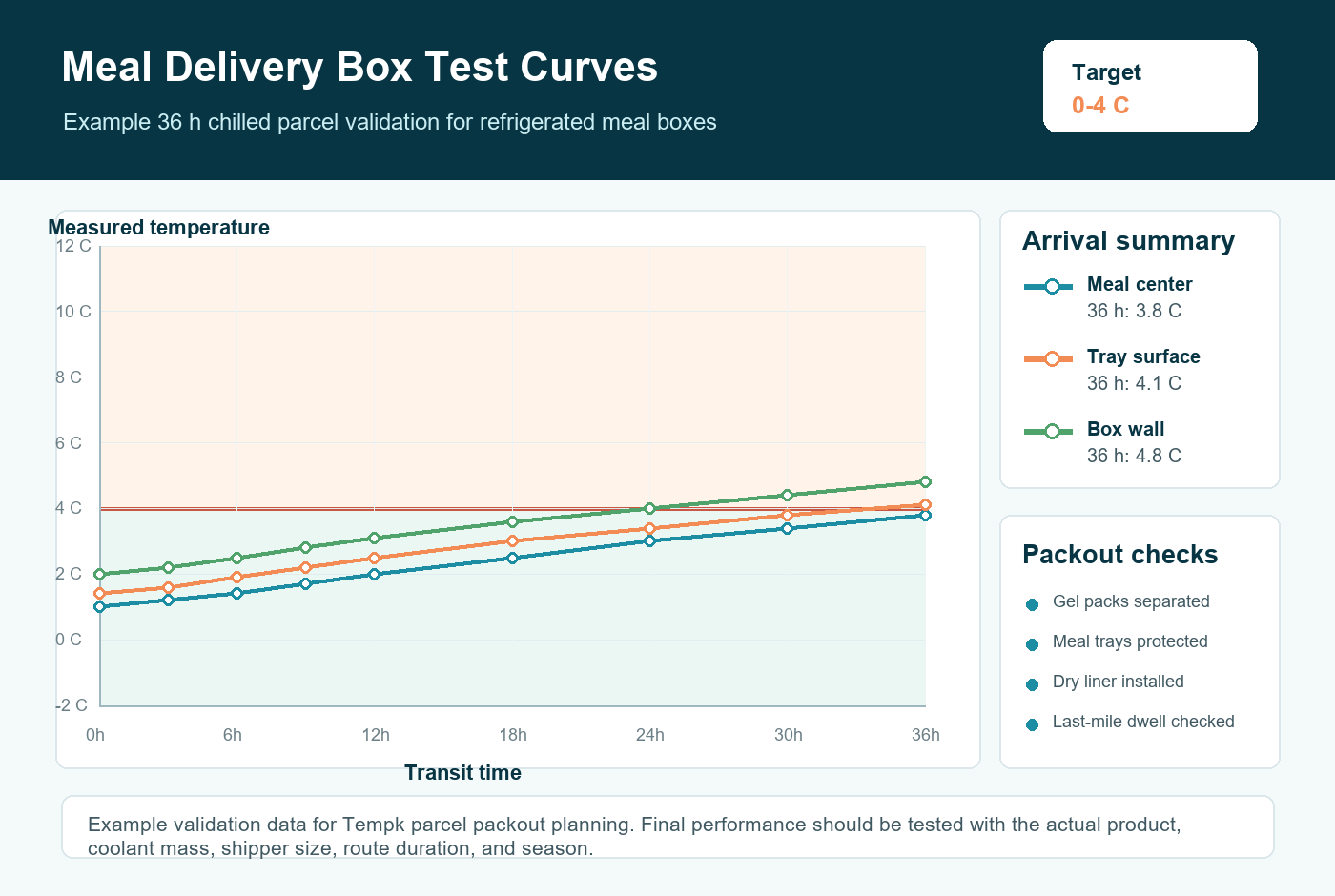
Testez l'itinéraire avec un délai de livraison réaliste et inspectez l'état des plateaux, pas seulement l'enregistreur.
Quand changer la conception
Améliorer la conception du revêtement, matériau absorbant, et conditionnement du liquide de refroidissement avant d'ajouter plus d'isolation.
Réduire la pression de charge supérieure, déplacer les packs de gel vers les poches latérales, et ajoutez un support de plateau.
Augmenter la marge d'isolation, ajuster la masse de liquide de refroidissement, réduire les vides chez les expéditeurs, ou raccourcir le niveau de service.
Ressources connexes
Partager le type de repas, taille du plateau, poids de charge utile, cible réfrigérée, durée de l'itinéraire, plage ambiante, format d'emballage, et les exigences de réception des clients. Tempk peut vous aider à choisir l'isolation, disposition du pack de gel, support de plateau, et étapes de validation.
Demander un examen de l'emballage du colisPrise en charge des emballages personnalisés
Pour des tailles de carton fixes, limites de charge utile, exigences en matière de marque, voies saisonnières, ou des cibles de validation, Tempk peut adapter cette solution dans un emballage personnalisé pour la chaîne du froid.