


Vacinas contra gripe
Remessas sazonais de alto volume precisam de estabilidade 2-8 Manipulação C, clínica rápida recebendo, controle de identidade da caixa, e proteção contra contato direto com gel congelado.
A maioria das rotas rotineiras de encomendas de vacinas são planejadas em torno 2-8 C, mas a verdadeira decisão de embalagem não é apenas a temperatura. Os frascos e caixas devem ser protegidos contra congelamento, ganho de calor, dano na etiqueta, contato de refrigerante, longo tempo de transferência, e atrasos no recebimento.
Para distribuição de vacinas, uma embalagem mais forte nem sempre é uma embalagem mais fria. Muitas vacinas refrigeradas precisam de um ambiente estável 2-8 C e deve ser mantido longe do contato direto do gel congelado. Tempk constrói o pacote em torno do condicionamento do refrigerante, espessura de isolamento, suporte para frasco/caixa, e a evidência da rota que o receptor precisa.
Remessas sazonais de alto volume precisam de estabilidade 2-8 Manipulação C, clínica rápida recebendo, controle de identidade da caixa, e proteção contra contato direto com gel congelado.
Menor, encomendas de maior valor precisam de proteção contra congelamento, proteção da caixa original, clareza do rótulo, e manuseio consciente da luz durante o reabastecimento da clínica.
As vacinas com adjuvante precisam de forte prevenção contra congelamento, refrigerante condicionado, suporte para frasco, e evidência clara de temperatura no recebimento.
| Rota do produto | Intenção de temperatura | Configuração de embalagem | Faixa preliminar de refrigerante | Verifique no recebimento |
|---|---|---|---|---|
| Reabastecimento de clínica de vacina contra gripe | 2-8 C, evite congelar durante picos de volume sazonais. | Caixa isolada ou remetente EPP, caixa do frasco no centro, pacotes de gel condicionado ou 5 C PCM separado por placa tampão. | Sobre 1.0-2.5 kg de pacotes de gel condicionado ou PCM para um 1-4 L carga útil refrigerada em 8-24 h pistas. | Registro do registrador, secura da caixa do frasco, clareza do rótulo, posição do refrigerante, e tempo fora do armazenamento. |
| Pacote de vacina contra HPV ou transferência clínica | 2-8 C com congelamento forte e manuseio consciente da luz. | Caixas originais protegidas em uma bandeja interna rígida, refrigerante nas laterais/parte superior, nenhuma superfície congelada direta na caixa. | Sobre 1.2-3.2 kg de pacotes de gel condicionado ou PCM para 12-36 h pistas, ajustado pelo tamanho do remetente e pela estação. | Temperatura mínima, esmagamento de caixa, condição do rótulo, exposição à luz durante o manuseio, e estado restante do líquido refrigerante. |
| Distribuição da vacina contra hepatite B | 2-8 C, com atenção extra à prevenção de congelamento. | Carga útil do centro tamponado, refrigerante condicionado, camada absorvente ou divisória onde a condensação pode afetar as caixas. | Sobre 1.0-3.0 kg de pacotes de gel condicionado ou PCM para 8-36 h pistas; evite a carga útil de toque de gel congelado não condicionado. | Qualquer leitura abaixo de zero, umidade do frasco/caixa, movimentação de produtos, e tempo de transferência documentado. |
Essas faixas são faixas de planejamento para discussão de embalagens, não liberar critérios. A embalagem final deve ser confirmada com o rótulo da vacina, perfil de rota, tamanho da carga útil, registrador de temperatura, e requisitos de manuseio local.
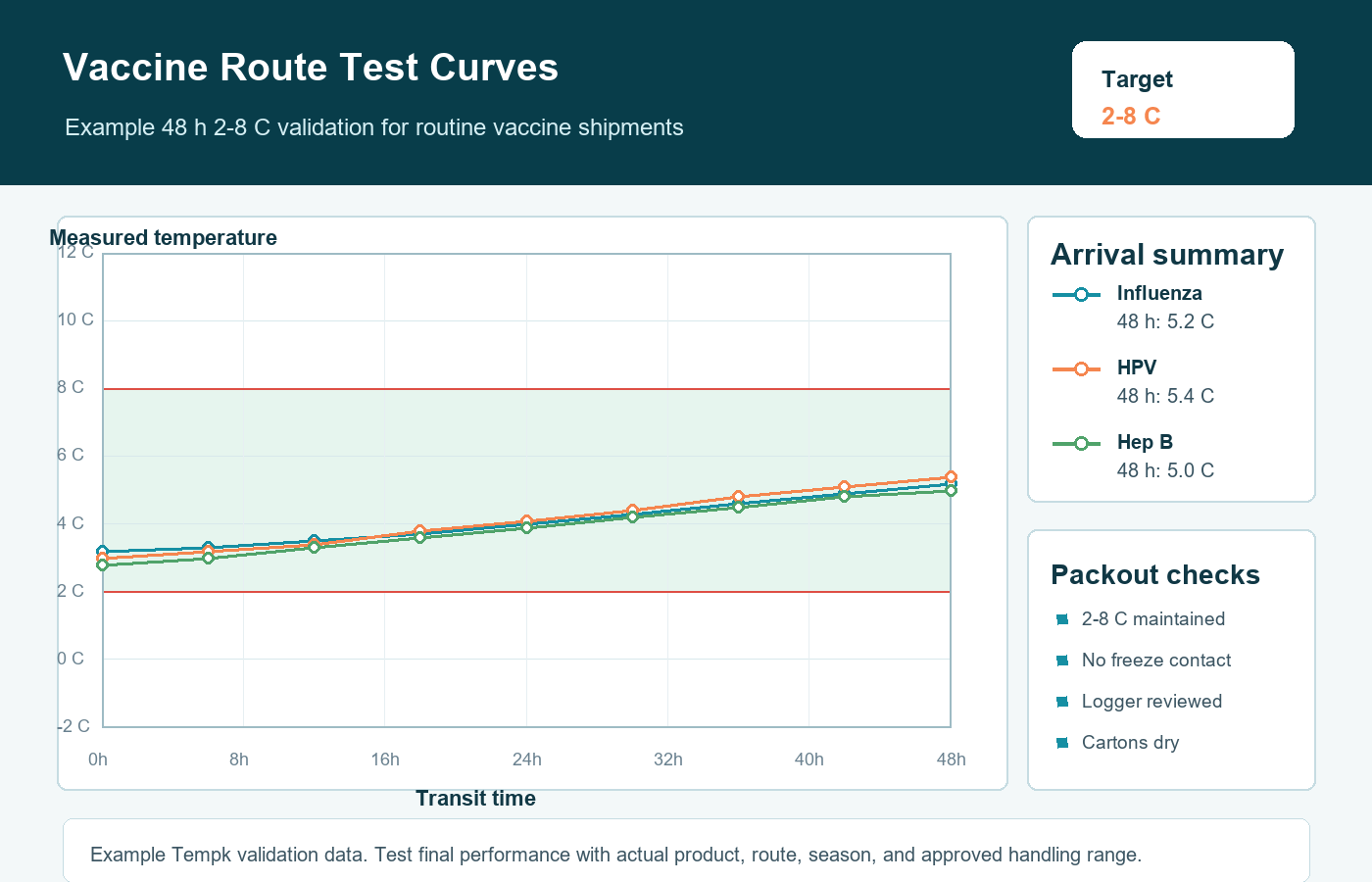
Use a curva de validação junto com as verificações de recebimento do produto. A embalagem da vacina deve ser avaliada pelo histórico de temperatura, evitar congelamento, condição da caixa, e com que facilidade o destinatário pode confirmar a remessa.
Para produtos que ainda não precisam de uma página de solução dedicada, esses guias mantêm o hub de soluções útil sem criar muitas páginas que exigem muita manutenção.
Use este artigo quando o produto não estiver em uma das três páginas dedicadas à solução de vacina, ou quando a via precisa de uma nota separada na embalagem específica da vacina.
Use este artigo quando o produto não estiver em uma das três páginas dedicadas à solução de vacina, ou quando a via precisa de uma nota separada na embalagem específica da vacina.
Use este artigo quando o produto não estiver em uma das três páginas dedicadas à solução de vacina, ou quando a via precisa de uma nota separada na embalagem específica da vacina.
Use estas páginas quando a pista, temperatura ambiente, ou a seleção do líquido refrigerante precisa de uma segunda verificação rápida antes do teste.
A maioria das vacinas de rotina são mais vulneráveis ao congelamento do que a condições de frio moderado. O plano de embalagem deve manter 2 para 8 C, evitando o contato direto do frio com frascos ou caixas.
Exposição congelada, atrasos na abertura da clínica, tamanhos de caixa mistos, e a má colocação do registrador são os principais motivos pelos quais uma embalagem de vacina falha na validação.
Use refrigerante condicionado, uma cesta de produtos, e separação clara entre as embalagens do líquido refrigerante e da vacina. Mantenha o registrador de dados na zona de carga útil, não contra o refrigerante.
Usar 2 para 8 C PCM ou pacotes de gel devidamente condicionados. Evite gelo seco, a menos que o produto seja especificamente rotulado e validado para transporte congelado.
Valide as faixas de verão e inverno separadamente. O recebimento deve verificar a posição do registrador, condição da caixa, temperatura mínima, e tempo fora da refrigeração.
Para vacinas de rotina, a primeira questão de design geralmente não é como adicionar mais resfriamento, mas como evitar o congelamento enquanto segura 2 para 8 C. A carga útil deve ficar dentro de uma cavidade protegida com líquido refrigerante condicionado ou PCM qualificado ao seu redor.
As rotas de inverno precisam de atenção especial porque um remetente que passa em um teste de estação quente ainda pode resfriar demais as caixas durante a entrega ao ar livre. A colocação do registrador deve representar as embalagens da vacina, não é a parede mais fria do remetente.
Tempk deve validar a temperatura mínima, temperatura máxima, contagem de carga útil, condicionamento de refrigerante, e atraso no recebimento. A verificação de aceitação deve incluir dados do registrador, condição da caixa, e se a equipe da clínica pode desfazer as malas rapidamente.
Suporte a pacotes personalizados
Para tamanhos de caixa fixos, limites de carga útil, requisitos de marca, pistas sazonais, ou alvos de validação, A Tempk pode adaptar esta solução em um pacote personalizado de cadeia de frio.
Compartilhe o tipo de vacina, volume de carga útil, tamanho do remetente, duração da pista, condição ambiente, e exigia recebimento de cheques. Tempk pode ajudar a comparar o isolamento, massa de refrigerante, colocação de refrigerante, e o plano de validação antes do envio ao vivo.
Solicite uma revisão do pacote