


Exposición al calor
La permanencia cálida puede socavar la confianza del cliente cuando el producto se vende en vivo., fermentar, o posicionamiento del ingrediente activo.
Los envíos de cuidado probiótico necesitan un empaque que respete la declaración de almacenamiento de la marca y proteja el posicionamiento de activos. La configuración debe reducir exposición al calor, controlar condensación y mantener presentables tarros, tubos, etiquetas y cartones.
Para entrega de cosméticos en cadena de frío, El mejor paquete es el que protege tanto el estado de la fórmula como la presentación al cliente.. La configuración de embalaje a continuación brinda un punto de partida práctico antes de realizar la prueba en el carril..
La permanencia cálida puede socavar la confianza del cliente cuando el producto se vende en vivo., fermentar, o posicionamiento del ingrediente activo.
Las compresas frías dentro de pequeños paquetes de cosméticos pueden crear condensación y mojar la caja de venta minorista si no hay una barrera contra la humedad..
Una ruta refrigerada aún puede no pasar los controles de presentación si los paquetes de gel tocan los tarros, tubos, etiquetas, O cajas de cartón directamente.
| Condición de la ruta | Intención de temperatura | Configuración de embalaje | Rango preliminar de refrigerante | Revisión de recepción |
|---|---|---|---|---|
| Entrega local, 4-8 h | Utilice las instrucciones de almacenamiento de la marca.; Muchas rutas necesitan protección contra el calor y algunas requieren manejo en frío.. | Envío aislado o caja pequeña, manga de humedad, uno o dos paquetes de gel acondicionado o PCM con espaciador. | Acerca de 0.4-0.9 kilogramos para un 0.5-2 kg de carga útil. | Sello del producto, sequedad del cartón, y entrega rápida. |
| Cálida ruta de comercio electrónico, 8-24 h | Ruta fresca o refrigerada según la etiqueta y la promesa de la marca; evitar la congelación a menos que esté explícitamente validado. | Cartón aislado o caja compacta de EPP, cavidad central del producto, refrigerante amortiguado en posiciones laterales/superiores, capa de control de humedad. | Acerca de 0.9-2.0 kilogramos para un 0,5-3 kg de carga útil. | Registro de registro si se utiliza, condensación, aplastamiento de cartón, y textura del producto. |
| Ruta caliente o riesgo de fin de semana, 24-36 h | Ruta validada en frío o enfriada con margen de permanencia adicional. | Aislamiento de mayor rendimiento, paquetes de gel acondicionados o PCM, producto aislado del refrigerante, registrador opcional para carriles DTC premium. | Acerca de 2.0-3.2 kg para un cargador compacto; confirmar mediante prueba de ruta. | Temperatura mínima y máxima, refrigerante restante, sequedad de etiqueta, y sello de tapa. |
Utilice estos rangos para discusiones y muestreos sobre empaques.. La masa final del refrigerante debe confirmarse con la fórmula actual., recuento de unidades, tamaño del frasco o tarro, dimensiones del cartón, duración de la ruta, condición ambiental, y cualquier requisito del registrador.
Confirme si el producto requiere manejo refrigerado, protección fresca o solo reducción de picos de calor. Esto evita sobreenfriar una fórmula que solo necesita protección de verano.
Usar mangas, revestimiento, o separación absorbente para que la condensación del refrigerante no dañe las cajas y las etiquetas.
Coloque gel packs acondicionados o PCM alrededor de la carga, no contra ella. Los paquetes pequeños de cuidado de la piel suelen necesitar más separación que masa extra de refrigerante.
Pruebe el recuento real de tarros o tubos, inserciones, aislamiento, refresco, y duración de la ruta antes de escalar el envío de DTC.
Estos son los problemas que la configuración de embalaje debe reducir antes de que el envío llegue al cliente.
Utilice la curva de prueba como comparación de trabajo, luego validar con el producto real, refresco, aislamiento, duración de la ruta, y temporada. For cuidado de la piel, también revisa la presentación: sequedad de etiqueta, condición del cartón, sello de tapa, y textura del producto.
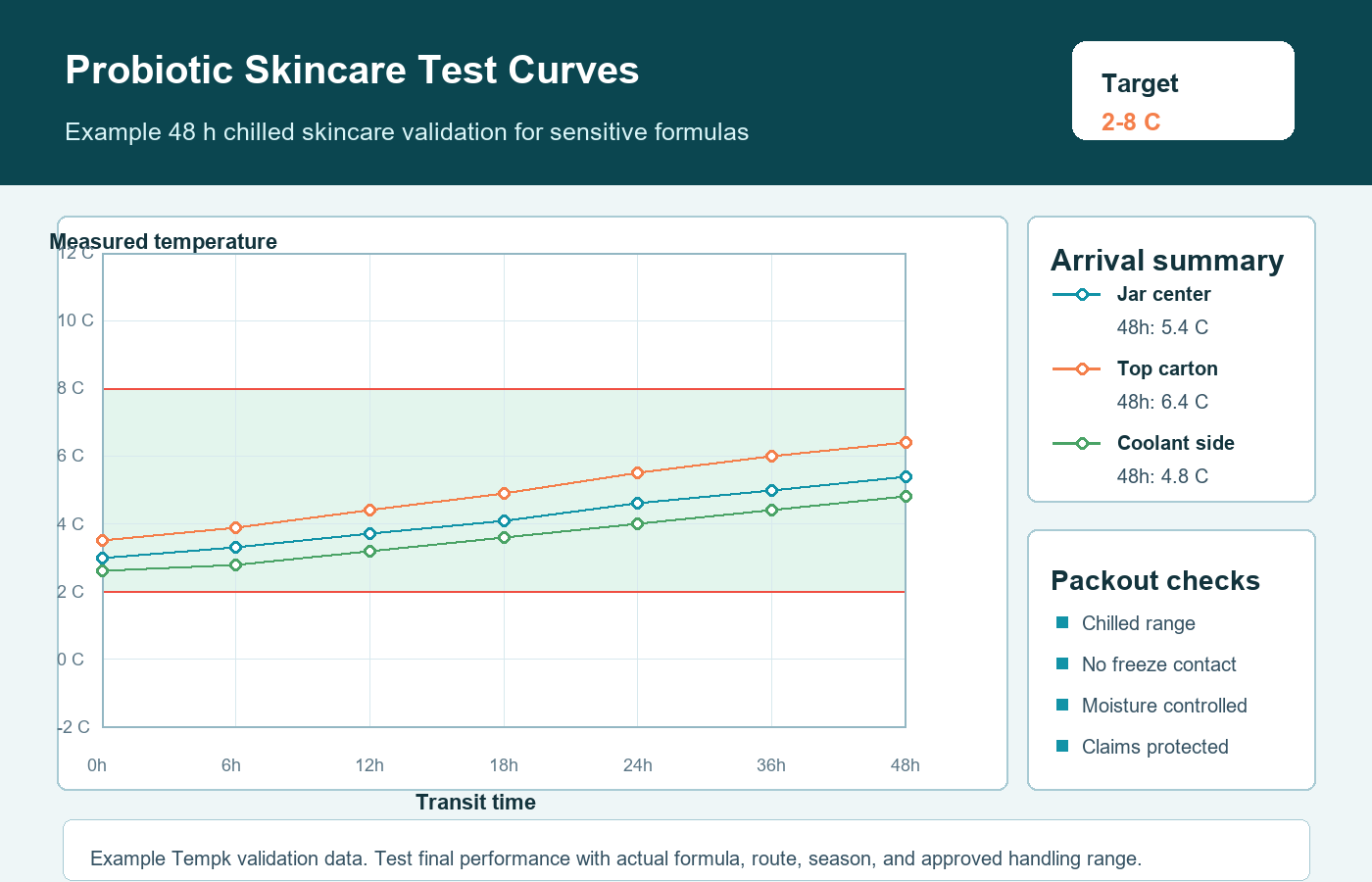
Utilice estas páginas para comparar rutas de productos cercanas, seleccionar refrigerante, y comprobar el riesgo de la ruta antes del muestreo.
Probiotic cuidado de la piel may be marketed around live or active ingredients, por lo que la confianza en la temperatura y la presentación limpia son importantes en el momento de la entrega.
La pérdida puede aparecer como separación de fórmulas., cambio de olor, humedad del cartón, levantamiento de etiquetas, y preocupación del cliente por la entrega cálida.
Utilice embalajes para paquetes aislados con un divisor de producto y una envoltura interior resistente a la humedad.. Mantenga el refrigerante lo suficientemente cerca para estabilizar la carga útil pero separado de la cara del cartón..
Utilice paquetes de gel fríos o PCM según la etiqueta de la fórmula.. Para productos refrigerados, validar 2 a 8 C y evite el contacto directo con el paquete congelado.
Comprobar textura visual, olor, condición de la etiqueta, y cualquier indicador de estabilidad requerido. Registre si el producto todavía se siente premium cuando se abre..
Some cuidado probiótico de la piel products only need heat moderation, mientras que otros requieren manipulación refrigerada. La configuración de embalaje debe seguir la etiqueta de fórmula y los datos de estabilidad en lugar de aplicar una regla de envío cosmética para cada SKU..
Utilice una cavidad de producto protegida, envoltura interior resistente a la humedad, y gel frío o PCM según sea necesario. Si la fórmula requiere 2 a 8 do, Evite el contacto directo con el paquete congelado y valide los carriles frío y caliente..
Las pruebas de ruta Tempk deberían verificar la textura de la fórmula, olor, condición de la etiqueta, sequedad del cartón, y si el producto todavía se siente premium cuando se abre. Para productos de belleza, La presentación es parte de la solución..
For cuidado probiótico de la piel, Comience con el requisito de estabilidad.. Si la fórmula requiere 2 a 8 do, Utilice PCM o paquetes de gel acondicionados en una zona de refrigerante separada y valide carriles fríos y calientes.. Si el producto sólo necesita protección térmica, un diseño de gel frío más suave puede proteger la fórmula sin mojar el estuche de belleza.. El embalaje debe contener tarros., tubos, o bombas sin aire en posición vertical y limpia. La recepción debe comprobar el olor., textura, presentación en cartón, condición de la etiqueta, y si la experiencia de apertura aún respalda una marca premium de cuidado de la piel.
Custom configuración de embalaje support
Para tamaños de cartón fijos, límites de carga útil, requisitos de marca, carriles estacionales, o objetivos de validación, Tempk can adapt this solution into a custom cold-chain configuración de embalaje.
Comparte las instrucciones de almacenamiento., recuento de unidades, tamaño del cartón, peso de carga útil, duración de la ruta, condición ambiental, entrega de entrega, y si necesitas un registrador de temperatura. Tempk puede ayudar a comparar paquetes de gel, PCM, PPE, cajas aisladas, capas de buffer, y recibir cheques.
Solicitar una revisión de configuración